Magnetoexcitons and Massive Dirac Fermions in Monolayers of Transition Metal Dichalcogenides in a High Magnetic Field
We present a theory of the emission spectrum of magnetoexcitons interacting with a $ν= 1$ quantum Hall state of massive Dirac fermions in monolayer transition metal dichalcogenides in high magnetic fields. Using an ab initio-parametrized massive Dirac fermion model including valley and spin degrees of freedom, combined with exact diagonalization techniques, we show that interband emission from the massive Dirac Fermion magnetoexciton interacting with $ν= 1$ state directly probes intra-conduction-band excitations of the $ν= 1$. Many-body interactions with the filled massive Dirac fermion $ν= 1$ level yield a strong renormalization of the emission spectrum, including fully polarized emission, a pronounced redshift, and broadening relative to neutral and charged excitons. The calculated spectra are consistent with recent experiments [1-3], establishing magneto-spectroscopy as a probe of finite carrier densities in massive Dirac systems.
💡 Research Summary
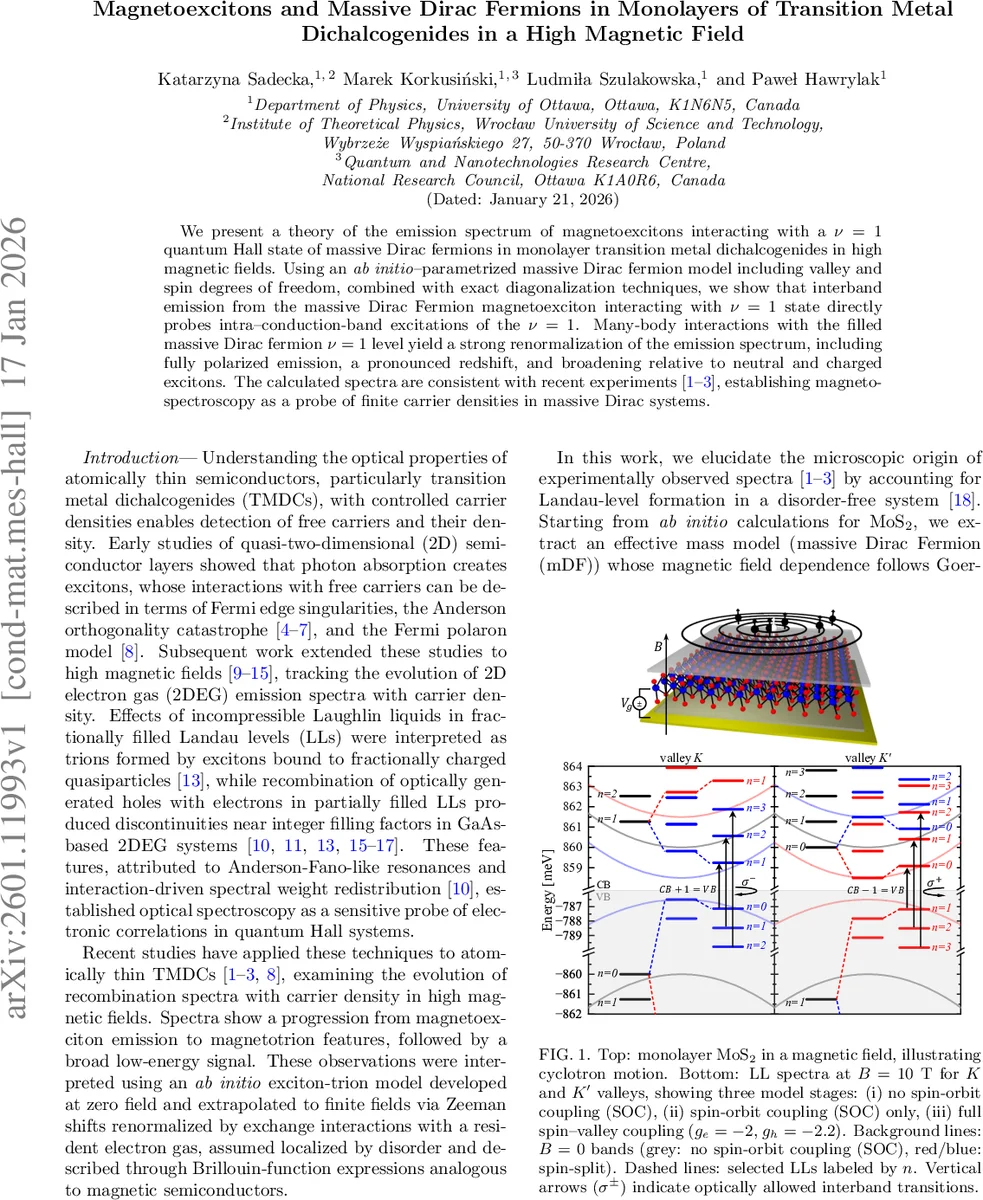
This paper presents a comprehensive theoretical study of the photoluminescence (PL) spectrum of magneto‑excitons that interact with a ν = 1 quantum Hall (QH) state formed by massive Dirac fermions (mDF) in monolayer transition‑metal dichalcogenides (TMDCs) under high magnetic fields. The authors start from first‑principles (ab‑initio) calculations of monolayer MoS₂ to extract key band parameters: a direct gap Δ ≈ 1.27 eV, conduction‑band spin‑orbit splitting Δ_CB^SOC ≈ −3 meV, valence‑band splitting Δ_VB^SOC ≈ 147 meV, and a pronounced spin‑valley locking, especially in the valence band. These quantities are fed into a low‑energy massive Dirac Hamiltonian that retains valley (K, K′) and spin (↑, ↓) degrees of freedom. The magnetic field is introduced via the Peierls substitution, leading to Landau‑level (LL) quantization with a characteristic n = 0 conduction LL that exists only in the K′ valley and a n = 0 valence LL only in K. The Zeeman term (g‑factors g_e = −2, g_h = −2.2) further splits the levels, producing a fully spin‑ and valley‑resolved LL spectrum.
The many‑body problem is built on top of this single‑particle basis. Electrons occupy the fully filled n = 0 conduction LL (the ν = 1 state) plus an additional gate‑induced population N_G that fills the lowest LL with a degeneracy M_LL. The interacting Hamiltonian includes the full Coulomb matrix elements ⟨i,j|V_C|k,l⟩ and a neutralizing background term ⟨i|V_P|j⟩. To treat the optical excitation, the authors employ a configuration‑interaction (CI) approach: an interband magneto‑exciton is created by promoting an electron from the valence band to the conduction band (typically from n = 0 or n = 1 LLs), while the ν = 1 sea remains intact. The resulting many‑body basis consists of electron‑hole pair configurations |i,j⟩ = c_i† c_j |GS⟩, where i (j) denotes a conduction (valence) state. Exact diagonalization within a truncated LL space (primarily n = 0, 1) yields the eigenstates of the initial interband exciton and the final intraband exciton (the state left after recombination).
A crucial insight emerges from the valley‑dependent exchange interaction with the ν = 1 sea. In the K′ valley the conduction electron of the exciton shares the same valley and spin as the electrons filling the ν = 1 LL, allowing a sizable exchange energy that lowers the exciton’s total energy. In contrast, a K‑valley exciton has opposite valley/spin alignment, suppressing exchange and placing it at higher energy. Consequently, the lowest‑energy manifold (the first ~50 eigenstates) is composed almost entirely of K′‑valley configurations, while the first K‑valley state appears only as the 51st level. This valley selectivity directly translates into the PL spectrum: emission remains fully valley‑polarized (K′) at all temperatures considered, unlike neutral excitons (X₀) which show mixed polarization.
The recombination process follows strict optical selection rules derived from the massive Dirac model: the electron and hole must belong to the same valley, have identical spin, differ in LL index by one (Δn = ±1), and share the same orbital quantum number m. For K‑valley excitons the hole recombines with the electron in the same valley, leaving the ν = 1 sea untouched; thus only a single final state (the ground state) contributes, producing a sharp line. For K′‑valley excitons the hole must recombine with an electron from the filled n = 0 LL, creating a vacancy that is filled by an electron from the n = 1 LL. This generates a manifold of intraband exciton final states, each corresponding to a different electron‑hole pair within the conduction band. The intraband spectrum is remarkably flat: the lowest 20 states span only ~2 meV, leading to an intrinsic broadening of the PL line (~5 meV) even at millikelvin temperatures.
Temperature effects are incorporated via Boltzmann weights W_k for the initial exciton states. At T = 1 mK the PL is dominated by the nearly degenerate low‑energy K′ excitons, yielding a narrow, fully polarized line that is already broadened by many‑body correlations. Raising the temperature to 5 K populates higher‑energy initial states and opens additional recombination channels, further widening the line and slightly reducing the polarization contrast. The calculated spectra display a pronounced redshift (≈5–10 meV) relative to the neutral exciton X₀, and a smaller but still noticeable shift for the trion X⁻ (which corresponds to a magneto‑exciton interacting with a single extra conduction electron). These shifts arise from the exchange interaction with the ν = 1 sea; the larger shift for the ν = 1 case reflects the collective nature of the filled LL.
The authors compare their theoretical PL spectra with recent magneto‑optical experiments on gated MoS₂ monolayers (Refs.
Comments & Academic Discussion
Loading comments...
Leave a Comment