Experimental Realization of Rabi-Driven Reset for Fast Cooling of a High-Q Cavity
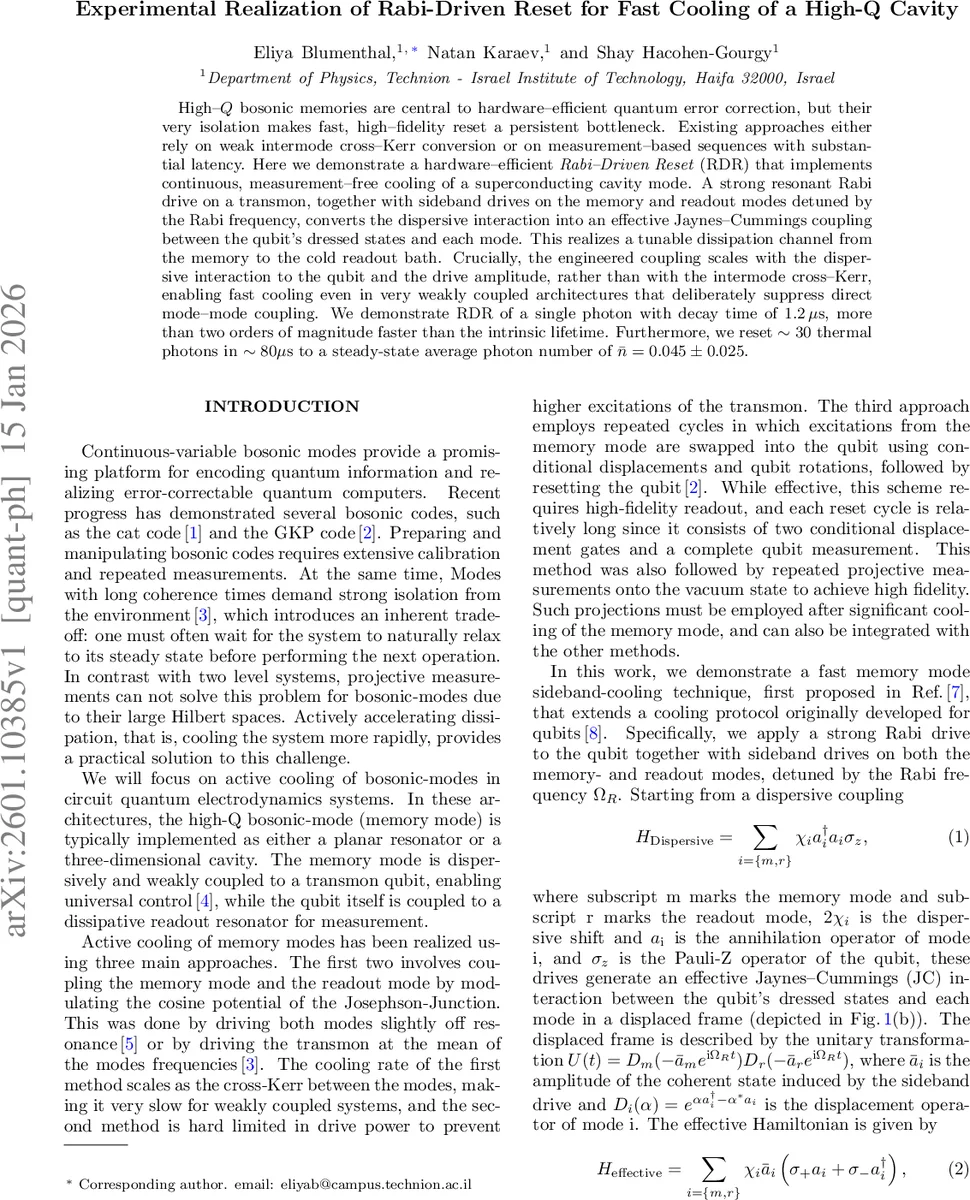
High-Q bosonic memories are central to hardware-efficient quantum error correction, but their isolation makes fast, high-fidelity reset a persistent bottleneck. Existing approaches either rely on weak intermode cross-Kerr conversion or on measurement-based sequences with substantial latency. Here we demonstrate a hardware-efficient Rabi-Driven Reset (RDR) that implements continuous, measurement-free cooling of a superconducting cavity mode. A strong resonant Rabi drive on a transmon, together with sideband drives on the memory and readout modes detuned by the Rabi frequency, converts the dispersive interaction into an effective Jaynes-Cummings coupling between the qubit dressed states and each mode. This realizes a tunable dissipation channel from the memory to the cold readout bath. Crucially, the engineered coupling scales with the qubit-mode dispersive interaction and the drive amplitude, rather than with the intermode cross-Kerr, enabling fast cooling even in very weakly coupled architectures that deliberately suppress direct mode-mode coupling. We demonstrate RDR of a single photon with a decay time of $1.2 μs$, more than two orders of magnitude faster than the intrinsic lifetime. Furthermore, we reset about 30 thermal photons in about $80 μs$ to a steady-state average photon number of $\bar{n} = 0.045 \pm 0.025$.
💡 Research Summary
The paper presents a hardware‑efficient protocol called Rabi‑Driven Reset (RDR) for fast, measurement‑free cooling of a high‑Q superconducting cavity used as a bosonic quantum memory. The authors exploit a strong resonant Rabi drive applied to a transmon qubit together with two sideband drives on the memory and readout resonators, each detuned from the qubit by the Rabi frequency Ω_R. In the regime Ω_R ≫ χ_i (the dispersive shifts), the original dispersive Hamiltonian H_disp = Σ_i χ_i a_i† a_i σ_z is transformed, in a displaced frame, into an effective Jaynes‑Cummings interaction H_eff = Σ_i χ_i \bar a_i (σ_+ a_i + σ_- a_i†), where \bar a_i ≈ ε_i/Ω_R is the coherent amplitude induced by the sideband drive ε_i. This effective coupling scales with the product of the dispersive shift and the sideband amplitude, rather than with the much weaker inter‑mode cross‑Kerr, allowing strong, tunable interaction even when direct mode‑mode coupling is deliberately suppressed.
Experimentally the system consists of a 6.914 GHz memory mode (lifetime 170 µs), a 6.33 GHz transmon (χ_m/2π = 57 kHz, T₁ = 25 µs, T₂^Echo = 20 µs), and a 7.7 GHz readout resonator (κ_r/2π = 0.382 MHz, χ_r/2π = 0.635 MHz). The Rabi frequency is set to Ω_R/2π = 9 MHz, comfortably larger than all other rates. Sideband amplitudes are calibrated via Stark‑shift measurements, and the Rabi drive is calibrated in the doubly Stark‑shifted frame.
The RDR sequence ramps up the two sideband drives, turns on the Rabi drive for a programmable duration, then ramps them down, with an 800 ns ramp time. Two benchmark experiments are performed. First, an on‑demand thermal state with ≈30 photons is prepared; RDR reduces the average photon number to ⟨n⟩ = 0.045 ± 0.025 within 80 µs, corresponding to a photon‑decay rate of up to –0.73 MHz, close to the theoretical limit of κ_r/2. Second, a single‑photon Fock state is generated and cooled to the vacuum in 1.2 µs with a final vacuum fidelity of 93 %. Wigner‑function tomography is used to extract ⟨n⟩ and to verify the non‑thermal intermediate dynamics, which exhibit a piecewise linear‑exponential decay due to the bottleneck imposed by the single‑excitation nature of the qubit.
The authors identify the readout resonator linewidth κ_r as the fundamental speed limit; increasing the effective coupling beyond κ_r/2 introduces non‑Markovian effects and degrades steady‑state purity. Higher‑order transitions to parasitic two‑level systems or to higher transmon levels become relevant at very large drive powers, imposing practical bounds on Ω_R and sideband amplitudes. Nevertheless, within these constraints RDR achieves a reset speed more than two orders of magnitude faster than the intrinsic cavity decay, while preserving the high‑Q nature of the memory.
In conclusion, RDR provides a scalable, fast, and hardware‑minimal method for resetting bosonic memories. By converting a dispersive interaction into a tunable Jaynes‑Cummings coupling via strong Rabi dressing, it enables rapid energy extraction through the readout bath without relying on weak cross‑Kerr processes or latency‑heavy measurement feedback. This technique is directly applicable to 3D cavities, planar resonators, and any architecture where bosonic modes are used for quantum error‑correcting codes, offering a critical tool for large‑scale superconducting quantum processors.
Comments & Academic Discussion
Loading comments...
Leave a Comment