Generalized Fruit Diophantine equation over number fields
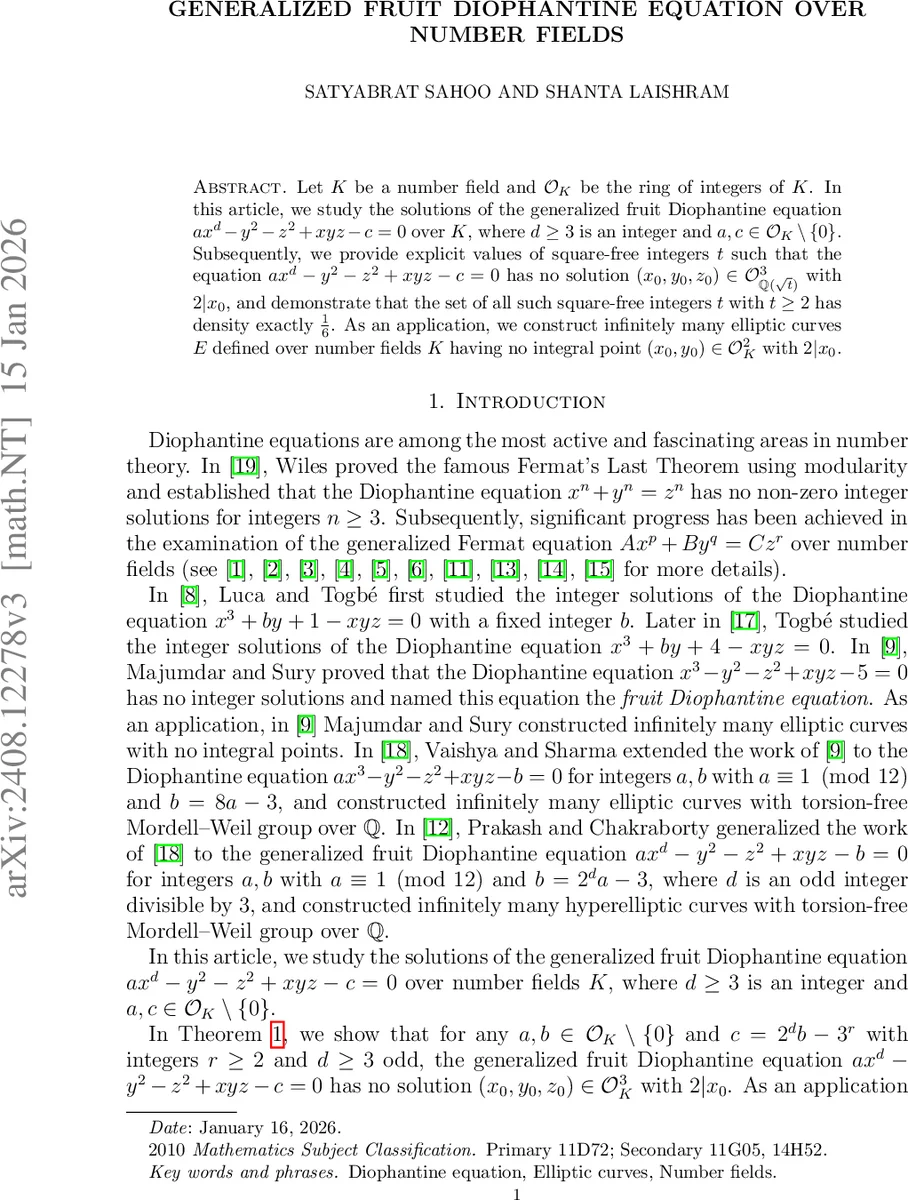
Let $K$ be a number field and $\mathcal{O}_K$ be the ring of integers of $K$. In this article, we study the solutions of the generalized fruit Diophantine equation $ax^d-y^2-z^2 +xyz-c=0$ over $K$, where $d \geq 3$ is an integer and $a,c\in \mathcal{O}K\setminus {0}$. Subsequently, we provide explicit values of square-free integers $t$ such that the equation $ax^d-y^2-z^2 +xyz-c=0$ has no solution $(x_0, y_0, z_0) \in \mathcal{O}{\mathbb{Q}(\sqrt{t})}^3$ with $2 | x_0$, and demonstrate that the set of all such square-free integers $t$ with $t \geq 2$ has density exactly $\frac{1}{6}$. As an application, we construct infinitely many elliptic curves $E$ defined over number fields $K$ having no integral point $(x_0,y_0) \in \mathcal{O}_K^2$ with $2|x_0$.
💡 Research Summary
This paper presents a comprehensive study of the generalized Fruit Diophantine equation over number fields, establishing conditions for the non-existence of certain integer solutions and deriving density results, with significant applications to the arithmetic of elliptic curves.
The core object of study is the equation (ax^d - y^2 - z^2 + xyz - c = 0), where (d \geq 3) is an integer, (K) is a number field with ring of integers (\mathcal{O}_K), and (a, c \in \mathcal{O}_K \setminus {0}). This equation generalizes the “Fruit equation” (x^3 - y^2 - z^2 + xyz - 5 = 0) studied over the integers.
The first main result (Theorem 1) states that if the number field (K) contains a prime ideal where the rational prime 2 splits completely (i.e., the set (T_K) of primes with ramification index and inertia degree equal to 1 over 2 is non-empty), then for any (a, b \in \mathcal{O}_K \setminus {0}) and (c = 2^d b - 3^r) with integers (r \geq 2) and odd (d \geq 3), the equation has no solution ((x_0, y_0, z_0) \in \mathcal{O}_K^3) with (2 \mid x_0) (i.e., with (x_0) being even). The proof cleverly reduces the equation modulo a suitable power of such a prime ideal, exploiting the isomorphism (\mathcal{O}_K / \mathfrak{P}^2 \simeq \mathbb{Z}/4\mathbb{Z}) provided by Lemma 1, and arrives at a contradiction by examining all possible quadratic residues modulo 4.
Focusing on quadratic fields (K = \mathbb{Q}(\sqrt{t})) for square-free integers (t), Corollary 1 specifies that the hypothesis of Theorem 1 holds if and only if (t \equiv 1 \pmod{8}), which is the condition for 2 to split completely. The second major result (Theorem 2) then quantifies the prevalence of such fields by proving that the set (U) of square-free integers (t \geq 2) with (t \equiv 1 \pmod{8}) has a relative density of exactly (1/6). This means that among all square-free numbers, about one-sixth yield quadratic fields where Theorem 1’s conclusion is guaranteed. The proof employs sophisticated asymptotic formulas for the distribution of square-free integers in arithmetic progressions.
The final and highly impactful part of the paper (Section 4) applies Theorem 1 to construct infinite families of elliptic curves with prescribed properties. For a number field (K) with (T_K \neq \emptyset) and an element (\alpha \in \mathcal{O}K) not satisfying a specific degree-8 polynomial, Theorem 4 defines the elliptic curve (E\alpha / K: y^2 - \alpha xy = x^3 - (\alpha^2 + 5)). It then proves that (E_\alpha) has no integral point ((x_0, y_0) \in \mathcal{O}_K^2) with (2 \mid x_0). The connection is made by observing that if such a point existed, the triple ((x_0, y_0, \alpha)) would be a solution to the generalized Fruit equation with parameters (a=b=1, d=3, c=5), contradicting Theorem 1. This application elegantly translates a Diophantine constraint into a constraint on integral points of elliptic curves. Further corollaries (Corollary 2 & 3) combine this construction with classical theorems like Nagell-Lutz to discuss the non-existence of certain torsion points on these curves over number fields and over (\mathbb{Q}).
In summary, this work successfully bridges several areas: it extends the study of a specific Diophantine equation to the general framework of number fields, uses local analysis and density theorems to obtain global results, and finally leverages these Diophantine results to generate interesting examples in the arithmetic geometry of elliptic curves, demonstrating the interconnectedness of number theory.
Comments & Academic Discussion
Loading comments...
Leave a Comment