Analytical Expression for Spherically Symmetric Photoacoustic Sources: A Unified General Solution (Theoretical Analysis and Derivation)
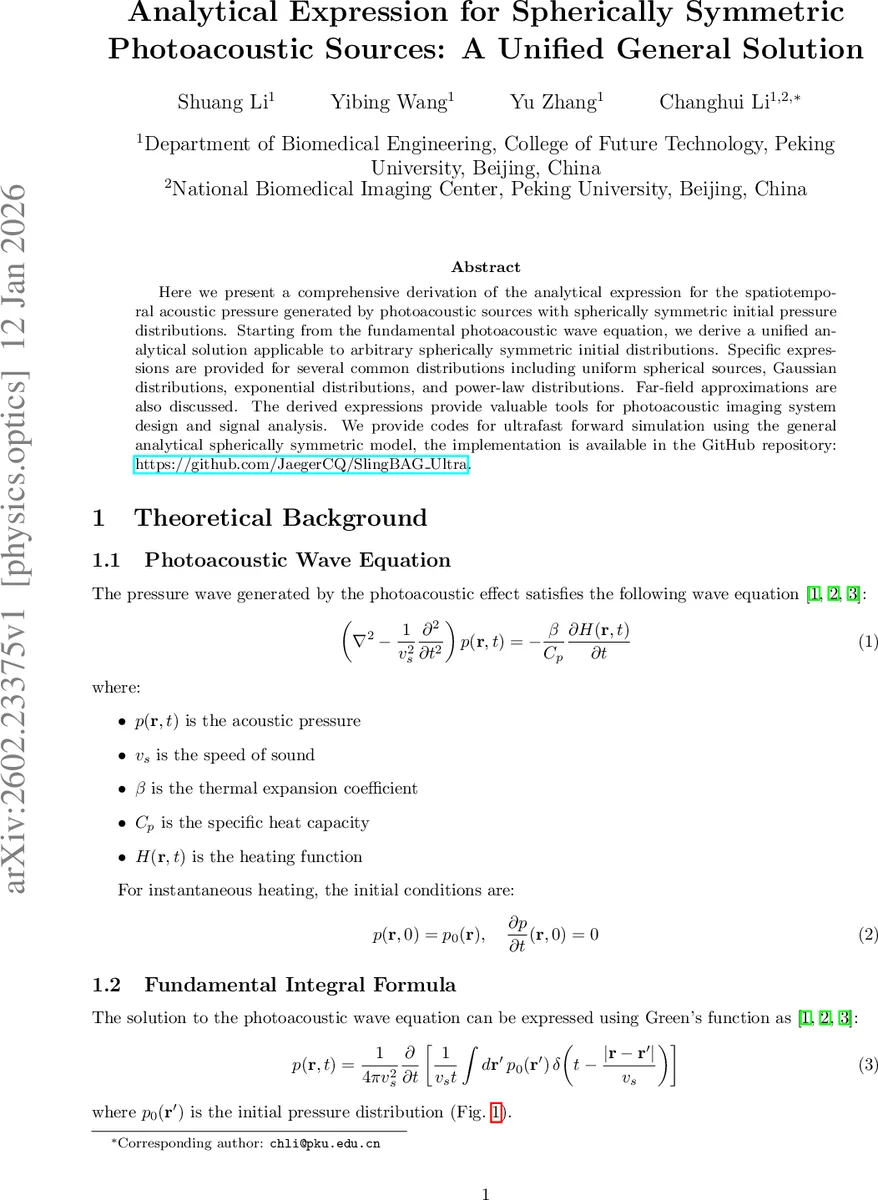
Here we present a comprehensive derivation of the analytical expression for the spatiotemporal acoustic pressure generated by photoacoustic sources with spherically symmetric initial pressure distributions. Starting from the fundamental photoacoustic wave equation, we derive a unified analytical solution applicable to arbitrary spherically symmetric initial distributions. Specific expressions are provided for several common distributions including uniform spherical sources, Gaussian distributions, exponential distributions, and power-law distributions. Far-field approximations are also discussed. The derived expressions provide valuable tools for photoacoustic imaging system design and signal analysis. We provide codes for ultrafast forward simulation using the general analytical spherically symmetric model, the implementation is available in the GitHub repository: \href{https://github.com/JaegerCQ/SlingBAG_Ultra}.
💡 Research Summary
The manuscript presents a rigorous derivation of an analytical solution for the acoustic pressure generated by photoacoustic (PA) sources with spherically symmetric initial pressure distributions. Starting from the fundamental PA wave equation ∇²p – (1/v_s²)∂²p/∂t² = –βC_p ∂H/∂t, the authors assume instantaneous heating so that only the initial pressure p₀(r) is non‑zero, with p(r,0)=p₀(r) and ∂p/∂t(r,0)=0. Using the Green’s function representation, the pressure field is expressed as a time derivative of a spatial convolution involving a Dirac delta function. By exploiting spherical symmetry, the delta function is scaled (δ(t–|r–r′|/v_s)=v_s δ(|r–r′|–v_s t)) and the geometry is described in spherical coordinates. The distance |r–r′| is related to the polar angle θ via the law of cosines, and a careful change of variables transforms the delta function into a form that isolates the angular dependence. Integration over the solid angle yields a factor 2πR/(r r′), and the remaining radial integral is limited to the interval |r–v_s t| ≤ r′ ≤ r+v_s t.
Applying Leibniz’s rule to the time derivative leads to a compact unified expression for any spherically symmetric initial distribution:
p(r,t) = ½ r
Comments & Academic Discussion
Loading comments...
Leave a Comment