On a square packing conjecture of Erdős
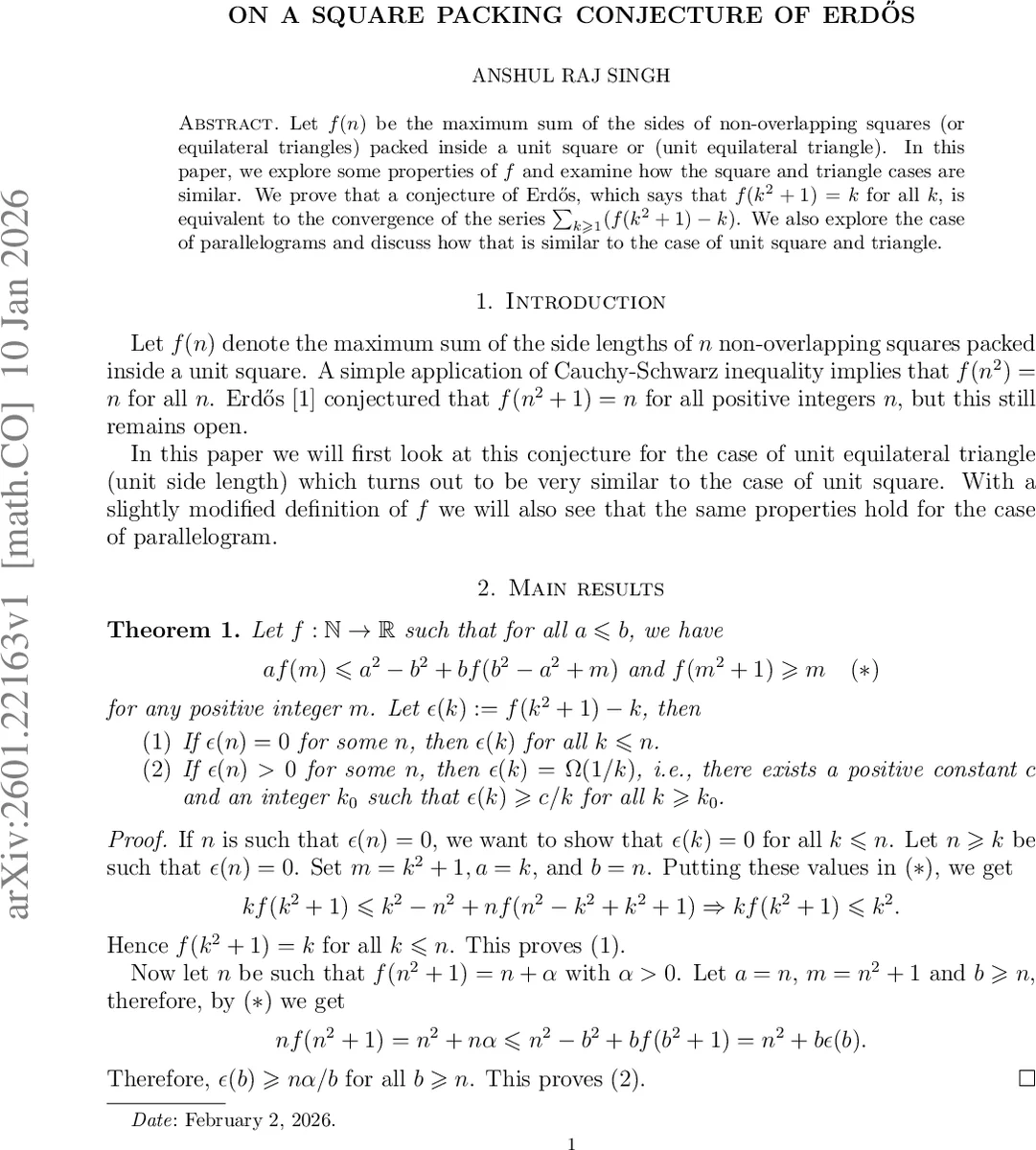
Let $f(n)$ be the maximum sum of the sides of non-overlapping squares (or equilateral triangles) packed inside a unit square or (unit equilateral triangle). In this paper, we explore some properties of $f$ and examine how the square and triangle cases are similar. We prove that a conjecture of Erdős, which says that $f(k^2+1) = k$ for all $k$, is equivalent to the convergence of the series $\sum_{k\geqslant 1}(f(k^2+1)-k)$. We also explore the case of parallelograms and discuss how that is similar to the case of unit square and triangle.
💡 Research Summary
The paper studies a geometric packing problem that can be phrased in purely analytic terms. For a given integer n, let f(n) denote the maximum possible sum of side lengths of n non‑overlapping squares (or, analogously, equilateral triangles) placed inside a unit square (or unit equilateral triangle). A classical observation via the Cauchy–Schwarz inequality shows that f(n²)=n for every n, because n congruent squares of side 1/n fill the unit square exactly.
Paul Erdős conjectured in 1994 that the same simple formula should hold when one extra shape is added, i.e.
f(k²+1)=k for all positive integers k.
No proof or counter‑example is known. The author therefore seeks a different route: rather than constructing explicit packings, he derives a universal scaling inequality that any such function f must satisfy.
The scaling inequality (∗).
For any positive integers a, b, m with a ≤ b,
a·f(m) ≤ a² − b² + b·f(b² − a² + m).
Geometrically, one starts with a b × b grid of unit‑size sub‑squares (or sub‑triangles), removes an a × a sub‑grid from a corner, and then inserts an optimal packing of m shapes into the removed region. The remaining (b² − a²) unit shapes are left untouched, giving the right‑hand side of (∗). The same construction works for equilateral triangles (using a triangular grid) and for any parallelogram that can be tiled by a square number of similar copies.
Define the “error term” ε(k)=f(k²+1)−k. The paper proves two complementary statements about ε(k).
-
Zero‑error propagation. If ε(n)=0 for some n, then ε(k)=0 for every k≤n. The proof substitutes a=k, b=n, m=k²+1 into (∗), obtaining k·f(k²+1) ≤ k², which forces f(k²+1)=k. Consequently, once the conjecture holds for a particular n, it automatically holds for all smaller indices.
-
Positive‑error lower bound. If ε(n)>0 for some n, then there exists a constant c>0 such that ε(k) ≥ c/k for all sufficiently large k. Here one sets a=n, m=n²+1, and lets b≥n vary. Inequality (∗) yields n·f(n²+1) ≤ n²−b²+b·f(b²+1). Rearranging gives ε(b) ≥ n·α/b, where α=ε(n)>0. Hence any positive deviation from the conjectured value cannot decay faster than order 1/k.
These two facts together imply a sharp dichotomy: either ε(k) is identically zero (the conjecture holds for every k) or ε(k) stays positive and decays at most like 1/k, which forces the series ∑_{k≥1}ε(k) to diverge. Consequently the conjecture is equivalent to the convergence of the series
∑{k≥1} ε(k) = ∑{k≥1}
Comments & Academic Discussion
Loading comments...
Leave a Comment