Formal Methods in Robot Policy Learning and Verification: A Survey on Current Techniques and Future Directions
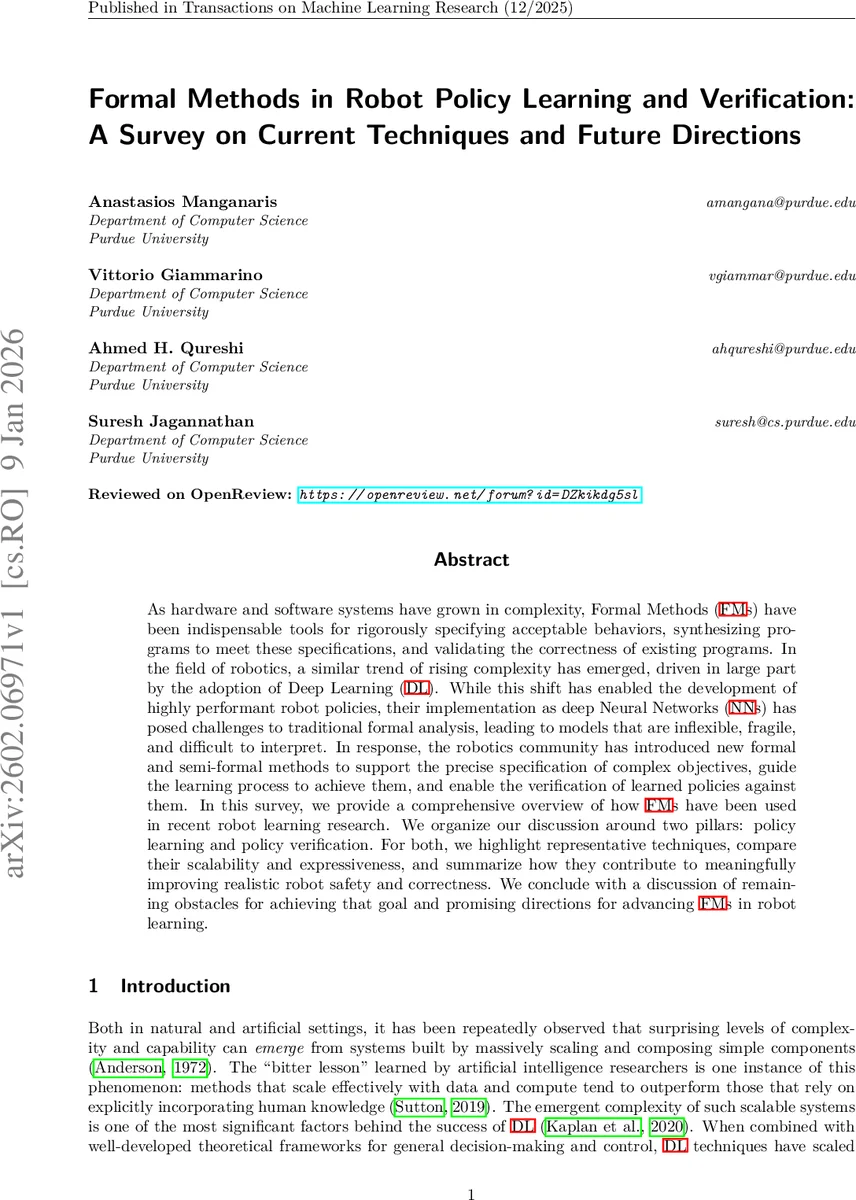
As hardware and software systems have grown in complexity, formal methods have been indispensable tools for rigorously specifying acceptable behaviors, synthesizing programs to meet these specifications, and validating the correctness of existing programs. In the field of robotics, a similar trend of rising complexity has emerged, driven in large part by the adoption of deep learning. While this shift has enabled the development of highly performant robot policies, their implementation as deep neural networks has posed challenges to traditional formal analysis, leading to models that are inflexible, fragile, and difficult to interpret. In response, the robotics community has introduced new formal and semi-formal methods to support the precise specification of complex objectives, guide the learning process to achieve them, and enable the verification of learned policies against them. In this survey, we provide a comprehensive overview of how formal methods have been used in recent robot learning research. We organize our discussion around two pillars: policy learning and policy verification. For both, we highlight representative techniques, compare their scalability and expressiveness, and summarize how they contribute to meaningfully improving realistic robot safety and correctness. We conclude with a discussion of remaining obstacles for achieving that goal and promising directions for advancing formal methods in robot learning.
💡 Research Summary
This survey provides a comprehensive overview of how formal methods (FMs) have been integrated into deep‑learning‑based robot policy learning and verification. The authors first motivate the need for rigorous specification, synthesis, and verification tools by highlighting the growing complexity of robotic systems and the opacity of neural‑network policies. They then introduce the foundational formal models—discrete transition systems, Linear‑Temporal Logic (LTL), Signal Temporal Logic (STL), and finite‑state automata—explaining how these languages can capture safety, recurrence, and performance requirements in both discrete and continuous domains.
The core of the paper is organized around two pillars. The first pillar, policy learning, surveys techniques that embed formal specifications into reinforcement learning, imitation learning, and offline RL. Approaches include specification‑driven reward shaping, constrained‑optimization formulations (e.g., CMDPs, Lagrangian methods), safe exploration using model‑based abstractions, and differentiable specifications that allow gradients to flow from logical constraints to neural‑network parameters. The authors compare these methods in terms of expressiveness (temporal, probabilistic, quantitative), scalability, and the types of robotic tasks they have been applied to (manipulation, navigation, human‑robot collaboration).
The second pillar, policy verification, reviews a spectrum of verification strategies. Environment abstraction techniques reduce high‑dimensional dynamics to finite models amenable to model checking. Reachability analyses—Hamilton‑Jacobi, set‑propagation, and sampling‑based methods—provide guarantees that unsafe states are never entered. Certified functions such as Lyapunov, barrier, and contraction metrics are discussed both as offline proof tools and as components that can be learned jointly with the policy. Runtime monitoring and falsification frameworks are presented as practical mechanisms for detecting specification violations during execution and triggering safe fallback actions. For each verification approach the survey details the underlying assumptions (deterministic vs stochastic policies, availability of accurate models, etc.) and highlights current scalability bottlenecks.
In the discussion of open challenges, the authors identify three major gaps: (1) the difficulty of constructing accurate formal models for high‑dimensional continuous systems; (2) the lack of automated trade‑off management between learning performance and specification satisfaction; and (3) the absence of lightweight, real‑time monitoring infrastructures that can operate on embedded hardware. To address these, they propose future research directions such as differentiable specifications that can be optimized jointly with policies, hybrid model‑data verification pipelines, distributed cloud/edge verification services, and interactive tools that let users refine specifications on the fly.
Overall, the survey positions formal methods as essential for transforming powerful but opaque deep‑learning policies into trustworthy, safety‑critical robotic controllers. By systematically cataloguing recent advances in FM‑guided learning and FM‑based verification, the paper offers a valuable roadmap for researchers aiming to bridge the gap between high‑performance learning and rigorous correctness guarantees in real‑world robotic applications.
Comments & Academic Discussion
Loading comments...
Leave a Comment