Low-Latency Event-Based Velocimetry for Quadrotor Control in a Narrow Pipe
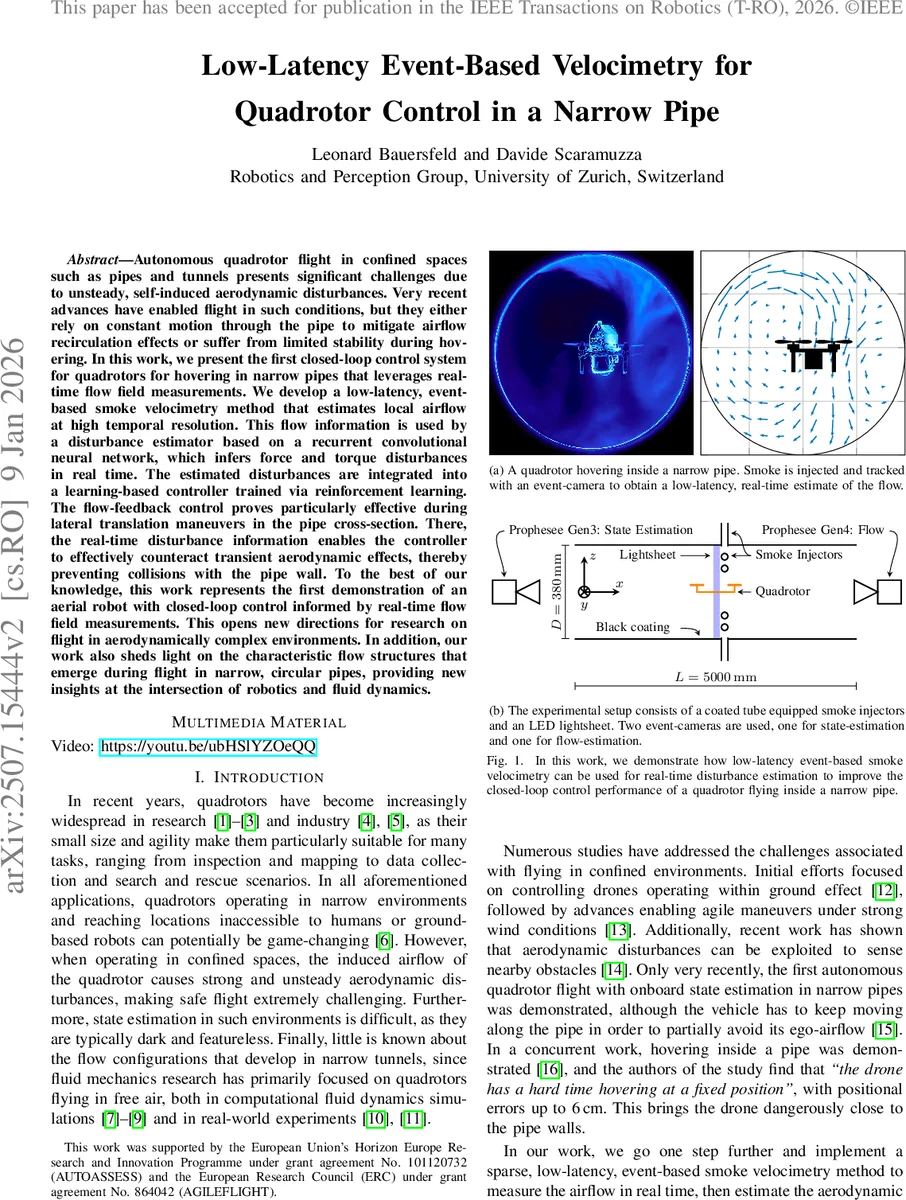
Autonomous quadrotor flight in confined spaces such as pipes and tunnels presents significant challenges due to unsteady, self-induced aerodynamic disturbances. Very recent advances have enabled flight in such conditions, but they either rely on constant motion through the pipe to mitigate airflow recirculation effects or suffer from limited stability during hovering. In this work, we present the first closed-loop control system for quadrotors for hovering in narrow pipes that leverages real-time flow field measurements. We develop a low-latency, event-based smoke velocimetry method that estimates local airflow at high temporal resolution. This flow information is used by a disturbance estimator based on a recurrent convolutional neural network, which infers force and torque disturbances in real time. The estimated disturbances are integrated into a learning-based controller trained via reinforcement learning. The flow-feedback control proves particularly effective during lateral translation maneuvers in the pipe cross-section. There, the real-time disturbance information enables the controller to effectively counteract transient aerodynamic effects, thereby preventing collisions with the pipe wall. To the best of our knowledge, this work represents the first demonstration of an aerial robot with closed-loop control informed by real-time flow field measurements. This opens new directions for research on flight in aerodynamically complex environments. In addition, our work also sheds light on the characteristic flow structures that emerge during flight in narrow, circular pipes, providing new insights at the intersection of robotics and fluid dynamics.
💡 Research Summary
This paper presents the first closed‑loop control system that enables a quadrotor to hover stably inside a narrow circular pipe by exploiting real‑time measurements of the surrounding airflow. The authors introduce an event‑based smoke velocimetry (EBSV) technique that uses a high‑speed event camera together with a thin LED light‑sheet to illuminate seeded smoke. By converting the asynchronous event stream into low‑resolution frames, performing 2 × 2 spatial binning, and applying GPU‑accelerated template matching with quadratic refinement, the method delivers velocity estimates with a mean error of 0.35 m s⁻¹ and a processing latency below one millisecond—far faster than conventional high‑speed camera PIV systems.
The measured 2‑D flow field is fed into a recurrent convolutional neural network (RCNN) that predicts the instantaneous disturbance wrench acting on the vehicle: horizontal and vertical forces as well as roll torque. The network processes a short temporal window (≈10 ms) of flow patches, producing disturbance estimates at >20 Hz. These estimates are then incorporated into a reinforcement‑learning (RL) controller trained with Proximal Policy Optimization. The policy receives the disturbance wrench as an auxiliary input and learns to generate motor commands that actively counteract the aerodynamic perturbations.
In addition to the flow‑feedback loop, the authors develop an event‑camera‑based monocular motion‑capture system that tracks millimeter‑scale active LED markers inside the pipe with sub‑millisecond latency, achieving pose accuracy comparable to multi‑camera optical‑motion‑capture rigs.
Experimental validation is performed in a 38 cm‑diameter, >5 m‑long pipe. The quadrotor (≈0.5 m length) is equipped with two event cameras: one for state estimation and one for flow estimation. Smoke is injected upstream, and the light‑sheet is positioned orthogonal to the pipe axis. Results show a 29 % reduction in hovering position deviation and a 71 % reduction in overshoot during lateral translation maneuvers compared with a baseline controller that lacks flow feedback. The system can track rapidly changing turbulent structures whose characteristic lifetime is on the order of 10 ms, confirming the necessity of sub‑millisecond processing.
Overall, the paper contributes three novel components: (1) the first event‑based smoke velocimetry method with sub‑millisecond latency, (2) the first real‑time flow‑based disturbance estimator for aerial robots, and (3) a reinforcement‑learning controller that learns to exploit these disturbance estimates for robust pipe‑flight. The work opens new avenues for aerial robotics in aerodynamically complex environments, suggesting future extensions such as onboard smoke generation, multi‑degree‑of‑freedom flow‑aware navigation, and application to other confined‑flow scenarios like tunnels, ducts, or industrial pipelines.
Comments & Academic Discussion
Loading comments...
Leave a Comment