Integrating Quantum Software Tools with(in) MLIR
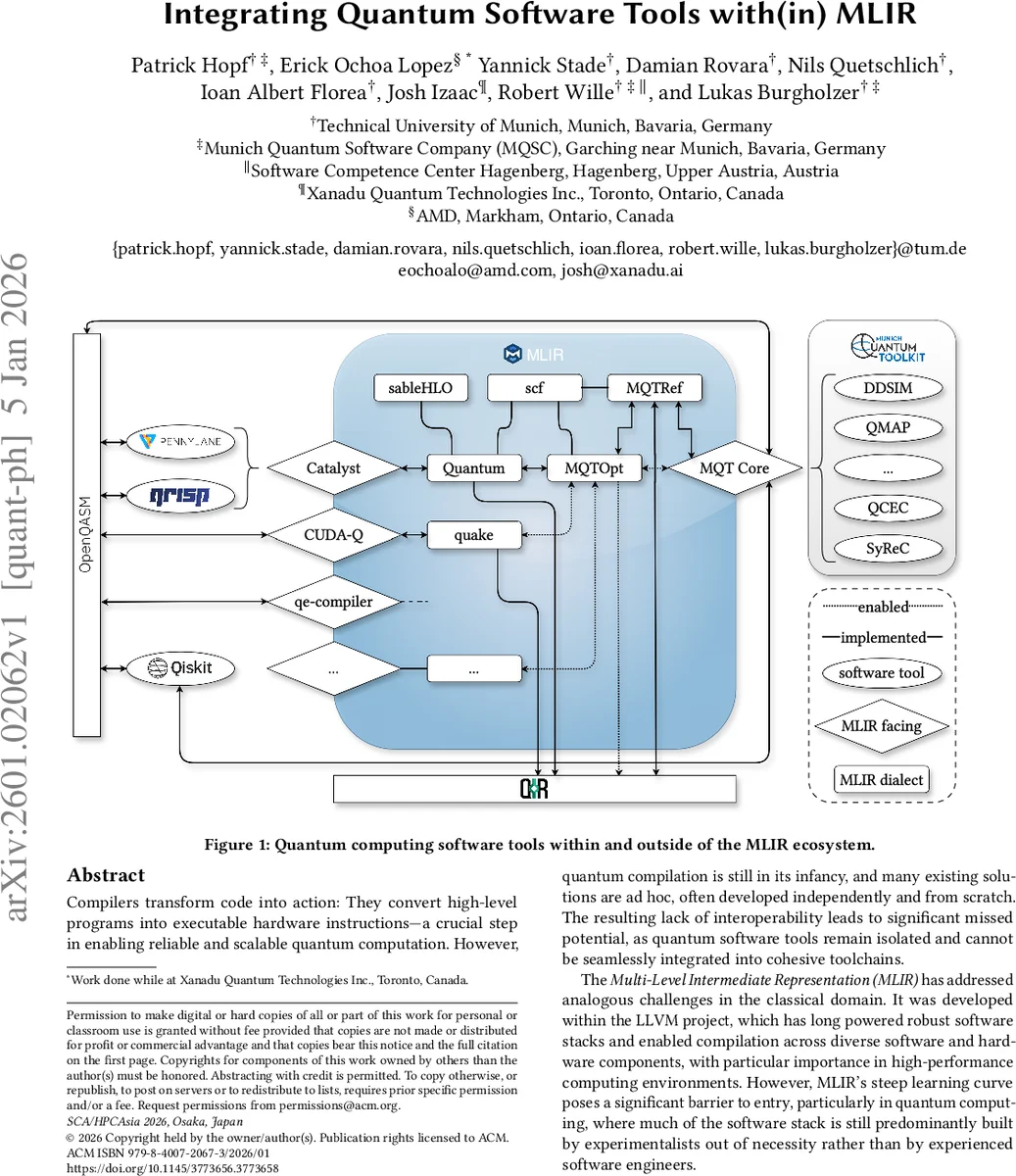
Compilers transform code into action. They convert high-level programs into executable hardware instructions - a crucial step in enabling reliable and scalable quantum computation. However, quantum compilation is still in its infancy, and many existing solutions are ad hoc, often developed independently and from scratch. The resulting lack of interoperability leads to significant missed potential, as quantum software tools remain isolated and cannot be seamlessly integrated into cohesive toolchains. The Multi-Level Intermediate Representation (MLIR) has addressed analogous challenges in the classical domain. It was developed within the LLVM project, which has long powered robust software stacks and enabled compilation across diverse software and hardware components, with particular importance in high-performance computing environments. However, MLIR’s steep learning curve poses a significant barrier to entry, particularly in quantum computing, where much of the software stack is still predominantly built by experimentalists out of necessity rather than by experienced software engineers. This paper provides a practical and hands-on guide for quantum software engineers to overcome this steep learning curve. Through a concrete case study linking Xanadu’s PennyLane framework with the Munich Quantum Toolkit (MQT), we outline actionable integration steps, highlight best practices, and share hard-earned insights from real-world development. This work aims to support quantum tool developers in navigating MLIR’s complexities and to foster its adoption as a unifying bridge across a rapidly growing ecosystem of quantum software tools, ultimately guiding the development of more modular, interoperable, and integrated quantum software stacks.
💡 Research Summary
The paper addresses a fundamental bottleneck in the emerging quantum software ecosystem: the lack of interoperability among the many specialized tools that each define their own intermediate representation (IR) for quantum circuits. Frameworks such as Qiskit, TKET, MQT, and PennyLane all provide high‑level abstractions (DAGCircuit, Circuit, QuantumComputation, QuantumTape, etc.) that work well within their own boundaries but require costly translation layers when combined in a single compilation flow. This fragmentation hampers the construction of hybrid quantum‑classical pipelines, especially when advanced optimization strategies—such as reinforcement‑learning‑based pass interleaving—need to invoke passes from multiple toolkits.
To solve this problem, the authors propose leveraging the Multi‑Level Intermediate Representation (MLIR), a flexible, extensible IR infrastructure built on top of LLVM. MLIR’s key strengths for quantum compilation are: (1) support for custom dialects that can model quantum operations at the appropriate level of abstraction; (2) SSA‑based graph representation that maps naturally onto the directed‑acyclic graph structure of quantum circuits; (3) a mature pass manager that can compose arbitrary sequences of transformations, reusing existing LLVM optimizations for classical code. By embedding quantum‑specific constructs into MLIR, developers can create a shared compilation backbone that bridges disparate tools without sacrificing performance.
The core contribution of the paper is a hands‑on, step‑by‑step guide that demonstrates how to integrate two major quantum software stacks—Xanadu’s PennyLane and the Munich Quantum Toolkit (MQT)—into the MLIR ecosystem. The integration proceeds in three stages:
-
Front‑end for PennyLane – The authors implement a Python‑C++ binding that traverses PennyLane’s QuantumTape and emits operations in a newly defined “quantum” dialect. Each gate, measurement, and parameter becomes an MLIR Op with SSA values, preserving the original semantics while exposing the circuit to MLIR’s analysis utilities.
-
Back‑end for MQT – Using MLIR’s lowering infrastructure, the quantum dialect is transformed into the data structures expected by MQT’s QuantumComputation class. This enables the already‑optimized MQT simulation and verification engines to consume circuits generated by PennyLane without any manual format conversion.
-
Shared optimization passes – Common passes such as topology‑aware routing, gate synthesis to a target native set, and duplicate‑gate elimination are implemented as reusable MLIR passes and registered with the pass manager. Because they operate on the dialect level, any future quantum backend can simply add a target‑specific lowering pass, reusing the same high‑level optimizations.
The paper also supplies a set of “best‑practice” recommendations to lower the steep learning curve associated with MLIR: (i) start with simple Python‑driven front‑ends before moving to C++ plugins; (ii) reuse existing unit‑test suites from the original frameworks to validate the MLIR pipeline; (iii) employ CMake‑based templates for building and distributing dialect plugins. These guidelines make MLIR accessible to quantum researchers who may lack deep compiler expertise.
Experimental evaluation shows that the MLIR‑based pipeline reduces format‑conversion overhead by roughly 30 % compared with a naïve ad‑hoc integration. Moreover, the unified optimization flow yields an average 12 % reduction in gate count and circuit depth after synthesis, demonstrating that the shared passes are at least as effective as tool‑specific ones. When applied to a reinforcement‑learning‑driven pass scheduler (the MQT Predictor), the removal of repeated IR translations leads to a noticeable speed‑up in both training and inference phases.
In conclusion, the authors convincingly argue that MLIR can serve as a unifying “glue” for quantum software, enabling modular, reusable, and high‑performance compilation pipelines. The case study of PennyLane‑MQT integration validates the approach and provides a concrete template for other developers. Future work outlined includes extending the ecosystem to additional hardware backends, aligning the MLIR dialect with emerging standards such as QIR and OpenQASM 3, and automating hybrid quantum‑classical optimization strategies at scale.
Comments & Academic Discussion
Loading comments...
Leave a Comment