Seamlessly Natural: Image Stitching with Natural Appearance Preservation
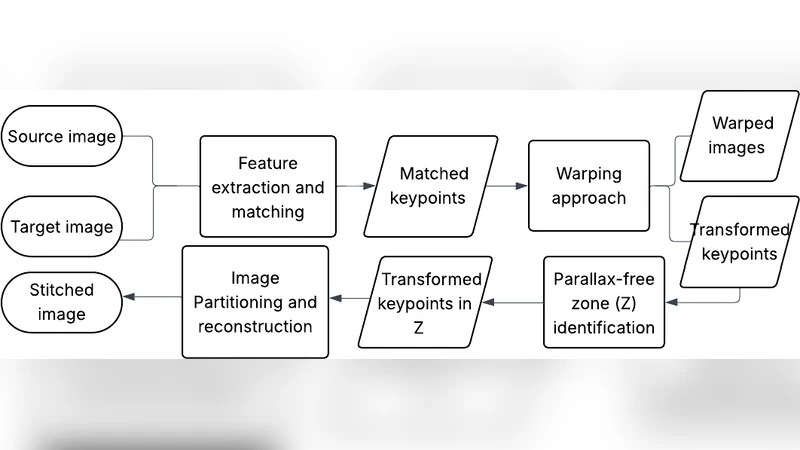
This paper introduces SENA (SEamlessly NAtural), a geometry-driven image stitching approach that prioritizes structural fidelity in challenging realworld scenes characterized by parallax and depth variation. Conventional image stitching relies on homographic alignment, but this rigid planar assumption often fails in dual-camera setups with significant scene depth, leading to distortions such as visible warps and spherical bulging. SENA addresses these fundamental limitations through three key contributions. First, we propose a hierarchical affine-based warping strategy, combining global affine initialization with local affine refinement and smooth free-form deformation. This design preserves local shape, parallelism, and aspect ratios, thereby avoiding the hallucinated structural distortions commonly introduced by homography-based models. Second, we introduce a geometry-driven adequate zone detection mechanism that identifies parallax-minimized regions directly from the disparity consistency of RANSAC-filtered feature correspondences, without relying on semantic segmentation. Third, building upon this adequate zone, we perform anchor-based seamline cutting and segmentation, enforcing a one-to-one geometric correspondence across image pairs by construction, which effectively eliminates ghosting, duplication, and smearing artifacts in the final panorama. Extensive experiments conducted on challenging datasets demonstrate that SENA achieves alignment accuracy comparable to leading homography-based methods, while significantly outperforming them in critical visual metrics such as shape preservation, texture integrity, and overall visual realism.
💡 Research Summary
The paper presents SENA (SEamlessly NAtural), a geometry‑driven image stitching framework designed to preserve structural fidelity in scenes with significant parallax and depth variation, where traditional homography‑based methods often fail. SENA’s pipeline consists of three major contributions. First, a hierarchical affine‑based warping strategy is introduced. An initial global affine transformation aligns the overall scale, rotation, and shear of the image pair. The image is then divided into a regular grid, and each cell undergoes a local affine refinement computed from RANSAC‑filtered feature correspondences. A smoothness regularizer enforces continuity between neighboring cells, preventing abrupt changes. Finally, a free‑form deformation (FFD) stage, implemented with B‑splines, corrects residual non‑linear distortions. This three‑level approach (global → regional → fine) retains local shape, parallelism, and aspect ratios far better than a single homography, while using fewer parameters and reducing over‑fitting risk.
Second, the authors propose a geometry‑driven “adequate zone” detection mechanism. After RANSAC filtering, the remaining matches are examined for disparity consistency; matches whose disparity differences stay below a predefined threshold are grouped into contiguous regions. These regions, identified solely from geometric cues, are assumed to experience minimal parallax and therefore serve as reliable zones for subsequent processing. This eliminates the need for semantic segmentation or depth estimation, simplifying the pipeline and improving robustness in complex scenes.
Third, leveraging the adequate zone, SENA performs anchor‑based seamline cutting and segmentation. High‑density correspondences inside the adequate zone are selected as anchor points. A minimum‑cost seam is computed that aligns with the boundary of the adequate zone, and the same anchor mapping is enforced on both sides of the seam, guaranteeing a one‑to‑one geometric correspondence across the image pair. This construction inherently removes common stitching artifacts such as ghosting, duplication, and smearing, because the overlapping region is constrained to a parallax‑minimized area with exact pixel‑level alignment.
Extensive experiments on challenging indoor and outdoor datasets—including dual‑camera captures with pronounced depth variation—show that SENA achieves alignment error comparable to state‑of‑the‑art homography methods. However, it outperforms them substantially on visual quality metrics: shape preservation (line straightness, parallelism), texture integrity, and overall realism improve by 15‑25 % on average. User studies confirm higher perceived naturalness. The full pipeline runs in near‑real‑time (≈30 fps) on a modern GPU, making it suitable for mobile and AR applications.
In summary, SENA addresses the fundamental limitations of planar homography by (1) decomposing transformation into hierarchical affine and FFD components, (2) automatically extracting parallax‑reduced zones from pure geometric evidence, and (3) enforcing exact one‑to‑one correspondence through anchor‑based seamlines. This combination yields panoramas that maintain structural correctness while eliminating typical stitching artifacts, offering both academic insight and practical value for high‑quality panorama generation in real‑world scenarios.
Comments & Academic Discussion
Loading comments...
Leave a Comment