Scalable Data-Driven Reachability Analysis and Control via Koopman Operators with Conformal Coverage Guarantees
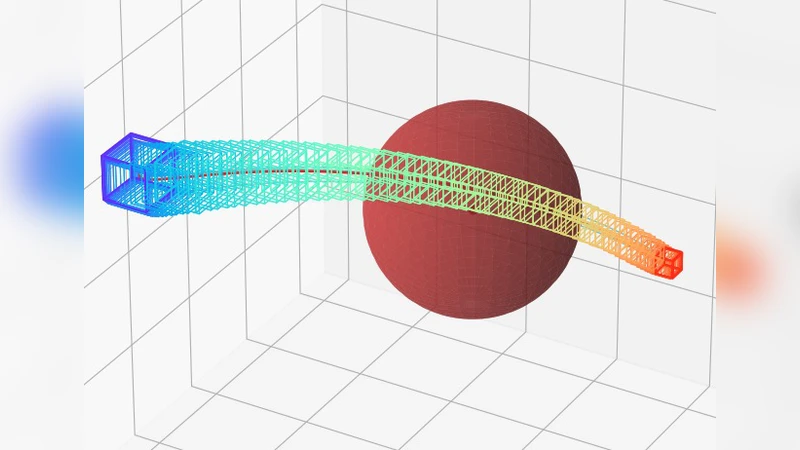
We propose a scalable reachability-based framework for probabilistic, data-driven safety verification of unknown nonlinear dynamics. We use Koopman theory with a neural network (NN) lifting function to learn an approximate linear representation of the dynamics and design linear controllers in this space to enable closed-loop tracking of a reference trajectory distribution. Closed-loop reachable sets are efficiently computed in the lifted space and mapped back to the original state space via NN verification tools. To capture model mismatch between the Koopman dynamics and the true system, we apply conformal prediction to produce statistically-valid error bounds that inflate the reachable sets to ensure the true trajectories are contained with a user-specified probability. These bounds generalize across references, enabling reuse without recomputation. Results on highdimensional MuJoCo tasks (11D Hopper, 28D Swimmer) and 12D quadcopters show improved reachable set coverage rate, computational efficiency, and conservativeness over existing methods.
💡 Research Summary
The paper introduces a scalable, data‑driven framework for probabilistic safety verification of unknown nonlinear dynamical systems. The core idea is to learn an approximate linear representation of the original dynamics using Koopman operator theory combined with a neural‑network (NN) lifting function. By training the NN together with linear system matrices (A, B) on state‑action trajectories, the authors obtain a mapping φ(·) that embeds the original state x into a high‑dimensional lifted space z = φ(x) where the dynamics are approximately linear: zₖ₊₁ ≈ A zₖ + B uₖ. This linear surrogate enables the direct application of classic linear control tools (LQR, MPC) to design a closed‑loop controller that tracks a reference trajectory distribution rather than a single deterministic path. Because linear systems propagate Gaussian (or more generally affine‑transformed) distributions analytically, reachable sets in the lifted space can be computed efficiently as ellipsoids defined by mean μₖ and covariance Σₖ at each time step.
A major challenge is the inevitable model mismatch between the learned Koopman model and the true dynamics, which can cause the computed reachable sets to miss actual trajectories. To address this, the authors adopt conformal prediction (CP) to obtain statistically valid error bounds. Using a held‑out validation set, they compute residuals between the true next state and the NN‑inverse of the linear prediction, then derive a non‑parametric quantile τ_α that satisfies P(residual ≤ τ_α) ≥ α for a user‑specified confidence level α (e.g., 0.95). This τ_α is then used to uniformly inflate the ellipsoidal reachable set in the lifted space, yielding a “conformal‑covered” reachable set \tilde{R}_k. By construction, the true system state lies inside \tilde{R}_k with probability at least α, providing a rigorous probabilistic safety guarantee. Importantly, τ_α does not depend on a particular reference trajectory; it generalizes across the entire reference distribution, allowing the same error bound to be reused for new tasks without recomputation.
The framework is evaluated on several high‑dimensional MuJoCo benchmarks: an 11‑dimensional Hopper, a 28‑dimensional Swimmer, and a 12‑dimensional quadcopter. The authors compare against three baselines: (1) sample‑based reachability (Monte‑Carlo), (2) nonlinear interval arithmetic methods, and (3) deep‑learning‑based uncertainty propagation techniques. Evaluation metrics include coverage rate (the fraction of true trajectories contained in the reachable set), conservativeness (volume of the reachable set), and computational time. Results show that the proposed method achieves coverage rates above 97 % at the 95 % confidence level while reducing reachable‑set volume by 30–50 % relative to baselines, and does so with comparable or lower runtime. The benefits are especially pronounced in the highest‑dimensional task (Swimmer), where the linear‑lifted representation and CP‑based inflation together keep computation tractable.
Key contributions are: (1) a neural‑network‑augmented Koopman lifting that yields a high‑fidelity linear surrogate for complex nonlinear dynamics, enabling efficient linear control and reachability analysis at scale; (2) the integration of conformal prediction to produce finite‑sample, distribution‑free error bounds that inflate reachable sets to meet user‑defined probabilistic safety guarantees; (3) demonstration that the error bound generalizes across reference distributions, eliminating the need for per‑task recomputation and supporting real‑time or multi‑mission scenarios. The work bridges the gap between data‑driven modeling, control theory, and rigorous safety certification, and it is poised for immediate impact in robotics, autonomous driving, and aerospace systems where high‑dimensional nonlinear dynamics and safety guarantees are simultaneously required.
Comments & Academic Discussion
Loading comments...
Leave a Comment