📝 Original Info
- Title: FedHypeVAE: Federated Learning with Hypernetwork Generated Conditional VAEs for Differentially Private Embedding Sharing
- ArXiv ID: 2601.00785
- Date: 2026-01-02
- Authors: Sunny Gupta, Amit Sethi (Indian Institute of Technology Bombay, Mumbai, India)
📝 Abstract
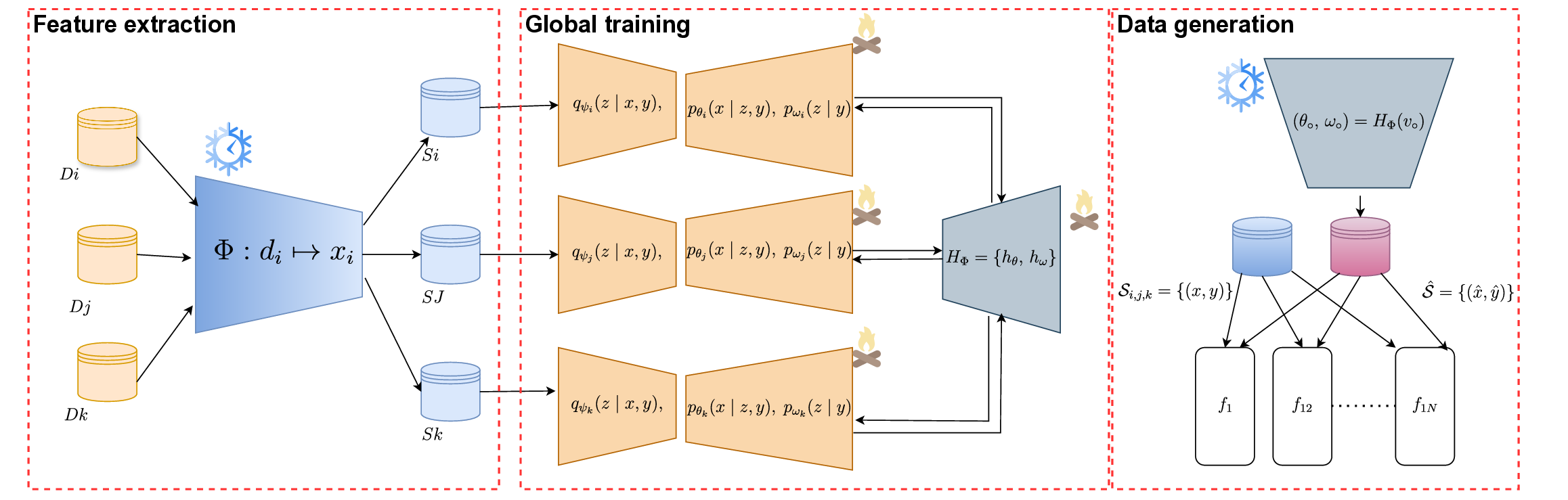
Federated data sharing promises utility without centralizing raw data, yet existing embedding-level generators struggle under non-IID client heterogeneity and provide limited formal protection against gradient leakage. We propose FedHypeVAE, a differentially private, hypernetwork-driven framework for synthesizing embedding-level data across decentralized clients. Building on a conditional VAE backbone, we replace the single global decoder and fixed latent prior with client-aware decoders and class-conditional priors generated by a shared hypernetwork from private, trainable client codes. This bi-level design personalizes the generative layerrather than the downstream modelwhile decoupling local data from communicated parameters. The shared hypernetwork is optimized under differential privacy, ensuring that only noise-perturbed, clipped gradients are aggregated across clients. A local MMD alignment between real and synthetic embeddings and a Lipschitz regularizer on hypernetwork outputs further enhance stability and distributional coherence under non-IID conditions. After training, a neutral meta-code enables domain-agnostic synthesis, while mixtures of meta-codes provide controllable multi-domain coverage. FedHypeVAE unifies personalization, privacy, and distribution alignment at the generator level, establishing a principled foundation for privacy-preserving data synthesis in federated settings. Code: github.com/sunnyinAI/FedHypeVAE
💡 Deep Analysis
Deep Dive into FedHypeVAE: Federated Learning with Hypernetwork Generated Conditional VAEs for Differentially Private Embedding Sharing.
Federated data sharing promises utility without centralizing raw data, yet existing embedding-level generators struggle under non-IID client heterogeneity and provide limited formal protection against gradient leakage. We propose FedHypeVAE, a differentially private, hypernetwork-driven framework for synthesizing embedding-level data across decentralized clients. Building on a conditional VAE backbone, we replace the single global decoder and fixed latent prior with client-aware decoders and class-conditional priors generated by a shared hypernetwork from private, trainable client codes. This bi-level design personalizes the generative layerrather than the downstream modelwhile decoupling local data from communicated parameters. The shared hypernetwork is optimized under differential privacy, ensuring that only noise-perturbed, clipped gradients are aggregated across clients. A local MMD alignment between real and synthetic embeddings and a Lipschitz regularizer on hypernetwork outputs
📄 Full Content
FEDHYPEVAE: FEDERATED LEARNING WITH
HYPERNETWORK-GENERATED CONDITIONAL VAES FOR
DIFFERENTIALLY-PRIVATE EMBEDDING SHARING
Sunny Gupta, Amit Sethi
Indian Institute of Technology Bombay
Mumbai, India
{sunnygupta, asethi}@iitb.ac.in
ABSTRACT
Federated data sharing promises utility without centralizing raw data, yet existing embedding-level
generators struggle under non-IID client heterogeneity and provide limited formal protection against
gradient leakage. We propose FedHypeVAE, a differentially private, hypernetwork-driven framework
for synthesizing embedding-level data across decentralized clients. Building on a conditional VAE
backbone, we replace the single global decoder and fixed latent prior with client-aware decoders and
class-conditional priors generated by a shared hypernetwork from private, trainable client codes. This
bi-level design personalizes the generative layerrather than the downstream modelwhile decoupling
local data from communicated parameters.
The shared hypernetwork is optimized under differential privacy, ensuring that only noise-perturbed,
clipped gradients are aggregated across clients. A local MMD alignment between real and synthetic
embeddings and a Lipschitz regularizer on hypernetwork outputs further enhance stability and
distributional coherence under non-IID conditions. After training, a neutral meta-code enables
domain-agnostic synthesis, while mixtures of meta-codes provide controllable multi-domain coverage.
FedHypeVAE unifies personalization, privacy, and distribution alignment at the generator level,
establishing a principled foundation for privacy-preserving data synthesis in federated settings. Code:
github.com/sunnyinAI/FedHypeVAE
Keywords Federated Learning · Privacy · Gradient Inversion
Introduction
Deep Neural Networks (DNNs) have driven remarkable progress in medical imaging, yet their widespread clinical
deployment remains constrained by limited data availability and stringent privacy requirements [1, 2]. Medical datasets
are often siloed across institutions, while the low prevalence of certain diseases further restricts access to diverse,
high-quality training data [3]. Although collaborative data sharing could mitigate these challenges, strict regulatory
frameworks such as HIPAA and GDPR render centralized dataset aggregation infeasible.
To address these limitations, Federated Learning (FL) [4] has emerged as a distributed paradigm that enables multiple
institutions to collaboratively train models without exposing raw data. The classical FedAvg algorithm [4] aggregates
model updates from clients to construct a global model, ensuring that sensitive data remain within institutional
boundaries. However, FL faces several persistent challenges. Communication overhead is substantial—especially
with high-capacity architectures such as Vision Transformers (ViTs) [5]—and performance often degrades under
non-IID client distributions. Recent efforts to improve efficiency through lightweight architectures [6, 7] have reduced
transmission cost but at the expense of robustness and diagnostic fidelity.
An emerging alternative is synthetic data sharing, where generative models produce privacy-preserving surrogate
datasets instead of transmitting model updates [8, 9]. Such methods reduce communication burden and improve
arXiv:2601.00785v1 [cs.LG] 2 Jan 2026
FedHypeVAE
cross-domain applicability. While Generative Adversarial Networks (GANs) [10] and diffusion models [11] achieve
high-fidelity synthesis, they remain unstable or computationally expensive for federated environments. In contrast,
Variational Autoencoders (VAEs) and their conditional extensions (CVAEs) offer stable, likelihood-based training
and computational efficiency, albeit at the cost of reduced perceptual sharpness. Recent work [12] demonstrated that
generating data in embedding space rather than image space can preserve task-relevant information while mitigating
privacy leakage.
This embedding-level paradigm is strengthened by the advent of foundation encoders such as DINOv2 [13], which
provide compact, semantically rich representations that generalize across imaging domains [14]. Training CVAEs on
such embeddings enables the generative model to capture diagnostic features efficiently while reducing redundancy and
risk of reconstruction-based attacks.
Despite these advances, two fundamental challenges persist. First, existing federated generative frameworks lack the
ability to adapt to client-specific heterogeneity, leading to degraded performance under non-IID distributions. Second,
formal privacy guarantees are rarely incorporated, with most prior methods relying on heuristic noise injection rather
than certified Differential Privacy (DP). Addressing these limitations requires a framework capable of personalized,
differentially-private generative modeling that remains consistent and generalizable across diverse clinical domains.
To this end, we propose FedHypeVAE—a Federated Hypernetwork-Generated Conditional
…(Full text truncated)…
📸 Image Gallery
Reference
This content is AI-processed based on ArXiv data.