Anomalous (3+1)d Fermionic Topological Quantum Field Theories via Symmetry Extension
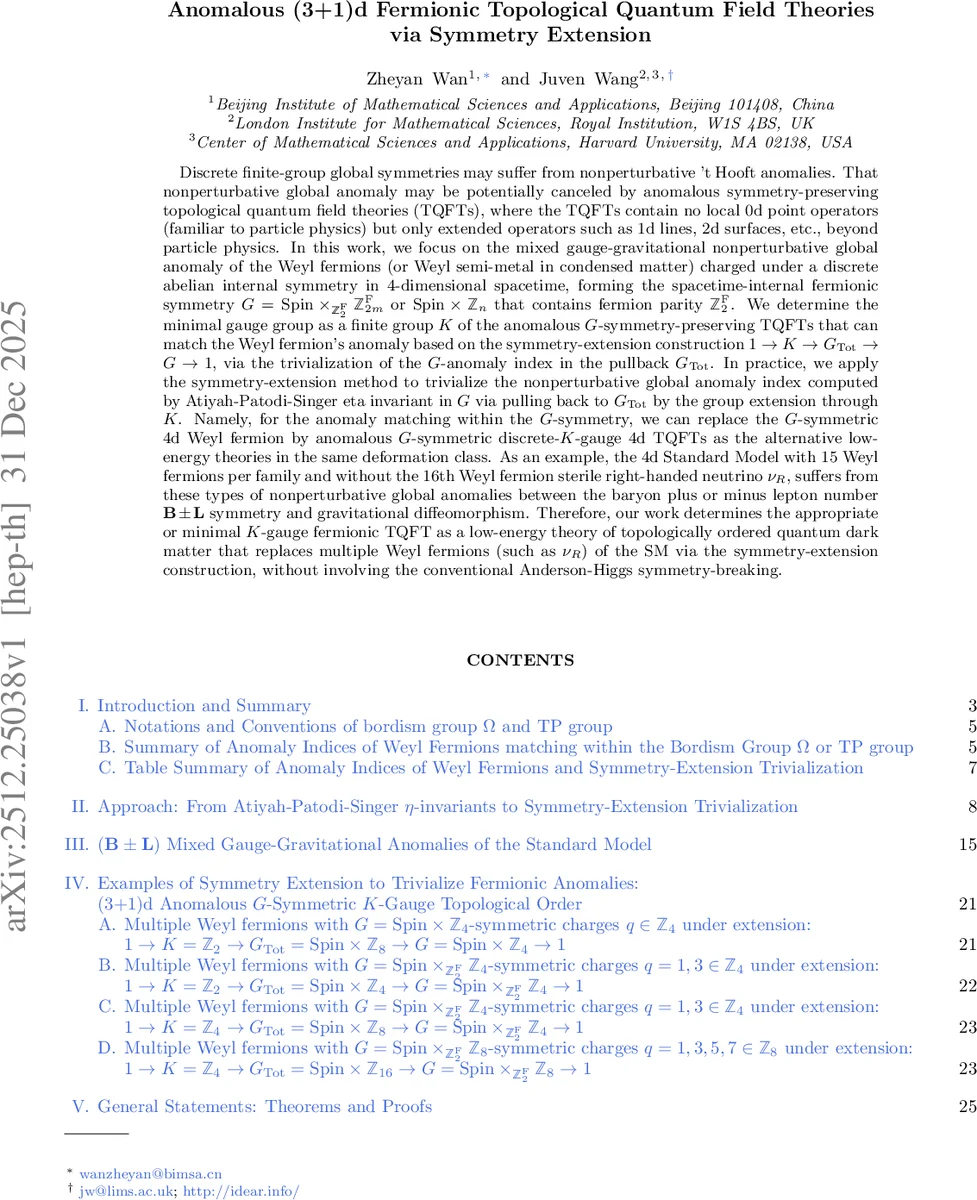
Discrete finite-group global symmetries may suffer from nonperturbative ’t-Hooft anomalies. Such global anomalies can be canceled by anomalous symmetry-preserving topological quantum field theories (TQFTs), which contain no local point operators but only extended excitations such as line and surface operators. In this work, we study mixed gauge-gravitational nonperturbative global anomalies of Weyl fermions (or Weyl semimetals in condensed matter) charged under discrete Abelian internal symmetries in four-dimensional spacetime, with spacetime-internal fermionic symmetry $G=$Spin$\times_{\mathbb{Z}2^{\rm F}}\mathbb{Z}{2m}^{\rm F}$ or Spin$\times\mathbb{Z}n$ that contains fermion parity $\mathbb{Z}{2}^{\rm F}$. We determine the minimal finite gauge group $K$ of anomalous $G$-symmetric TQFTs that can match the fermionic anomaly via the symmetry-extension construction $1 \to K \to G_{\rm Tot} \to G \to 1$, where the anomaly in $G$ is trivialized upon pullback to $G_{\rm Tot}$, computed by Atiyah-Patodi-Singer eta invariant. This allows one to replace a $G$-symmetric four-dimensional Weyl fermion by an anomalous $G$-symmetric discrete-$K$-gauge TQFT as an alternative low-energy theory in the same deformation class. As an application, we show that the four-dimensional Standard Model with 15 Weyl fermions per family, in the absence of a sterile right-handed neutrino $ν_R$, exhibits mixed gauge-gravitational global anomalies between baryon and lepton number symmetries $({\bf B \pm L})$ and spacetime diffeomorphisms. We identify the corresponding minimal $K$-gauge fermionic TQFT that cancels these anomalies and can be interpreted as a gapped, topologically ordered dark sector replacing missing Weyl fermions via symmetry extension, without invoking conventional Anderson-Higgs symmetry breaking.
💡 Research Summary
The paper investigates non‑perturbative ’t Hooft global anomalies that arise for Weyl fermions (or Weyl semimetals) in four‑dimensional spacetime when the fermions are charged under discrete Abelian internal symmetries. The authors focus on spacetime‑internal fermionic symmetry groups of the form
(G = \mathrm{Spin}\times_{\mathbb Z_2^{F}}\mathbb Z_{2m}^{F}) or (G = \mathrm{Spin}\times\mathbb Z_n),
where the fermion‑parity (\mathbb Z_2^{F}) is a subgroup of the total symmetry. Such anomalies cannot be cancelled by ordinary perturbative counterterms; instead they must be matched by an anomalous, symmetry‑preserving topological quantum field theory (TQFT) that contains only extended operators (lines, surfaces) and no local point operators.
The authors adopt the symmetry‑extension framework: one seeks a finite gauge group (K) and an enlarged symmetry (G_{\rm Tot}) fitting into an exact sequence
(1\to K\to G_{\rm Tot}\to G\to 1).
The key requirement is that the anomaly class (\nu_G\in \mathrm{TP}{5}(G)) (the Freed‑Hopkins group classifying 4‑d fermionic anomalies) becomes trivial when pulled back to (G{\rm Tot}): (r^{*}\nu_G=0\in \mathrm{TP}{5}(G{\rm Tot})). The anomaly class is computed via the Atiyah‑Patodi‑Singer η‑invariant on a 5‑dimensional spin manifold equipped with a (G)‑bundle. Because (\mathrm{TP}_{5}(G)) for the groups under study is purely torsion, the problem reduces to analyzing the torsion part of the spin bordism groups (\Omega^{\rm Spin}_5(BG)).
The paper provides explicit calculations of (\Omega^{\rm Spin}5(B\mathbb Z{2^p\cdot3^r\cdot s})) and (\Omega^{\rm Spin}5(B\mathbb Z{2^p\cdot3^r\cdot s})) for generic factorizations of the discrete symmetry. The results show that the bordism groups decompose into direct sums of (\mathbb Z_{2^{p\pm k}}), (\mathbb Z_{3^{r\pm 1}}) and (\mathbb Z_{s}) factors, giving rise to two independent anomaly invariants (\tilde a_m,\tilde b_m) (for the (\mathbb Z_{2m}^{F}) case) or (a_n,b_n) (for the plain (\mathbb Z_n) case). These invariants are linear combinations of the cubic and linear powers of the charge (q) of the Weyl fermions, reproducing known results for continuous (U(1)) anomalies when reduced appropriately.
Armed with these indices, the authors systematically construct minimal extensions. For example, with (G=\mathrm{Spin}\times\mathbb Z_4) and two Weyl fermions of charge (q=1), the anomaly is cancelled by extending to (G_{\rm Tot}=\mathrm{Spin}\times\mathbb Z_8) with kernel (K=\mathbb Z_2). More generally, they list families of extensions:
- (1\to \mathbb Z_2\to \mathrm{Spin}\times\mathbb Z_{2^{k+1}}\to \mathrm{Spin}\times\mathbb Z_{2^{k}}\to1),
- (1\to \mathbb Z_4\to \mathrm{Spin}\times\mathbb Z_{2^{k+2}}\to \mathrm{Spin}\times\mathbb Z_{2^{k+1}}^{F}\to1), and analogous constructions for mixed (\mathbb Z_{2^p}\times\mathbb Z_{3^r}) groups. In each case the pull‑back of the original anomaly class vanishes, guaranteeing that a symmetric, anomalous TQFT based on a discrete (K)‑gauge theory can replace the original Weyl fermion sector without breaking the symmetry.
A particularly compelling application is to the Standard Model (SM) without right‑handed neutrinos. The SM with 15 Weyl fermions per generation suffers from a mixed gauge‑gravitational anomaly between the baryon‑plus‑or‑minus‑lepton number symmetries ((B\pm L)) and diffeomorphisms. The anomaly coefficient is (-N_f+n_{\nu_R}= -3) (for three generations and no sterile neutrinos). By employing the symmetry‑extension method, the authors identify a minimal kernel (K=\mathbb Z_4) (or (\mathbb Z_2) in certain variants) that trivializes the anomaly. The resulting low‑energy theory is a 4‑d fermionic TQFT with a discrete gauge group (K), interpreted as a gapped, topologically ordered “dark sector”. This sector carries the missing anomaly charge and thus can be viewed as a topological replacement for the absent right‑handed neutrinos, all while preserving the full SM gauge and global symmetry structure—no Anderson‑Higgs mechanism is required.
The paper also discusses constraints: certain anomalies cannot be matched by any symmetric TQFT (the “no‑go” theorems of Cordova‑Ohmori). The authors delineate which torsion classes admit a symmetry‑extension solution and which do not, providing rigorous proofs for 2‑torsion, 3‑torsion, and more general s‑torsion cases.
In summary, the work achieves three major goals:
- It computes the full set of non‑perturbative mixed gauge‑gravitational anomalies for Weyl fermions with discrete internal symmetries using the APS η‑invariant and spin bordism theory.
- It establishes a systematic symmetry‑extension algorithm that identifies the minimal finite gauge group (K) needed to trivialize any given anomaly class.
- It applies the framework to realistic particle‑physics models, notably the SM, showing how a topologically ordered dark sector can replace missing fermionic degrees of freedom while maintaining all global symmetries.
The results open a pathway to constructing and classifying anomalous (3+1)‑d fermionic TQFTs, with potential implications for both high‑energy theory (anomaly matching, beyond‑Standard‑Model physics) and condensed‑matter systems (Weyl semimetals, symmetry‑enriched topological orders).
Comments & Academic Discussion
Loading comments...
Leave a Comment