📝 Original Info
- Title: The Agentic Leash: Extracting Causal Feedback Fuzzy Cognitive Maps with LLMs
- ArXiv ID: 2601.00097
- Date: 2025-12-31
- Authors: Researchers from original ArXiv paper
📝 Abstract
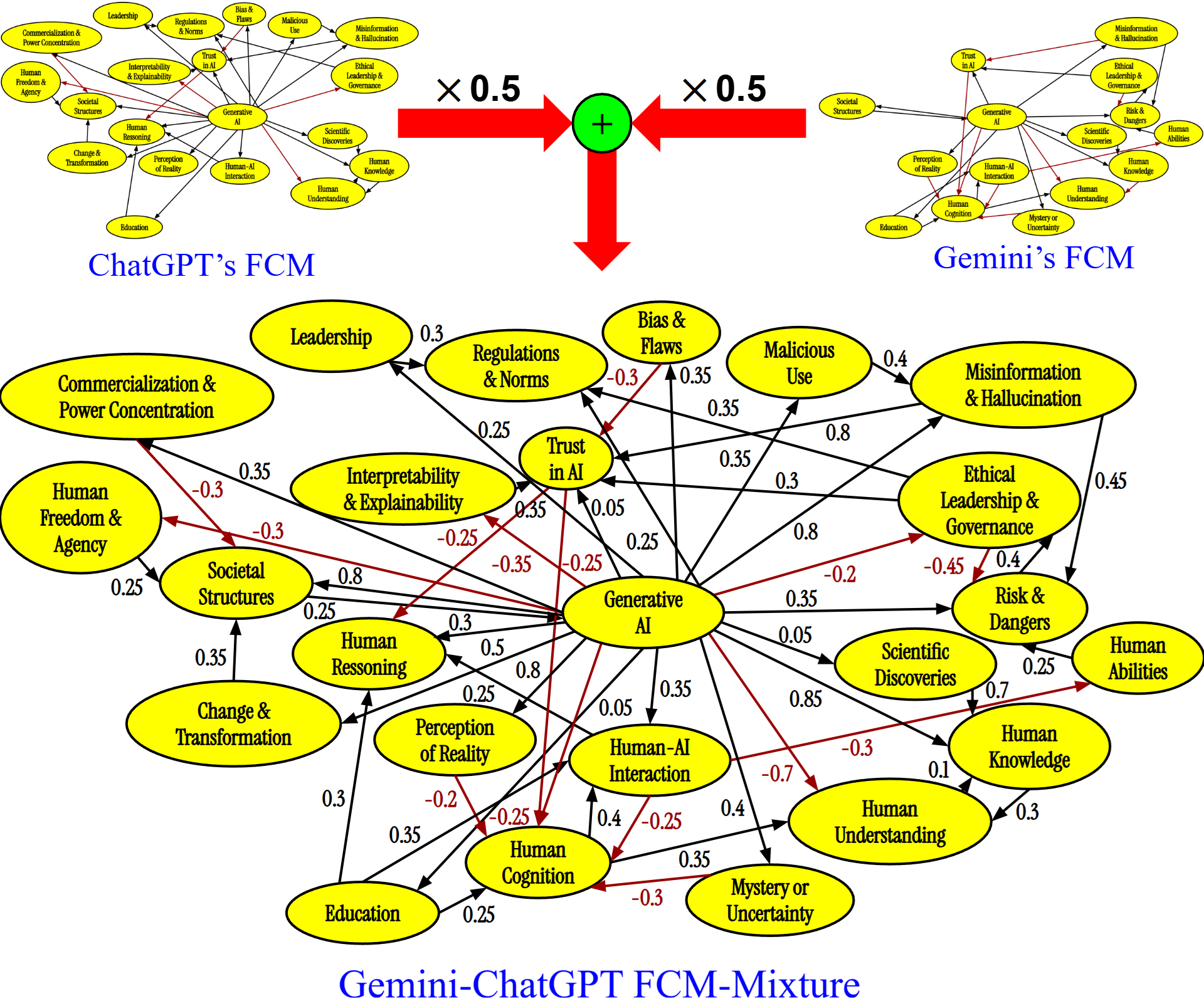
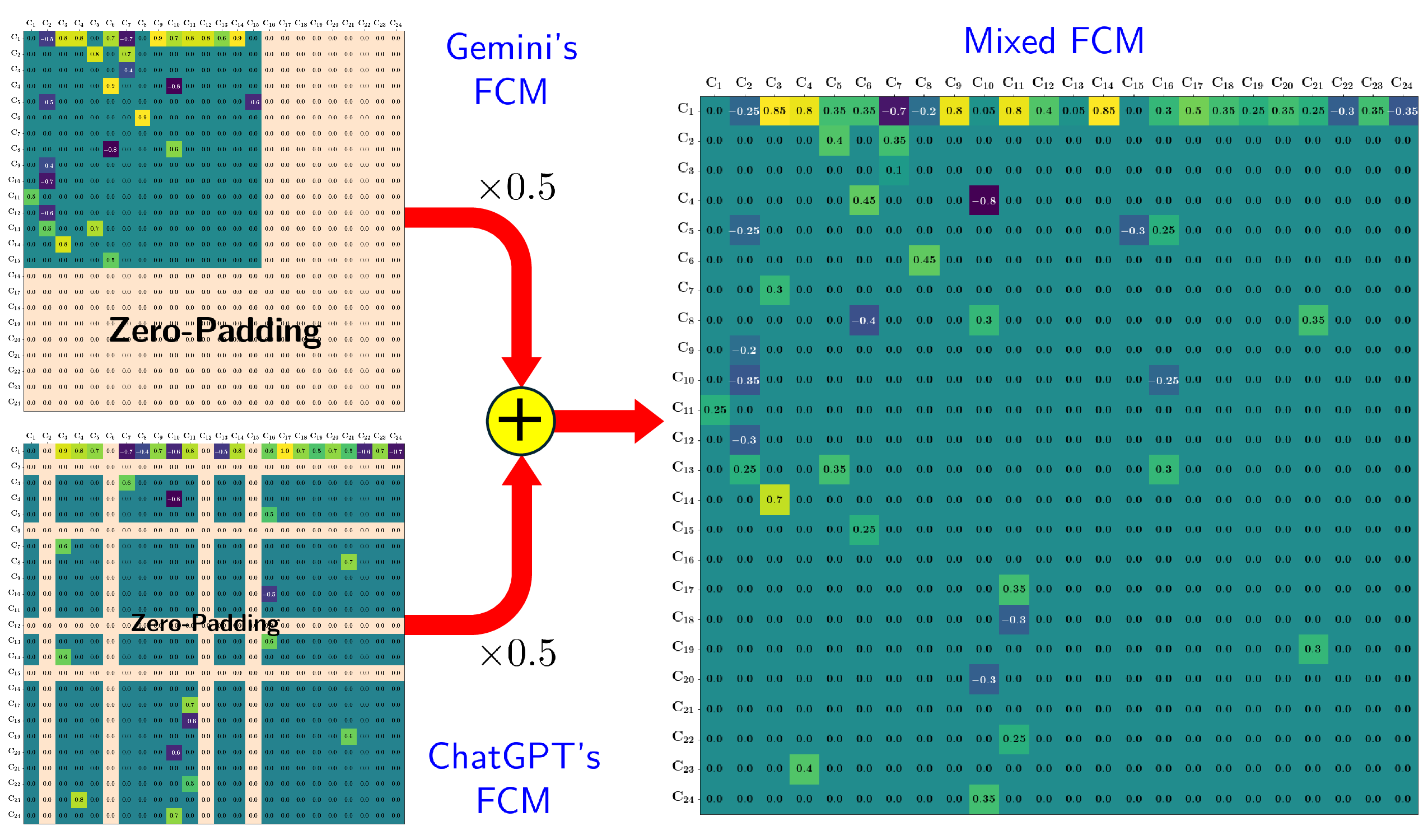
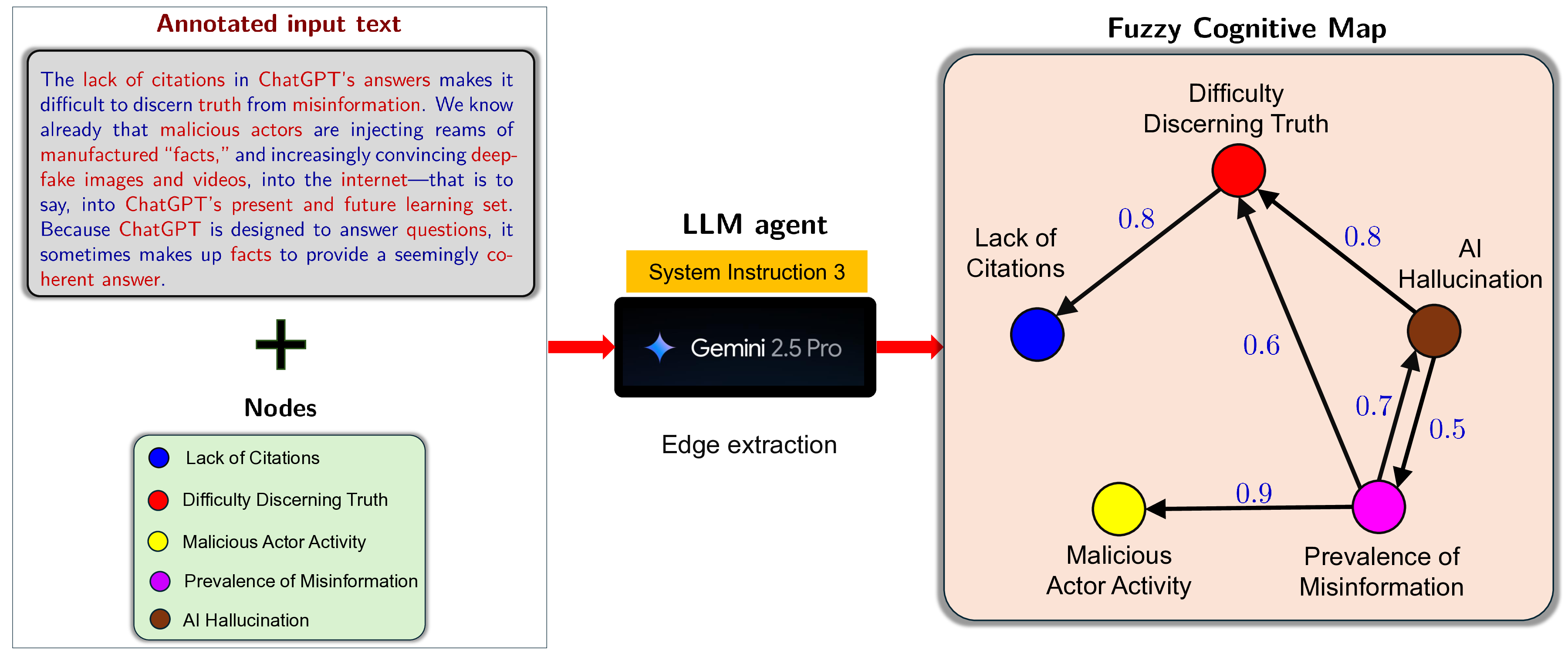
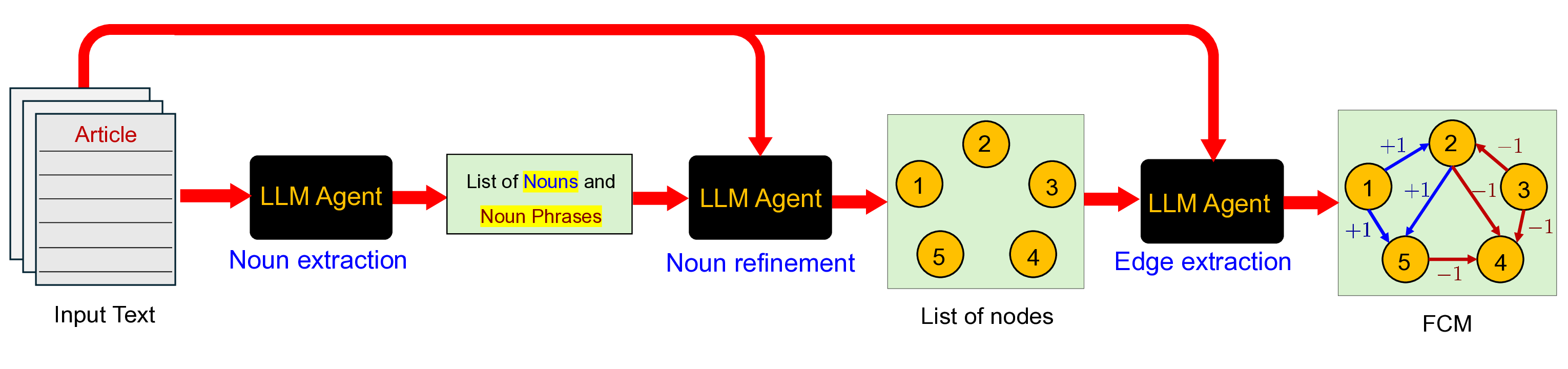
We design a large-language-model (LLM) agent that extracts causal feedback fuzzy cognitive maps (FCMs) from raw text. The causal learning or extraction process is agentic both because of the LLM's semiautonomy and because ultimately the FCM dynamical system's equilibria drive the LLM agents to fetch and process causal text. The fetched text can in principle modify the adaptive FCM causal structure and so modify the source of its quasi-autonomy-its equilibrium limit cycles and fixed-point attractors. This bidirectional process endows the evolving FCM dynamical system with a degree of autonomy while still staying on its agentic leash. We show in particular that a sequence of three finely tuned system instructions guide an LLM agent as it systematically extracts key nouns and noun phrases from text, as it extracts FCM concept nodes from among those nouns and noun phrases, and then as it extracts or infers partial or fuzzy causal edges between those FCM nodes. We test this FCM generation on a recent essay about the promise of AI from the late diplomat and political theorist Henry Kissinger and his colleagues. This three-step process produced FCM dynamical systems that converged to the same equilibrium limit cycles as did the humangenerated FCMs even though the human-generated FCM differed in the number of nodes and edges. A final FCM mixed generated FCMs from separate Gemini and ChatGPT LLM agents. The mixed FCM absorbed the equilibria of its dominant mixture component but also created new equilibria of its own to better approximate the underlying causal dynamical system.
💡 Deep Analysis
Deep Dive into The Agentic Leash: Extracting Causal Feedback Fuzzy Cognitive Maps with LLMs.
We design a large-language-model (LLM) agent that extracts causal feedback fuzzy cognitive maps (FCMs) from raw text. The causal learning or extraction process is agentic both because of the LLM’s semiautonomy and because ultimately the FCM dynamical system’s equilibria drive the LLM agents to fetch and process causal text. The fetched text can in principle modify the adaptive FCM causal structure and so modify the source of its quasi-autonomy-its equilibrium limit cycles and fixed-point attractors. This bidirectional process endows the evolving FCM dynamical system with a degree of autonomy while still staying on its agentic leash. We show in particular that a sequence of three finely tuned system instructions guide an LLM agent as it systematically extracts key nouns and noun phrases from text, as it extracts FCM concept nodes from among those nouns and noun phrases, and then as it extracts or infers partial or fuzzy causal edges between those FCM nodes. We test this FCM generation o
📄 Full Content
The Agentic Leash: Extracting Causal Feedback
Fuzzy Cognitive Maps with Mixed Large
Language Models
Akash Kumar Panda1, Olaoluwa Adigun2, and Bart Kosko3
1 University of Southern California, Los Angeles, CA 90007, USA
akashpan@usc.edu
2 Florida International University, Miami, FL 33199, USA
olaadigu@fiu.edu
3 University of Southern California, Los Angeles, CA 90007, USA
kosko@usc.edu
Abstract. We design a large-language-model (LLM) agent that extracts
causal feedback fuzzy cognitive maps (FCMs) from raw text. The causal
learning or extraction process is agentic both because of the LLM’s semi-
autonomy and because ultimately the FCM dynamical system’s equilib-
ria drive the LLM agents to fetch and process causal text. The fetched
text can in principle modify the adaptive FCM causal structure and so
modify the source of its quasi-autonomy–its equilibrium limit cycles and
fixed-point attractors. This bidirectional process endows the evolving
FCM dynamical system with a degree of autonomy while still staying
on its agentic leash. We show in particular that a sequence of three
finely tuned system instructions guide an LLM agent as it systemati-
cally extracts key nouns and noun phrases from text, as it extracts FCM
concept nodes from among those nouns and noun phrases, and then as
it extracts or infers partial or fuzzy causal edges between those FCM
nodes. We test this FCM generation on a recent essay about the promise
of AI from the late diplomat and political theorist Henry Kissinger and
his colleagues. This three-step process produced FCM dynamical systems
that converged to the same equilibrium limit cycles as did the human-
generated FCMs even though the human-generated FCM differed in the
number of nodes and edges. A final FCM mixed generated FCMs from
separate Gemini and ChatGPT LLM agents. The mixed FCM absorbed
the equilibria of its dominant mixture component but also created new
equilibria of its own to better approximate the underlying causal dynam-
ical system.
Keywords: fuzzy cognitive maps · causal reasoning · agentic LLMs
1
The Agentic Leash: Growing Fuzzy Cognitive Map
Dynamical Systems from Text
We show how agentic passes through structured LLM agents can grow causal
feedback fuzzy cognitive maps (FCM) from sampled text documents.
arXiv:2601.00097v2 [cs.AI] 14 Jan 2026
2
P. Akash et al.
These causal FCM feedback dynamical systems form local fuzzy or partial
causal rules from the sampled documents. This local causal structure in turn
defines global equilibrium limit cycles that serve as scenario-like answers to
causal what-if questions. They also define the very source of the FCM dynam-
ical system’s agency – its evolving equilibrium limit cycles. This differs from
ordinary feedforward agentic systems whose agency resides only in programmed
commands. Mixing FCMs can give both richer learned causal knowledge bases
and richer global equilibria. The extraction process is agentic [1] or partially
autonomous because the FCM’s evolving global equilibria command the LLM
agents to fetch and process further text that then tends to change the command-
ing FCM equilibria. Related work uses an autoencoder-like mapping to convert
FCMs to text and continue the reverberatory process [13]. This bidirectional
process keeps the FCM’s LLM agents on a type of flexible agentic leash.
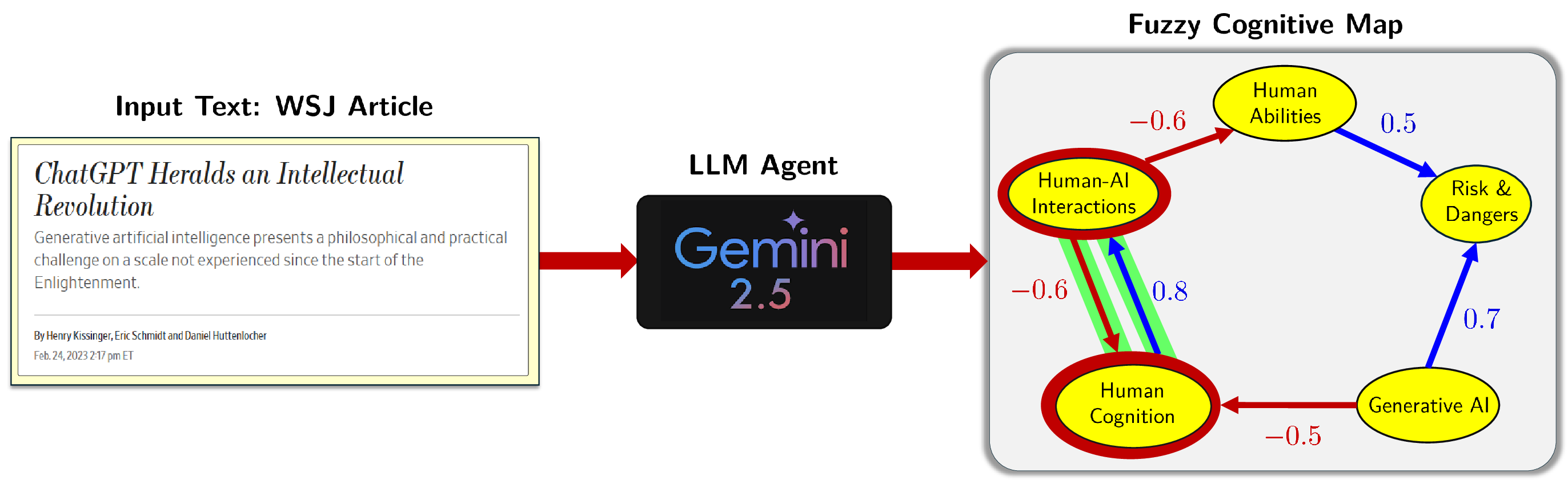
Fig. 1: A Large Language Model (LLM) extracts causal variables and their causal re-
lationships out of a Wall Street Journal article from Henry Kissinger and colleagues
about the promise of AI and then creates a Fuzzy Cognitive Map (FCM). The figure
shows only 5 out of the 15 AI-extracted nodes and the directed weighted edges that
connect them. The positive edges are in blue and the negative edges are in red. The
figure highlights one of many feedback loops in the FCM in green. In this case: Growth
of Human Cognition increases Human-AI Interactions but an increase in Human-AI
Interactions decreases Human Cognition.
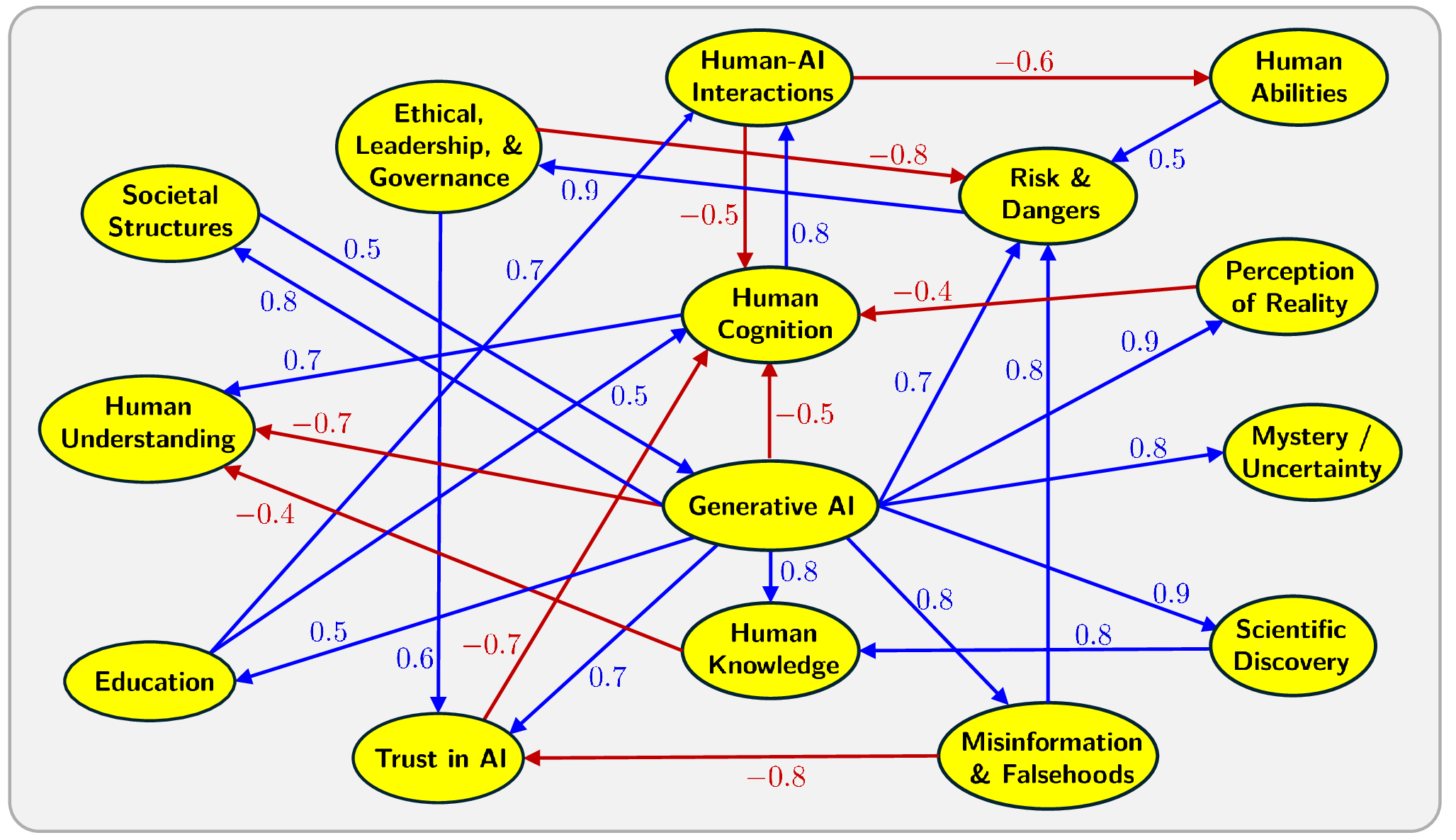
Figure 1 shows a feedback causal sub-network of the complete 15-node FCM
in Figure 2. An LLM agent grew the complete FCM from a recent AI article
titled “ChatGPT Heralds an Intellectual Revolution” by Henry Kissinger et al.
in the Wall Street Journal [8]. The green highlight shows just one embedded
feedback loop that traces the causal flow from Human-AI Interaction to Human
Cognition and then back to itself: Human-AI Interaction →Human Cognition
→Human-AI Interaction. Here “→” denotes a negative edge and “→” denotes
a positive edge. Even this smaller 5-node sub-FCM encodes equilibrium limit
cycles that can serve as answers to what-if questions. Figure 7 below shows this
process for a simpler FCM.
These learned FCM knowledge graphs consist of local causal rules. The rules
give an immediate local form of interpretability or explainable AI (XAI) [2,4,6,
Agentic Learning of Feedback Causal FCMs with LLM Agents
3
Fig. 2: A 15-node FCM extracted by the LLM from the WSJ article titled “ChatGPT Heralds an
Intellectual Revolution” by Henry Kissi
…(Full text truncated)…
📸 Image Gallery
Reference
This content is AI-processed based on ArXiv data.