Bisplit graphs -- A Structural and algorithmic study
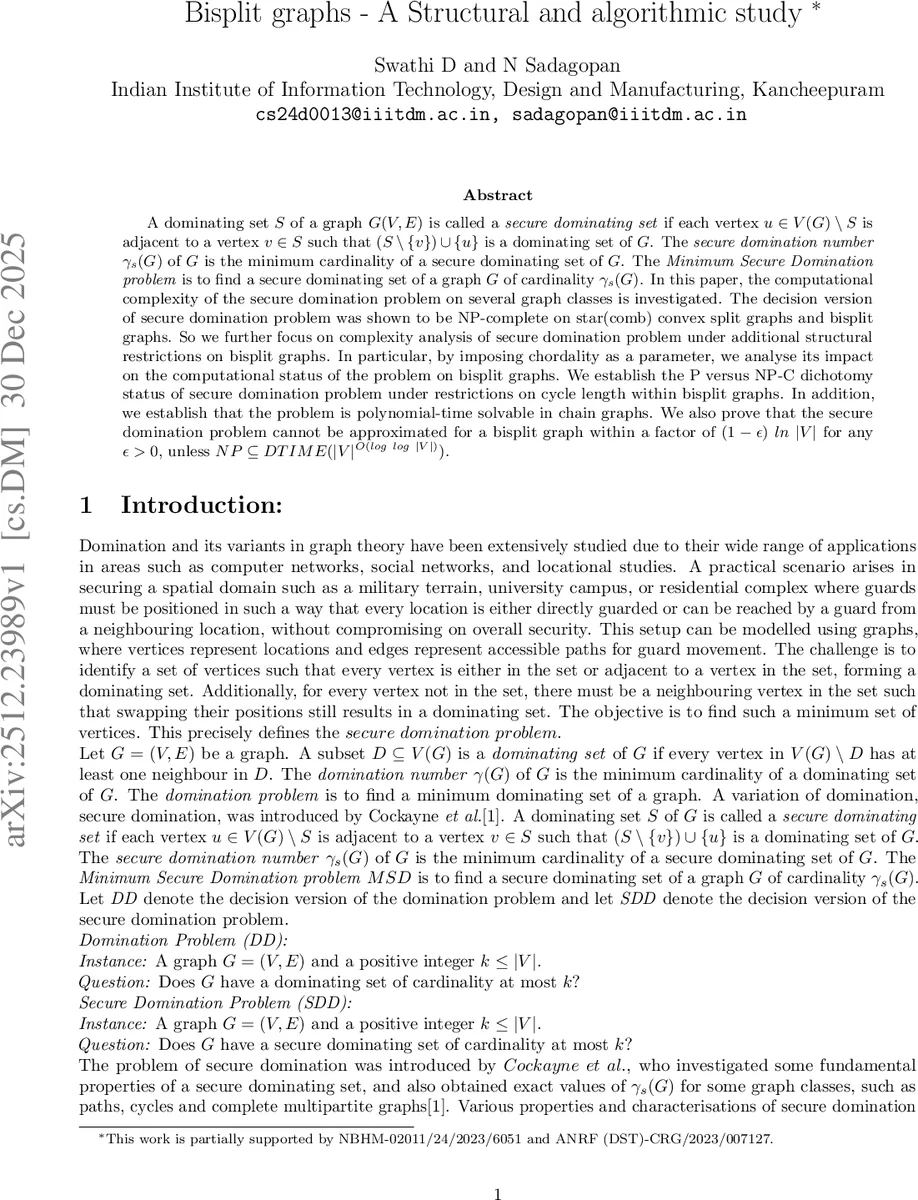
A dominating set $S$ of a graph $G(V,E)$ is called a \textit{secure dominating set} if each vertex $u \in V(G) \setminus S$ is adjacent to a vertex $v \in S$ such that $(S \setminus {v}) \cup {u}$ is a dominating set of $G$. The \textit{secure domination number} $γ_s(G)$ of $G$ is the minimum cardinality of a secure dominating set of $G$. The \textit{Minimum Secure Domination problem} is to find a secure dominating set of a graph $G$ of cardinality $γ_s(G)$. In this paper, the computational complexity of the secure domination problem on several graph classes is investigated. The decision version of secure domination problem was shown to be NP-complete on star(comb) convex split graphs and bisplit graphs. So we further focus on complexity analysis of secure domination problem under additional structural restrictions on bisplit graphs. In particular, by imposing chordality as a parameter, we analyse its impact on the computational status of the problem on bisplit graphs. We establish the P versus NP-C dichotomy status of secure domination problem under restrictions on cycle length within bisplit graphs. In addition, we establish that the problem is polynomial-time solvable in chain graphs. We also prove that the secure domination problem cannot be approximated for a bisplit graph within a factor of $(1-ε)ln|V|$ for any $ε> 0$, unless $NP \subseteq DTIME(|V|^{O(loglog|V|)})$.
💡 Research Summary
The paper investigates the computational complexity of the Secure Domination problem (SDD) on bisplit graphs and several of their subclasses. A secure dominating set (SDS) is a dominating set D such that for every vertex u∉D there exists a neighbor v∈D with the property that swapping u for v (i.e., (D{v})∪{u}) still yields a dominating set. The minimum size of such a set is denoted γₛ(G). While the ordinary domination problem (DD) is well‑known to be NP‑complete, the authors focus on how this hardness propagates to the more constrained secure version when the underlying graph belongs to specific families.
Main Contributions
-
NP‑Completeness on Bisplit Graphs
A bisplit graph is defined by a partition V = X ∪ Y ∪ Z where X, Y, Z are independent sets and Y∪Z induces a complete bipartite subgraph (a biclique). The authors reduce the known NP‑complete domination problem on bisplit graphs to SDD on bisplit graphs by adding a 4‑vertex path (x–y–z–x′) and carefully connecting it to the original parts. The resulting graph G* remains a bisplit graph, and they prove a tight correspondence: a dominating set D of size ≤k in G exists iff a secure dominating set D* of size ≤k+2 exists in G*. This establishes that SDD is NP‑complete for bisplit graphs. -
Structural Restrictions and Algorithmic Dichotomies
- Chordal Bisplit Graphs: When the bisplit graph is chordal (no induced cycles of length ≥4), the authors present a polynomial‑time algorithm based on tree‑decomposition and dynamic programming.
- Chordal Bipartite Bisplit Graphs: Adding the bipartite restriction does not alleviate hardness; the problem remains NP‑complete, showing that chordality alone is insufficient.
- Chain Graphs: For chain graphs (a subclass of bipartite graphs where the neighborhoods of vertices on one side are nested), they devise a linear‑time greedy algorithm that yields an optimal secure dominating set. The key observation is that the secure domination condition reduces to selecting a minimal set of consecutive intervals.
- Bounded Tree‑Width: Extending known results for domination, they show that when the tree‑width is bounded, SDD can be solved in linear time using dynamic programming over a tree decomposition.
-
Inapproximability
The paper proves that for bisplit graphs no polynomial‑time algorithm can achieve an approximation factor better than (1‑ε)·ln|V| for any ε>0 unless NP ⊆ DTIME(|V|^{O(log log |V|)}). The proof is a gap‑preserving reduction from Set Cover, transferring the classic logarithmic hardness of approximation to the secure domination setting. -
Additional Observations
- The authors note that the secure domination number is tightly linked to the structure of the closed neighborhoods of vertices in the dominating set; each vertex’s induced subgraph on its closed neighborhood must be a clique.
- They also discuss how the results fit into the broader landscape: while SDD is linear on trees, cographs, and proper interval graphs, the bisplit class demonstrates that even modest extensions of bipartite or split structures can re‑introduce full NP‑hardness.
Implications and Future Work
The study provides a comprehensive map of where the secure domination problem is tractable and where it remains intractable within the bisplit family. Practically, this informs algorithm designers for security‑oriented placement problems (e.g., guard deployment, sensor placement) about which network topologies admit efficient exact solutions. The authors suggest several avenues for further research: exploring parameterized algorithms with respect to the size of X, investigating approximation schemes for restricted subclasses, and extending the analysis to other hybrid graph classes such as perfect graphs or line graphs.
Overall, the paper makes a significant contribution by pinpointing the exact boundary between polynomial‑time solvability and NP‑completeness for secure domination in bisplit graphs, enriching both theoretical understanding and practical algorithm design.
Comments & Academic Discussion
Loading comments...
Leave a Comment