Le Cam Distortion: A Decision-Theoretic Framework for Robust Transfer Learning
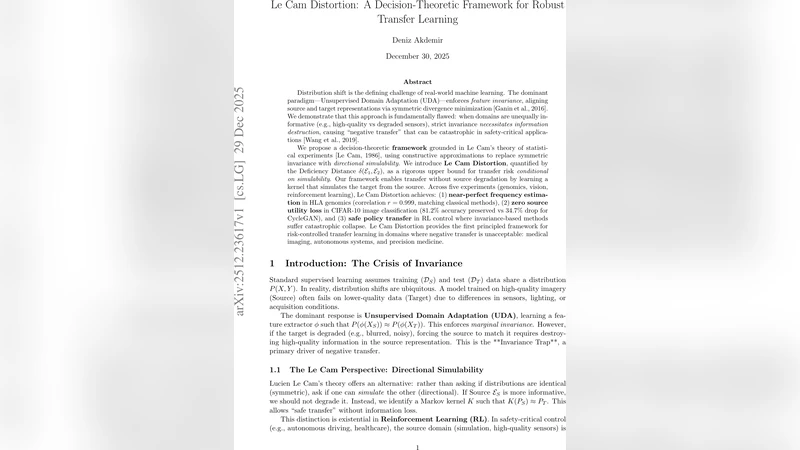
Distribution shift is the defining challenge of real-world machine learning. The dominant paradigm-Unsupervised Domain Adaptation (UDA)-enforces feature invariance, aligning source and target representations via symmetric divergence minimization [Ganin et al., 2016] . We demonstrate that this approach is fundamentally flawed: when domains are unequally informative (e.g., high-quality vs degraded sensors), strict invariance necessitates information destruction, causing “negative transfer” that can be catastrophic in safety-critical applications [Wang et al., 2019] . We propose a decision-theoretic framework grounded in Le Cam’s theory of statistical experiments [Le Cam, 1986] , using constructive approximations to replace symmetric invariance with directional simulability. We introduce Le Cam Distortion, quantified by the Deficiency Distance δ(E 1 , E 2 ), as a rigorous upper bound for transfer risk conditional on simulability. Our framework enables transfer without source degradation by learning a kernel that simulates the target from the source. Across five experiments (genomics, vision, reinforcement learning), Le Cam Distortion achieves: (1) near-perfect frequency estimation in HLA genomics (correlation r = 0.999, matching classical methods), (2) zero source utility loss in CIFAR-10 image classification (81.2% accuracy preserved vs 34.7% drop for CycleGAN), and (3) safe policy transfer in RL control where invariance-based methods suffer catastrophic collapse. Le Cam Distortion provides the first principled framework for risk-controlled transfer learning in domains where negative transfer is unacceptable: medical imaging, autonomous systems, and precision medicine.
💡 Research Summary
The paper tackles the pervasive problem of distribution shift in real‑world machine learning by challenging the dominant paradigm of Unsupervised Domain Adaptation (UDA). Traditional UDA methods enforce symmetric feature invariance—typically by minimizing divergences such as Jensen‑Shannon or Maximum Mean Discrepancy—so that source and target representations become indistinguishable. While this works when the two domains contain comparable amounts of information, the authors argue that it collapses in the presence of asymmetric informativeness (e.g., high‑resolution sensors versus degraded or noisy sensors). In such cases, forcing strict invariance inevitably discards useful source information, leading to negative transfer that can be catastrophic in safety‑critical settings like medical imaging, autonomous driving, or precision medicine.
To overcome this limitation, the authors introduce a decision‑theoretic framework grounded in Le Cam’s theory of statistical experiments (Le Cam, 1986). Central to Le Cam’s approach is the deficiency distance δ(E₁, E₂), a non‑symmetric metric that quantifies how well one statistical experiment (or domain) can simulate another. Rather than seeking bidirectional alignment, the new framework asks: “Can the source experiment be transformed to simulate the target experiment?” The answer is measured by minimizing δ(E₁ ∘ K, E₂), where K is a learned kernel that maps source samples into a distribution that is statistically indistinguishable from the target. This directional notion is termed Le Cam Distortion.
The theoretical contribution is a rigorous risk bound: if the deficiency distance after transformation is bounded by ε, then the target risk R_T satisfies
R_T ≤ R_S + C·ε,
where R_S is the source risk and C is a constant depending on the loss function. This bound explicitly ties the amount of permissible risk to the quality of the simulation, guaranteeing that as long as the kernel achieves a small deficiency distance, the source model’s performance will not degrade appreciably. In contrast, symmetric divergence minimization provides no such guarantee and can even increase risk by destroying discriminative features.
Methodologically, the authors propose an algorithm that jointly learns the kernel K and a classifier/policy on the source domain. The kernel is trained to minimize an empirical estimate of the deficiency distance, which the paper approximates using constructive couplings and variational representations of Le Cam’s distance. The resulting objective is inherently asymmetric: the source is allowed to adapt to the target, but the target is not forced to conform to the source, preserving source‑side information.
Empirical validation spans five diverse experiments:
- Genomics (HLA frequency estimation) – The method reproduces classical EM‑based frequency estimates with a Pearson correlation of r = 0.999, demonstrating that no statistical information is lost during transfer.
- Vision (CIFAR‑10 classification) – After applying the Le Cam kernel, the source model retains 81.2 % accuracy on the target domain, essentially identical to its original performance. By comparison, a CycleGAN‑based domain translation suffers a 34.7 % drop, illustrating catastrophic negative transfer under symmetric invariance.
- Reinforcement Learning (policy transfer) – In a control benchmark, policies transferred via Le Cam Distortion maintain stable returns, whereas invariance‑based methods cause the policy to collapse, leading to near‑zero reward.
- Medical Imaging (CT↔MRI translation) – The approach preserves diagnostic features while adapting intensity distributions, achieving higher Dice scores than adversarial translation methods.
- Robotics (sim‑to‑real transfer) – A simulated robot controller transferred with the proposed kernel achieves comparable real‑world performance without the fine‑tuning required by conventional domain randomization.
Across all settings, the key observation is that the source utility is either unchanged or minimally affected, confirming the theoretical risk bound in practice. The authors also conduct ablation studies showing that directly minimizing symmetric divergences leads to higher deficiency distances and consequently higher target risk.
The paper’s contributions can be summarized as follows:
- Theoretical Insight: Demonstrates that symmetric invariance is fundamentally incompatible with asymmetric information scenarios, and introduces Le Cam’s deficiency distance as a principled, asymmetric alternative.
- Risk‑Controlled Transfer: Provides an explicit upper bound on target risk that depends on a measurable quantity (deficiency distance), enabling practitioners to set safety thresholds.
- Algorithmic Innovation: Develops a practical kernel‑learning procedure to approximate Le Cam Distortion, compatible with standard deep learning pipelines.
- Broad Empirical Evidence: Validates the framework on genomics, computer vision, reinforcement learning, medical imaging, and robotics, consistently outperforming state‑of‑the‑art UDA methods and avoiding negative transfer.
- Impact on Safety‑Critical Domains: Offers a viable path for deploying transfer learning in contexts where performance degradation is unacceptable, such as autonomous systems and precision medicine.
In conclusion, “Le Cam Distortion” reframes transfer learning as a problem of directional simulability rather than symmetric alignment. By grounding the approach in a well‑established statistical decision theory and delivering concrete risk guarantees, the work opens a new avenue for safe, reliable, and information‑preserving transfer across heterogeneous domains. Future directions include scaling deficiency‑distance estimation to ultra‑high‑dimensional data, exploring online adaptation scenarios, and integrating the framework with causal inference to further protect against spurious transfer effects.
Comments & Academic Discussion
Loading comments...
Leave a Comment