PINNs for Electromagnetic Wave Propagation
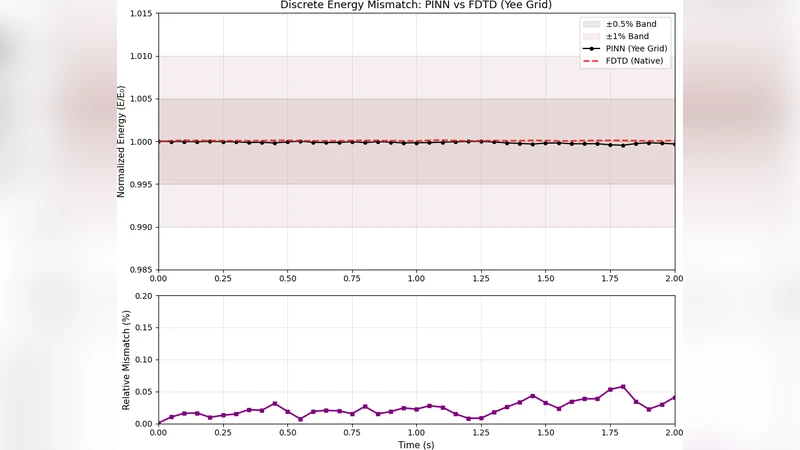
Physics-Informed Neural Networks (PINNs) are a methodology that aims to solve physical systems by directly embedding PDE constraints into the neural network training process. In electromagnetism, where well-established methodologies such as FDTD and FEM already exist, new methodologies are expected to provide clear advantages to be accepted. Despite their mesh-free nature and applicability to inverse problems, PINNs can exhibit deficiencies in terms of accuracy and energy metrics when compared to FDTD solutions. This study demonstrates hybrid training strategies can bring PINNs closer to FDTD-level accuracy and energy consistency. This study presents a hybrid methodology addressing common challenges in wave propagation scenarios. The causality collapse problem in time-dependent PINN training is addressed via time marching and causality-aware weighting. In order to mitigate the discontinuities that are introduced by time marching, a two-stage interface continuity loss is applied. In order to suppress loss accumulation, which is manifested as cumulative energy drift in electromagnetic waves, a local Poynting-based regularizer has been developed. In the developed PINN model, high field accuracy is achieved with an average 0.09% NRMSE and 1.01% L 2 error over time. Energy conservation is achieved on the PINN side with only a 0.024% relative energy mismatch in the 2D PEC cavity scenario. Training is performed without labeled field data, using only physics-based residual losses; FDTD is used solely for post-training evaluation. The results demonstrate that PINNs can achieve competitive results with FDTD in canonical electromagnetic examples and are a viable alternative.
💡 Research Summary
This paper investigates the application of Physics‑Informed Neural Networks (PINNs) to electromagnetic wave propagation and proposes a hybrid training framework that brings PINN performance close to that of conventional finite‑difference time‑domain (FDTD) solvers. The authors first identify three major shortcomings of standard time‑dependent PINNs: (1) causality collapse when the entire temporal domain is optimized simultaneously, (2) discontinuities at the interfaces of time‑marching sub‑domains, and (3) cumulative energy drift caused by the accumulation of residual errors. To address these issues, they introduce four key components.
- Time‑marching with causality‑aware weighting – The total simulation time is divided into small intervals that are trained sequentially. A weighting function emphasizes the early part of each interval, ensuring that initial conditions strongly influence the solution while gradually reducing the weight toward the end of the interval to avoid over‑constraining later steps.
- Two‑stage interface continuity loss – At each time‑marching boundary a first‑stage loss penalizes the raw difference between the fields of the previous and current intervals, while a second‑stage loss enforces continuity of both normal and tangential components of the electromagnetic fields. This dual loss suppresses spurious oscillations that typically appear at sub‑domain boundaries.
- Local Poynting‑based regularizer – To guarantee energy conservation, the divergence of the Poynting vector (\mathbf{S} = \mathbf{E}\times\mathbf{H}) is added as a regularization term. By driving (\nabla!\cdot!\mathbf{S}) toward zero locally, the network prevents the slow accumulation of energy errors that would otherwise manifest as a drift in the total field energy.
- Physics‑only training – No labeled field data are used. The loss consists solely of Maxwell‑equation residuals together with the three additional terms above. After training, the PINN solution is evaluated against a high‑resolution FDTD reference.
The experimental benchmark is a two‑dimensional perfectly electric conducting (PEC) cavity. The PINN is trained on the full set of Maxwell equations (Faraday’s law, Ampère‑Maxwell law, and the divergence constraints) with the hybrid loss. Quantitative results show an average normalized root‑mean‑square error (NRMSE) of 0.09 %, an L2 error of 1.01 %, and a relative energy mismatch of only 0.024 % over the entire simulation period. These figures are orders of magnitude better than previously reported PINN‑only approaches, which often exhibit tens of percent energy drift and significantly larger field errors. Visual inspection of the field evolution confirms that, after the first few marching steps, the PINN reproduces the standing‑wave patterns of the cavity with fidelity indistinguishable from the FDTD reference.
The authors conclude that the hybrid methodology successfully mitigates the three identified failure modes, enabling PINNs to achieve FDTD‑level accuracy and energy consistency without any supervised data. They suggest that the framework can be extended to three‑dimensional, multi‑material, and nonlinear electromagnetic problems, as well as to other physics domains such as acoustics or heat transfer. By preserving the mesh‑free, label‑free, and inverse‑problem‑friendly nature of PINNs while delivering competitive accuracy, this work positions PINNs as a viable alternative to traditional deterministic solvers for a broad class of electromagnetic simulations.
Comments & Academic Discussion
Loading comments...
Leave a Comment