Arxiv 2512.21652

Reading time: 6 minute
...

📝 Original Info

  • Title: Arxiv 2512.21652
  • ArXiv ID: 2512.21652
  • Date: 2025-12-25
  • Authors: Zi Wang, Mingkai Huang, Zhang Shi, Hongjie Hu, Lan Lan, Hui Zhang, Yan Li, Xi Hu, Qing Lu, Zongming Zhu, Qiong Yao, Yuxiang Dai, Fanwen Wang, Yinzhe Wu, Jun Lyu, Qianqian Gao, Guangming Xu, Zhenxuan Zhang, Haosen Zhang, Qing Li, Guangming Wang, Tianxing He, Lizhen Lan, Siyue Li, Le Xue, Mengting Sun, Yuntong Lyu, Junpu Hu, Jiayu Zhu, Rizwan Ahmad, Zhengyu Bu, Xianling Qian, Guanke Cai, Ruiyu Cao, Weirui Cai, Chang Xu, Yuyang Ren, Feidan Yu, Siying Ma, Ziqiang Xu, Xinran Chen, Sha Hua, Daniel Kim, Yajing Zhang, Chen Ouyang, Wenjia Bai, Jing Qin, Yucheng Yang, Daniel Rueckert, He Wang, Qian Tao, Claudia Prieto, Michael Markl, Alistair Young, Lianming Wu, Shuo Wang, Chen Qin, Mengsu Zeng, Xihong Hu, Haibo Xu, Xiaobo Qu, Hao Li, Guang Yang, Chengyan Wang

📝 Abstract

Multimodal cardiovascular magnetic resonance (CMR) imaging provides comprehensive and non-invasive insights into cardiovascular disease (CVD) diagnosis and underlying mechanisms. Despite decades of advancements, its widespread clinical adoption remains constrained by prolonged scan times and heterogeneity across medical environments. This underscores the urgent need for a generalist reconstruction foundation model for ultra-fast CMR imaging-one capable of adapting across diverse imaging scenarios and serving as the essential substrate for all downstream analyses. To enable this goal, we curate MMCMR-427K, the largest and most comprehensive multimodal CMR k-space database to date, comprising 427,465 multi-coil k-space data paired with structured metadata across 13 international centers, 12 CMR modalities, 15 scanners spanning four field strengths, and 17 CVD categories in populations across three continents. Building on this unprecedented resource, we introduce CardioMM, a generalist reconstruction foundation model capable of dynamically adapting to heterogeneous fast CMR imaging scenarios. CardioMM unifies semantic contextual understanding with physics-informed data consistency to deliver robust reconstructions across varied scanners, protocols, and patient presentations. Comprehensive evaluations demonstrate that CardioMM achieves state-of-the-art performance in the internal centers and exhibits strong zero-shot generalization to unseen external settings. Even at imaging acceleration up to 24×, CardioMM reliably preserves key cardiac phenotypes, quantitative myocardial biomarkers, and diagnostic image quality, enabling a substantial increase in CMR examination throughput without compromising clinical integrity. Together, our open-access MMCMR-427K database and CardioMM framework establish a scalable pathway toward high-throughput, high-quality, and clinically accessible multimodal CMR imaging, overcoming the long-standing barriers of slow acquisitions and real-world heterogeneity that have hindered broad clinical adoption of cardiovascular imaging. Cardiovascular diseases (CVDs) remain the leading cause of death worldwide and continue to impose a substantial burden on healthcare systems 1-3 . Multimodal cardiovascular magnetic resonance (CMR) imaging, encompassing diverse imaging

💡 Deep Analysis

Deep Dive into Arxiv 2512.21652.

Multimodal cardiovascular magnetic resonance (CMR) imaging provides comprehensive and non-invasive insights into cardiovascular disease (CVD) diagnosis and underlying mechanisms. Despite decades of advancements, its widespread clinical adoption remains constrained by prolonged scan times and heterogeneity across medical environments. This underscores the urgent need for a generalist reconstruction foundation model for ultra-fast CMR imaging-one capable of adapting across diverse imaging scenarios and serving as the essential substrate for all downstream analyses. To enable this goal, we curate MMCMR-427K, the largest and most comprehensive multimodal CMR k-space database to date, comprising 427,465 multi-coil k-space data paired with structured metadata across 13 international centers, 12 CMR modalities, 15 scanners spanning four field strengths, and 17 CVD categories in populations across three continents. Building on this unprecedented resource, we introduce CardioMM, a generalist re

📄 Full Content

However, routine CMR examinations are time-consuming (typically 30-60 minutes), forming the principal barrier preventing CMR from being integrated into time-sensitive clinical workflows 6 .

Achieving high-quality multimodal CMR imaging under high accelerations is therefore essential [10][11][12][13] . Such capability not only improves scanner throughput, patient comfort, and resilience to motion artifacts, but also facilitates richer multimodal examinations within the fixed time shots, thereby supporting comprehensive clinical decision-making 5,6,14,15 .

Conventional acceleration techniques such as parallel imaging 10,11 and compressed sensing 12,13 have been developed but remain intrinsically limited in achievable acceleration and clinically viable reconstruction times 15 . Artificial intelligence (AI)driven approaches offers both higher acceleration in acquisition and reconstruction, yet remains fragile to the substantial heterogeneity of real-world acquisitions, including variations across centers, vendors, protocols, and patient populations [15][16][17][18][19] .

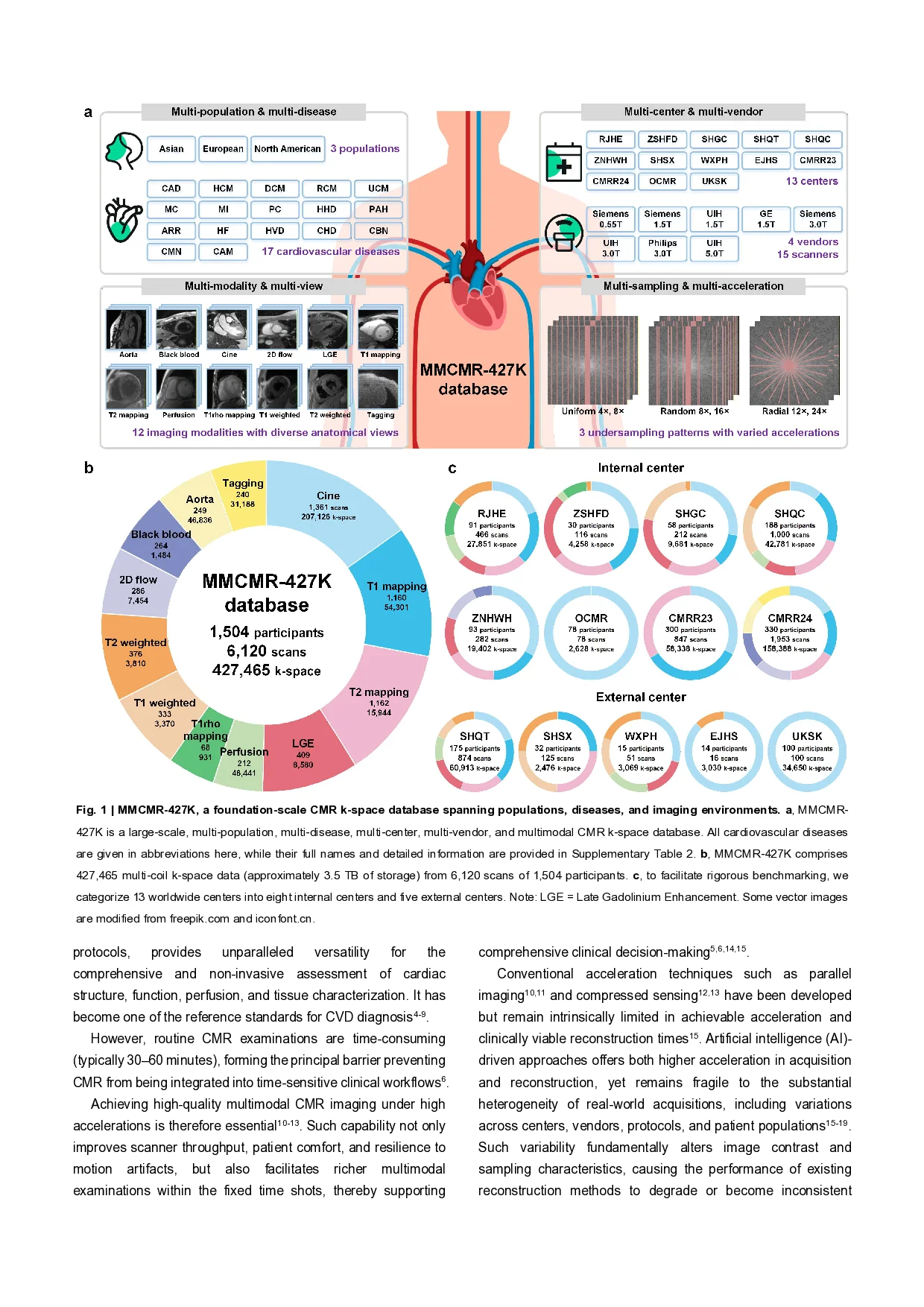
Such variability fundamentally alters image contrast and sampling characteristics, causing the performance of existing reconstruction methods to degrade or become inconsistent 427K is a large-scale, multi-population, multi-disease, multi-center, multi-vendor, and multimodal CMR k-space database. All cardiovascular diseases are given in abbreviations here, while their full names and detailed information are provided in Supplementary Table 2. b, MMCMR-427K comprises 427,465 multi-coil k-space data (approximately 3.5 TB of storage) from 6,120 scans of 1,504 participants. c, to facilitate rigorous benchmarking, we categorize 13 worldwide centers into eight internal centers and five external centers. Note: LGE = Late Gadolinium Enhancement. Some vector images are modified from freepik.com and iconfont.cn.

outside their narrow development domains.

In recent years, advances in medical AI 18,[20][21][22][23][24][25][26] have led to the development of generalist foundation models that have achieved impressive performance in post-reconstruction CMR analysis, such as segmentation, classification, and phenotyping 9,27,28 .

Nevertheless, most existing efforts focus on a limited set of CMR modalities and presuppose the availability of high-quality images.

Yet high-quality images fundamentally depend on reliable and efficient CMR acquisition and reconstruction pipelines. In this context, reliable image reconstruction for fast multimodal CMR imaging, the fundamental prerequisite for downstream analysis, remains at an early stage of investigation 29,30 .

A major bottleneck in developing reconstruction foundation models for fast multimodal CMR imaging and subsequent analysis lies in the scale and quality of data. Although several public CMR repositories [31][32][33][34][35][36][37][38] have increased in number over recent years, they are typically fragmented, restricted to specific populations, centers, vendors, CMR modalities, or diseases types, and often lack the raw k-space data and paired metadata required for clinically compatible model training, thereby restricting their usage for real-world reconstruction and analysis tasks. Addressing this gap calls for a large-scale, high-quality, standardized, and multimodal CMR k-space database with paired textual information.

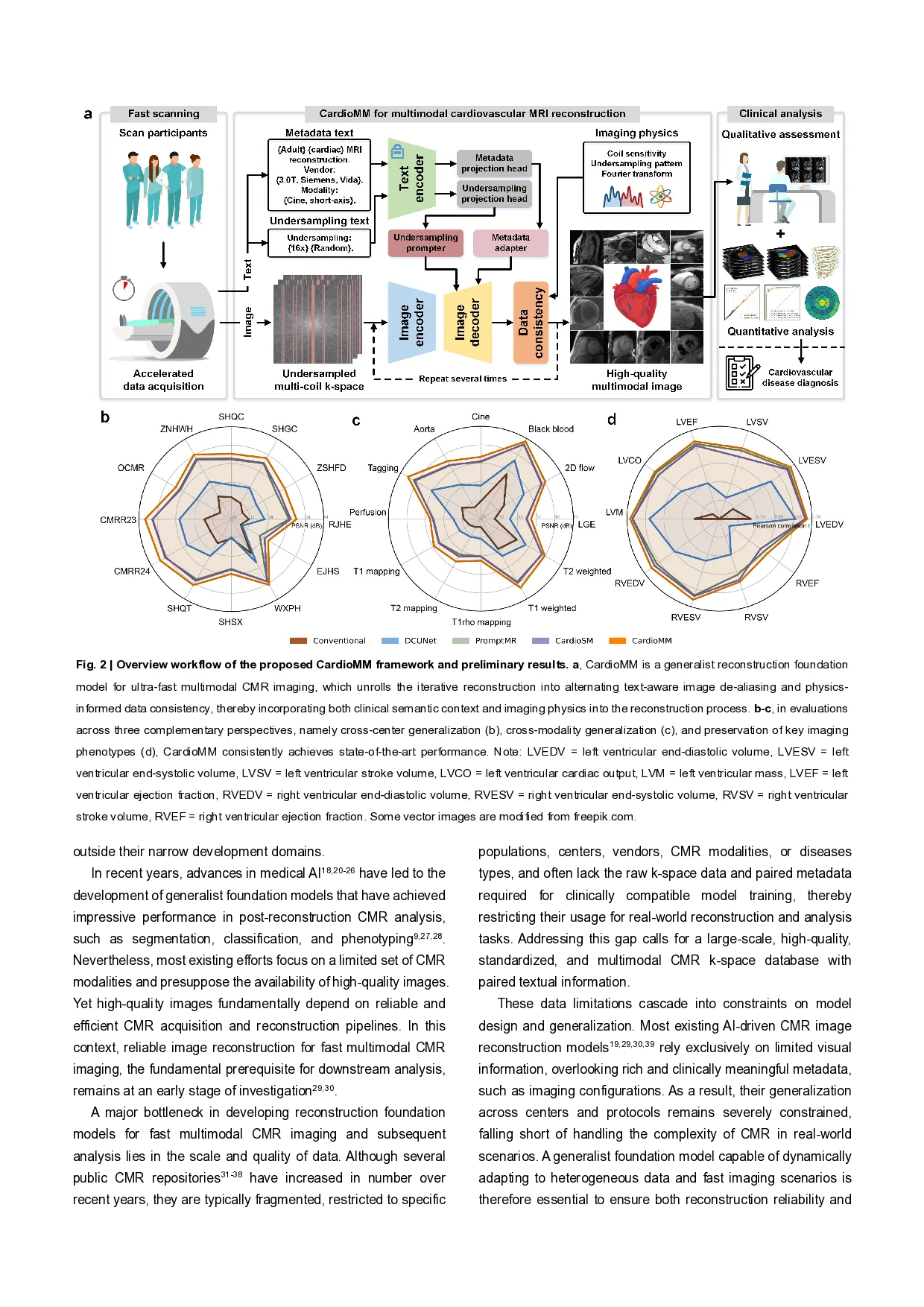
These data limitations cascade into constraints on model design and generalization. Most existing AI-driven CMR image reconstruction models 19,29,30,39 rely exclusively on limited visual information, overlooking rich and clinically meaningful metadata, such as imaging configurations. As a result, their generalization across centers and protocols remains severely constrained, falling short of handling the complexity of CMR in real-world scenarios. A generalist foundation model capable of dynamically adapting to heterogeneous data and fast imaging scenarios is therefore essential to ensure both reconstruction reliability and Beyond data and model development, robust validation remains a critical challenge. Most previous studies are confined to single center, a small number of CMR modalities, or evaluations based mainly on conventional image quality metrics, with insufficient emphasis on clinical relevance 6,29,30 . A rigorous and comprehensive evaluation strategy is required, extending beyond visual fidelity to assess diagnostic reliability through key imaging phenotypes and quantitative biomarkers, thereby fostering clinician trust and enabling meaningful clinical translation of AI-driven reconstruction.

In this work, to fill the data gap, we curate MMCMR-427K, the first large-scale, multi-population, multi-disease, multi-center, multi-vendor, and multimodal CMR k-space database (Fig. 1).

MMCMR-427K comprises 427,465 multi-coil k-space data from 6,120 scans of 1,504 participants, spanning 13 worldwide centers, 12 CMR modalities, 15 scanners with four field strengths, and 17 CVD categor

…(Full text truncated)…

📸 Image Gallery

cover.png page_2.webp page_3.webp

Reference

This content is AI-processed based on ArXiv data.

Start searching

Enter keywords to search articles

↑↓
ESC
⌘K Shortcut