📝 Original Info
- Title: A Unified Definition of Hallucination: It’s The World Model, Stupid!
- ArXiv ID: 2512.21577
- Date: 2025-12-25
- Authors: ** Emmy Liu, Varun Gangal, Chelsea Zou, Michael Yu, Xiaoqi Huang, Alex Chang, Zhuofu Tao, Karan Singh, Sachin Kumar, Steven Y. Feng **
📝 Abstract
Despite numerous attempts at mitigation since the inception of language models, hallucinations remain a persistent problem even in today's frontier LLMs. Why is this? We review existing definitions of hallucination and fold them into a single, unified definition wherein prior definitions are subsumed. We argue that hallucination can be unified by defining it as simply inaccurate (internal) world modeling, in a form where it is observable to the user. For example, stating a fact which contradicts a knowledge base OR producing a summary which contradicts the source. By varying the reference world model and conflict policy, our framework unifies prior definitions. We argue that this unified view is useful because it forces evaluations to clarify their assumed reference "world", distinguishes true hallucinations from planning or reward errors, and provides a common language for comparison across benchmarks and discussion of mitigation strategies. Building on this definition, we outline plans for a family of benchmarks using synthetic, fully specified reference world models to stress-test and improve world modeling components.
💡 Deep Analysis
Deep Dive into A Unified Definition of Hallucination: It's The World Model, Stupid!.
Despite numerous attempts at mitigation since the inception of language models, hallucinations remain a persistent problem even in today’s frontier LLMs. Why is this? We review existing definitions of hallucination and fold them into a single, unified definition wherein prior definitions are subsumed. We argue that hallucination can be unified by defining it as simply inaccurate (internal) world modeling, in a form where it is observable to the user. For example, stating a fact which contradicts a knowledge base OR producing a summary which contradicts the source. By varying the reference world model and conflict policy, our framework unifies prior definitions. We argue that this unified view is useful because it forces evaluations to clarify their assumed reference “world”, distinguishes true hallucinations from planning or reward errors, and provides a common language for comparison across benchmarks and discussion of mitigation strategies. Building on this definition, we outline pla
📄 Full Content
A Unified Definition of Hallucination: It’s The World Model, Stupid!
Emmy Liu 1 † Varun Gangal 2 † Chelsea Zou 3 † Michael Yu 4 † Xiaoqi Huang 4 † Alex Chang 4 †
Zhuofu Tao 4 † Karan Singh 3 † Sachin Kumar 5 † Steven Y. Feng 3 †
Abstract
Despite numerous attempts at mitigation since the
inception of language models, hallucinations re-
main a persistent problem even in today’s frontier
LLMs. Why is this? We review existing defini-
tions of hallucination and fold them into a single,
unified definition wherein prior definitions are
subsumed. We argue that hallucination can be uni-
fied by defining it as simply inaccurate (internal)
world modeling, in a form where it is observable
to the user. For example, stating a fact which con-
tradicts a knowledge base OR producing a sum-
mary which contradicts the source. By varying
the reference world model and conflict policy, our
framework unifies prior definitions. We argue that
this unified view is useful because it forces evalu-
ations to clarify their assumed reference “world”,
distinguishes true hallucinations from planning or
reward errors, and provides a common language
for comparison across benchmarks and discussion
of mitigation strategies. Building on this defini-
tion, we outline plans for a family of benchmarks
using synthetic, fully specified reference world
models to stress-test and improve world modeling
components.
1. Introduction
Suppose a language model is given this passage in context:
“Sherlock Holmes lives at 221B Baker Street in London” and
is asked the question “Where does Sherlock Holmes live?”
It responds with “Sherlock Holmes is a fictional character
and has no real address”. Is this statement considered a
https://github.com/DegenAI-Labs/HalluWorld
† DegenAI Labs
1Carnegie Mellon University
2Patronus
AI
3Stanford
University
4Independent
Researcher
5The
Ohio
State
University.
Correspondence
to:
Emmy
Liu
,
Varun
Gangal
, Steven Y. Feng .
Preprint. February 4, 2026.
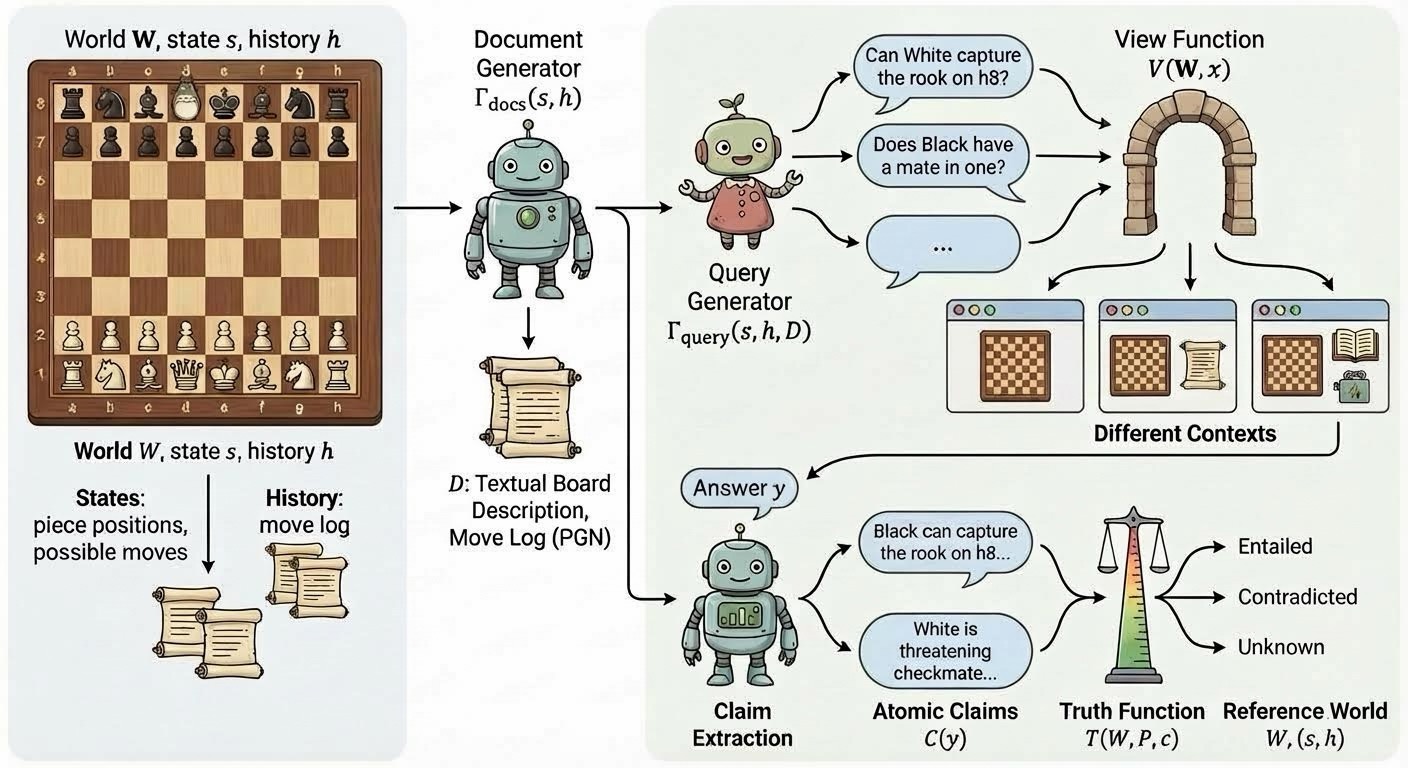
Figure 1. Hallucination as inaccurate (internal) world modeling
hallucination? A summarization researcher might say yes,
as the model contradicted the source. An open-domain QA
researcher might say no, as it is true that Sherlock Holmes
has no real world address. Hallucination, as a term, has
evolved since its first introduction, and now means different
things in different contexts. This fragmentation of defi-
nitions, tailored to task-specific assumptions about what
constitutes truth, makes it difficult to answer basic questions
about hallucination such as: Can LLMs ever be expected
to stop hallucinating? or Can we guarantee that hallucina-
tions will happen a predictable percentage of the time? If
we report that a technique “reduces hallucinations by 40%”,
what is this actually measuring, and can we expect these
improvements to transfer across contexts? These are not just
philosophical questions, but have real impact on research
directions and the public’s trust in deployed systems.
We argue that existing definitions of hallucination can be
unified as inaccurate world modeling that is observable
to the user through model outputs. More explicitly, we
argue that every setting implicitly assumes (1) a reference
world model encoding what is true, (2) a view function
specifying what information the model can observe, and (3)
a conflict policy determining how contradictions resolve. A
model hallucinates when its outputs imply claims that are
false according to the reference world model and conflict
policy. Prior definitions simply make different choices for
these components, but all share this underlying structure.
We further argue that making this structure explicit has prac-
tical benefits. First, it forces benchmark designers to be
more explicit about their assumptions, enabling better com-
1
arXiv:2512.21577v2 [cs.CL] 3 Feb 2026
A Unified Definition of Hallucination: It’s The World Model, Stupid!
parison across existing benchmarks. It also distinguishes
hallucination from other errors that can arise even with a
correct world model, and provides a common language for
why certain mitigations help in some settings but not others.
Lastly, it enables the creation of a class of larger-scale and
practically useful benchmarks by using synthetic environ-
ments where the reference world is fully specified (game
environments, simulated databases, or structured worlds).
By having a clear definition, we can more easily generate
evaluation instances where hallucination labels are fully
determined rather than requiring human annotation.
We start by reviewing how definitions of hallucination have
evolved over time (§2) before formalizing our framework
and unifying existing definitions (§3). We argue in §4 for the
benefits of unification, and outline in §5 how our framework
enables the creation of scalable benchmarks for advancing
hallucination research. Lastly, we discuss some alternative
views (§6), a call to action (§7), and future…(Full text truncated)…
📸 Image Gallery
Reference
This content is AI-processed based on ArXiv data.