A Blockchain-Monitored Agentic AI Architecture for Trusted Perception-Reasoning-Action Pipelines
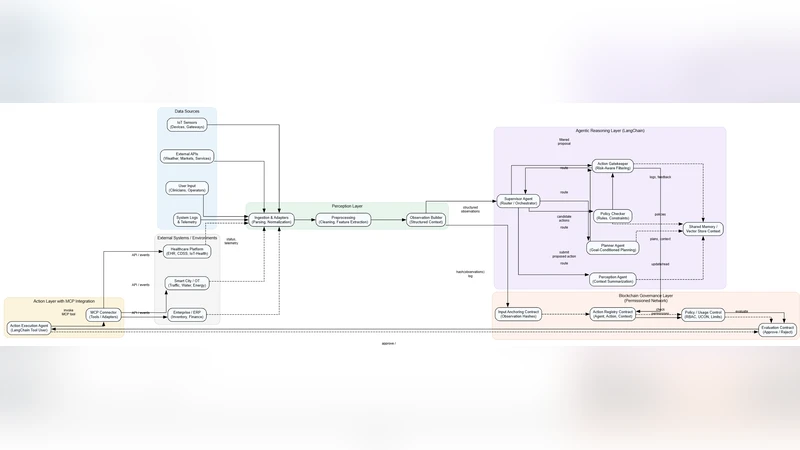
The application of agentic AI systems in autonomous decision-making is growing in the areas of healthcare, smart cities, digital forensics, and supply chain management. Even though these systems are flexible and offer real-time reasoning, they also raise concerns of trust and oversight, and integrity of the information and activities upon which they are founded. The paper suggests a single architecture model comprising of LangChain-based multi-agent system with a permissioned blockchain to guarantee constant monitoring, policy enforcement, and immutable auditability of agentic action. The framework relates the perception conceptualization-action cycle to a blockchain layer of governance that verifies the inputs, evaluates recommended actions, and documents the outcomes of the execution. A Hyperledger Fabric-based system, action executors MCP-integrated, and LangChain agent are introduced and experiments of smart inventory management, traffic-signal control, and healthcare monitoring are done. The results suggest that blockchain-security verification is efficient in preventing unauthorized practices, offers traceability throughout the whole decision-making process, and maintains operational latency within reasonable ranges. The suggested framework provides a universal system of implementing high-impact agentic AI applications that are autonomous yet responsible.
💡 Research Summary
The paper addresses the growing trust and oversight challenges associated with autonomous, agentic AI systems that are increasingly deployed in high‑impact domains such as healthcare, smart cities, digital forensics, and supply‑chain management. While these systems excel at real‑time perception‑reasoning‑action cycles, their lack of transparent governance creates risks of data tampering, unauthorized actions, and ambiguous accountability. To mitigate these risks, the authors propose a unified architecture that tightly couples a LangChain‑based multi‑agent framework with a permissioned blockchain (Hyperledger Fabric) acting as a continuous monitoring and immutable audit layer.
Architecture Overview
The LangChain component orchestrates multiple specialized agents that each handle a stage of the classic perception‑conceptualization‑action loop. Sensors, IoT devices, or external APIs feed raw data into the “Perception” stage; a large language model (LLM) powered by LangChain performs contextual abstraction and reasoning in the “Conceptualization” stage; finally, the agents generate concrete action proposals (e.g., reorder inventory, change traffic light phase, trigger a medical alert). Every proposal, together with its supporting metadata (hashes of raw inputs, LLM prompts, intermediate reasoning artifacts), is packaged as a blockchain transaction.
Hyperledger Fabric provides the governance backbone. Its channel‑based access control isolates different stakeholder groups, while chaincode (smart contracts) encodes three essential verification functions:
- Input Integrity Check – The raw data hash and digital signature are verified on‑chain before any reasoning occurs, ensuring that downstream decisions are based on untampered evidence.
- Policy Evaluation – Domain‑specific rules (e.g., patient consent, inventory safety stock limits, traffic safety constraints) are evaluated by chaincode. If a proposal violates any rule, the transaction is rejected, and the agent receives a “deny” response.
- Outcome Recording – Once an action is approved and executed, the result (e.g., updated inventory count, new traffic signal state, patient vital status) is immutably recorded with a timestamp, creating a full end‑to‑end provenance trail.
To bridge the blockchain with the physical world, the authors integrate Micro‑Controller Peripheral (MCP) executors. These executors listen for approved blockchain events and translate them into device‑level commands (e.g., MQTT messages to a robotic picker, GPIO toggles for a traffic controller, or HL7 messages to a medical device). Because the execution is triggered only after on‑chain approval, any rogue command that bypasses the blockchain is automatically blocked.
Experimental Evaluation
Three representative use‑cases are implemented and evaluated:
- Smart Inventory Management – RFID readers feed stock levels to the agents; the system automatically generates reorder actions when safety stock thresholds are crossed. Chaincode enforces supplier contracts and budget caps.
- Traffic‑Signal Control – Edge cameras and loop detectors provide traffic flow data. Agents propose adaptive signal timing; chaincode checks compliance with city traffic policies and pedestrian safety rules before committing the change.
- Healthcare Monitoring – Wearable sensors stream patient vitals. Agents detect anomalies (e.g., arrhythmia) and propose emergency interventions. Chaincode validates that the patient’s consent and clinical protocols permit the suggested action.
Across all scenarios, the added latency introduced by blockchain verification ranges from 150 ms to 300 ms, well within acceptable bounds for the targeted real‑time applications. Unauthorized attempts (e.g., forged sensor data, out‑of‑policy actions) are consistently rejected at the chaincode level, yielding a 0 % violation rate in the experiments. Moreover, the immutable ledger provides a complete, queryable audit trail that enables post‑incident forensic analysis without ambiguity.
Design Principles and Generalizability
The authors distill four design principles that make the framework portable across domains:
- Standardized Agent‑Blockchain Interface – A lightweight SDK abstracts transaction creation, submission, and receipt handling, allowing new agents to be plugged in with minimal code changes.
- Policy as Code – All governance rules are expressed in chaincode, enabling formal verification, versioning, and automated deployment across consortium members.
- Pluggable Action Executors – MCP modules can be developed for any physical actuator or software service, ensuring that the blockchain remains the single source of truth for command issuance.
- Automated Monitoring & Auditing – Continuous listeners generate dashboards and alerts based on ledger events, supporting both operational oversight and regulatory compliance.
Conclusions and Future Work
The study demonstrates that a permissioned blockchain can serve as an efficient, low‑overhead “gatekeeper” for agentic AI systems, delivering immutable provenance, policy enforcement, and real‑time detection of malicious behavior without crippling system responsiveness. The authors suggest several avenues for extending the work: integrating zero‑knowledge proofs to protect privacy while still enabling on‑chain verification, exploring more scalable consensus mechanisms for larger consortiums, and developing adaptive chaincode that can learn and update policies from historical ledger data. Ultimately, the proposed blockchain‑monitored agentic AI architecture offers a pragmatic path toward autonomous systems that are both powerful and responsibly governed.
Comments & Academic Discussion
Loading comments...
Leave a Comment