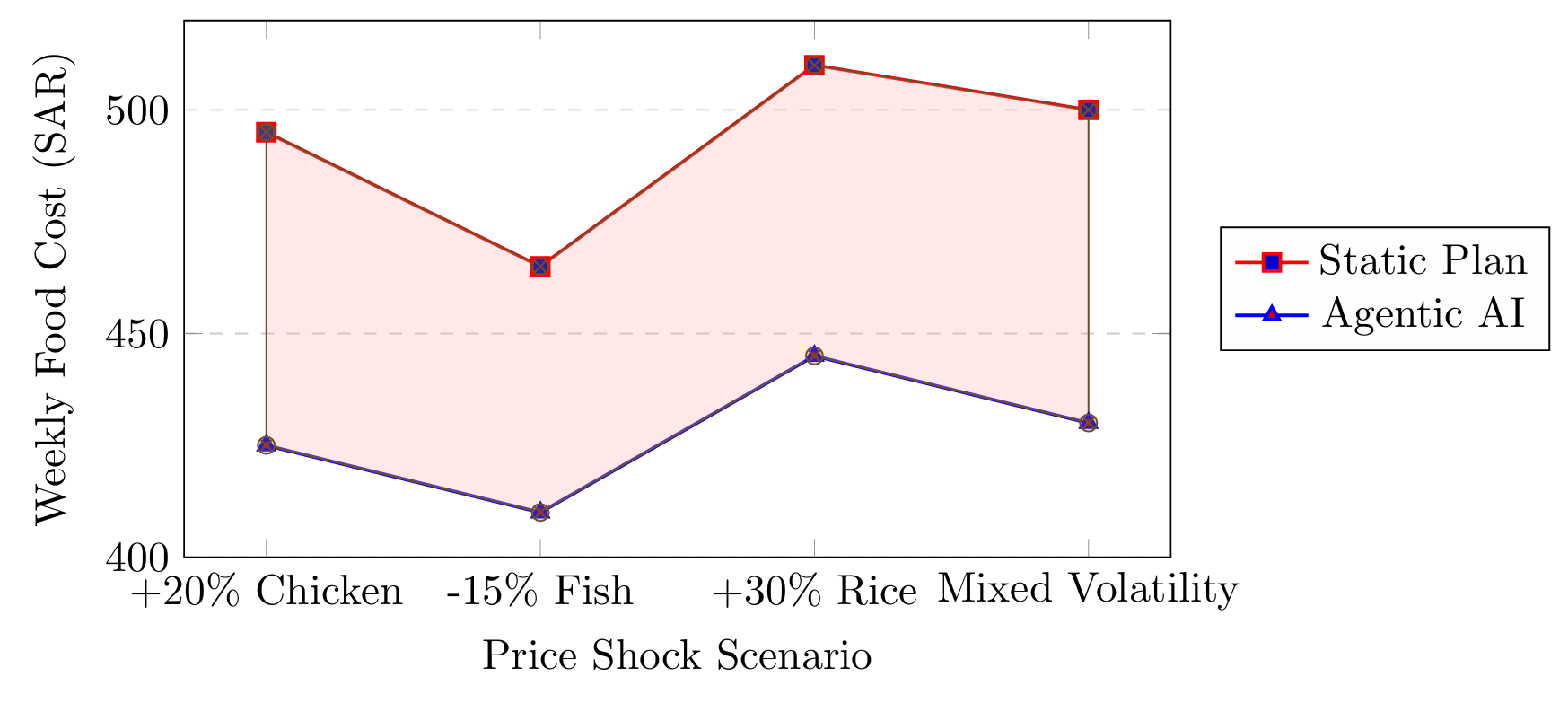
The issue of limited household budgets and nutritional demands continues to be a challenge especially in the middle-income environment where food prices fluctuate. This paper introduces a price aware agentic AI system, which combines personal finance management with diet optimization. With household income and fixed expenditures, medical and well-being status, as well as real-time food costs, the system creates nutritionally sufficient meals plans at comparatively reasonable prices that automatically adjust to market changes. The framework is implemented in a modular multi-agent architecture, which has specific agents (budgeting, nutrition, price monitoring, and health personalization). These agents share the knowledge base and use the substitution graph to ensure that the nutritional quality is maintained at a minimum cost. Simulations with a representative Saudi household case study show a steady 12-18\% reduction in costs relative to a static weekly menu, nutrient adequacy of over 95\% and high performance with price changes of 20-30%. The findings indicate that the framework can locally combine affordability with nutritional adequacy and provide a viable avenue of capacity-building towards sustainable and fair diet planning in line with Sustainable Development Goals on Zero Hunger and Good Health.
Deep Dive into FinAgent: An Agentic AI Framework Integrating Personal Finance and Nutrition Planning.
The issue of limited household budgets and nutritional demands continues to be a challenge especially in the middle-income environment where food prices fluctuate. This paper introduces a price aware agentic AI system, which combines personal finance management with diet optimization. With household income and fixed expenditures, medical and well-being status, as well as real-time food costs, the system creates nutritionally sufficient meals plans at comparatively reasonable prices that automatically adjust to market changes. The framework is implemented in a modular multi-agent architecture, which has specific agents (budgeting, nutrition, price monitoring, and health personalization). These agents share the knowledge base and use the substitution graph to ensure that the nutritional quality is maintained at a minimum cost. Simulations with a representative Saudi household case study show a steady 12-18% reduction in costs relative to a static weekly menu, nutrient adequacy of over 9
FinAgent: An Agentic AI Framework Integrating
Personal Finance and Nutrition Planning
Toqeer Ali Syed1,*, Abdulaziz Alshahrani1, Ali Ullah1, Ali Akarma1
Sohail Khan2, Muhammad Nauman2, Salman Jan3
1Faculty of Computer and Information System, Islamic University of Madinah, Saudi Arabia
2Department of Computer Science, Effat College of Engineering, Effat University, Saudi Arabia
3Arab Open University, Bahrain
*Corresponding author: toqeer@iu.edu.sa
Abstract—The issue of limited household budgets and
nutritional demands continues to be a challenge especially
in the middle-income environment where food prices
fluctuate. This paper introduces a price aware agentic
AI system, which combines personal finance management
with diet optimization. With household income and fixed
expenditures, medical and well-being status, as well as real-
time food costs, the system creates nutritionally sufficient
meals plans at comparatively reasonable prices that au-
tomatically adjust to market changes. The framework is
implemented in a modular multi-agent architecture, which
has specific agents (budgeting, nutrition, price monitoring,
and health personalization). These agents share the knowl-
edge base and use the substitution graph to ensure that
the nutritional quality is maintained at a minimum cost.
Simulations with a representative Saudi household case
study show a steady 12-18% reduction in costs relative
to a static weekly menu, nutrient adequacy of over 95%
and high performance with price changes of ±20-30%. The
findings indicate that the framework can locally combine
affordability with nutritional adequacy and provide a
viable avenue of capacity-building towards sustainable and
fair diet planning in line with Sustainable Development
Goals on Zero Hunger and Good Health.
Index Terms—Agentic AI, Household Budgeting, Diet
Optimization, Nutritional Adequacy, Multi-Agent Systems,
Price-Aware Meal Planning, Sustainable Development
Goals
I. INTRODUCTION
Financial, healthcare, and digital services have also
been transformed by artificial intelligence (AI) with gen-
erative AI being used to create content, reason, and sup-
port interactive decision-making [1], [2]. Nevertheless,
the majority of systems are responsive and do not have
long-term planning or goal-seeking independence. The
This paper was presented at the IEEE International Conference on
Computing and Applications (ICCA 2025), Bahrain.
gaps are filled in agentic AI, which involves combining
action loops based on planning, monitoring, memory and
tools, and facilitating goal-directed behaviour [3], [4].
Gartner estimates that in 2028, agentic-AI will be present
in one-third of applications [5].
With these developments, household decisionmaking,
especially at the point of budgeting and nutritional
requirements, is under-served. Current tools monitor
expenses or suggest meals but do not combine financial
constraints, nutritional needs and real-time prices [6].
Low quality of diet increases long term health risks
[7], particularly among the low income families, which
explains the applicability to SDG-2 and SDG-3.
This work presents a model of agentic-AI that inte-
grates the real-time price monitoring, budgeting, nutri-
tional maximization, and customized dietary restrictions.
The system takes into account the market changes and
health needs by using a multiagent architecture and
cost-sensitive optimization with substitution graphs to
adapt the household menus. Saudi household simulations
reveal 12-18 % of cost reduction, and more than 95 %
nutrient adequacy.
II. BACKGROUND
A. Healthy Diet Fundamentals
Healthy diets are not only preventive of chronic dis-
ease, but must contain balanced macronutrients, suffi-
cient amounts of vitamins and minerals, and minimal
amounts of sugars, saturated fats, and sodium [8], [9].
FAO focuses on different kinds of foods such as fruits,
vegetables, legumes, whole grains, lean proteins, and
dairy [10]. Iron, calcium and omega-3 fatty acid defi-
ciencies are still common across the globe [11]. Cultural
and religious considerations including halal rules and
Ramadan fasting also influence the preferences of the
arXiv:2512.20991v1 [cs.AI] 24 Dec 2025
diet and promote flexible and individualized planning of
meals [12].
B. Personal Finance for Households
Financial management is important to the stability of
the household. Whilst guidelines like the 50/30/20 rule
are helpful in providing a framework, they might not
be suitable to low and middle-income families [13]. In
most middle-income areas, the proportion of food to
income is 15-25 % and increases with inflation [14].
By combining nutrition and budgeting, food resources,
which are limited in number, can be allocated more
effectively.
C. Agentic AI Concepts
Agents AI combine perception, memory, planning and
self-monitoring in a loop [15]. It drives the retail, travel,
and shopping agents that operate round the clock, but
most of them are aimed at convenience, not health or
financial welfare [1
…(Full text truncated)…
This content is AI-processed based on ArXiv data.