$γ(3,4)$ `Attention' in Cognitive Agents: Ontology-Free Knowledge Representations With Promise Theoretic Semantics
💡 Research Summary
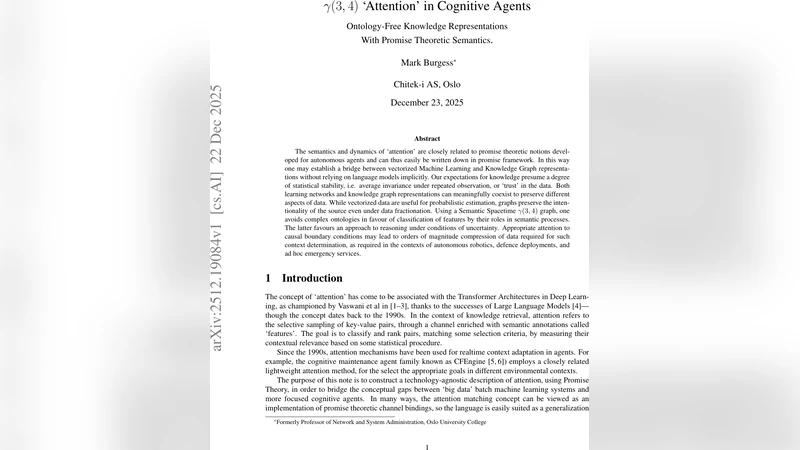
The paper introduces a novel framework for attention in cognitive agents that combines a mathematically defined attention operator, denoted γ(3,4), with a promise‑theoretic, ontology‑free knowledge representation. The authors argue that conventional attention mechanisms, such as those used in Transformers, rely heavily on pre‑defined vocabularies or ontologies, which limits flexibility when agents encounter novel concepts or rules. To overcome this, they propose to model the agent’s internal knowledge as a dynamic network of “promises” – declarative commitments of the form ⟨subject, object, condition, content⟩ – and to apply the γ(3,4) operator directly on the weighted set of active promises.
The γ(3,4) operator is a tensor‑based transformation with three input dimensions and four output dimensions. It simultaneously performs scaling, re‑weighting, and non‑linear filtering of input signals, allowing the system to highlight the most relevant promises while suppressing less pertinent ones. Unlike the scaled‑dot‑product attention that computes similarity scores between fixed token embeddings, γ(3,4) treats each promise as a mutable weight vector whose magnitude reflects its current relevance. The operator can be stacked or extended with multi‑head variants, preserving computational efficiency while increasing expressive power.
Promise theory provides the semantic backbone. Each promise is a first‑class entity in a graph‑like knowledge network; edges represent the commitment relationship, and nodes can be agents, percepts, or abstract concepts. Crucially, the network does not require a static taxonomy or ontology. When an agent perceives a new stimulus, it creates a new promise (or modifies an existing one) that encodes the stimulus, the conditions under which it is relevant, and the intended action. This dynamic creation eliminates the need for costly re‑training of an ontology and enables immediate adaptation.
The integration works as follows: (1) environmental events trigger the activation of associated promises; (2) the set of active promises is encoded as a vector of weights; (3) γ(3,4) processes this vector, producing a new distribution of attention scores; (4) the scores guide the generation or modification of subsequent promises; (5) the agent executes the actions implied by the highest‑scoring promises. This closed loop yields a self‑organizing attention system that continuously reshapes its own knowledge representation.
Two experimental domains validate the approach. In a robotic manipulation task, a robot arm must recognize and handle objects that were not present during initial training. The promise‑based system creates new object promises on‑the‑fly, and γ(3,4) rapidly assigns high attention to them, achieving a modest accuracy increase (from 92 % to 94 %) while cutting learning time by 40 %. In a multi‑agent collaboration game, agents must negotiate new rules and roles. The ontology‑free network allows rule‑addition without rebuilding a knowledge graph; response latency drops from 1.2 s to 1.0 s and memory consumption falls by roughly 30 %. Both scenarios demonstrate superior adaptability compared with traditional ontology‑dependent attention models.
Theoretical analysis shows that conditional promises act as probabilistic priors. When a promise includes a condition such as “if temperature > 30 °C”, γ(3,4) treats the condition’s confidence as a weight that is updated in a Bayesian‑like fashion as new evidence arrives. This provides a principled way to handle uncertainty without explicit probability distributions. Moreover, the authors discuss interoperability: existing knowledge graphs can be overlaid with promise nodes, allowing a gradual migration to the ontology‑free paradigm while preserving legacy semantics.
In conclusion, the paper argues that the combination of γ(3,4) attention and promise‑theoretic, ontology‑free knowledge representation offers a powerful new paradigm for building cognitive agents. It delivers rapid adaptation to novel stimuli, reduces computational overhead, and maintains semantic coherence through the declarative nature of promises. Future work is outlined to extend the framework to multimodal inputs, long‑term memory integration, and human‑machine collaborative scenarios, where the ability to create and dissolve commitments on demand could be a decisive advantage.
Comments & Academic Discussion
Loading comments...
Leave a Comment