The measured speed in the evanescent regime reflects the spatial decay of the wavefunction, not particle motion
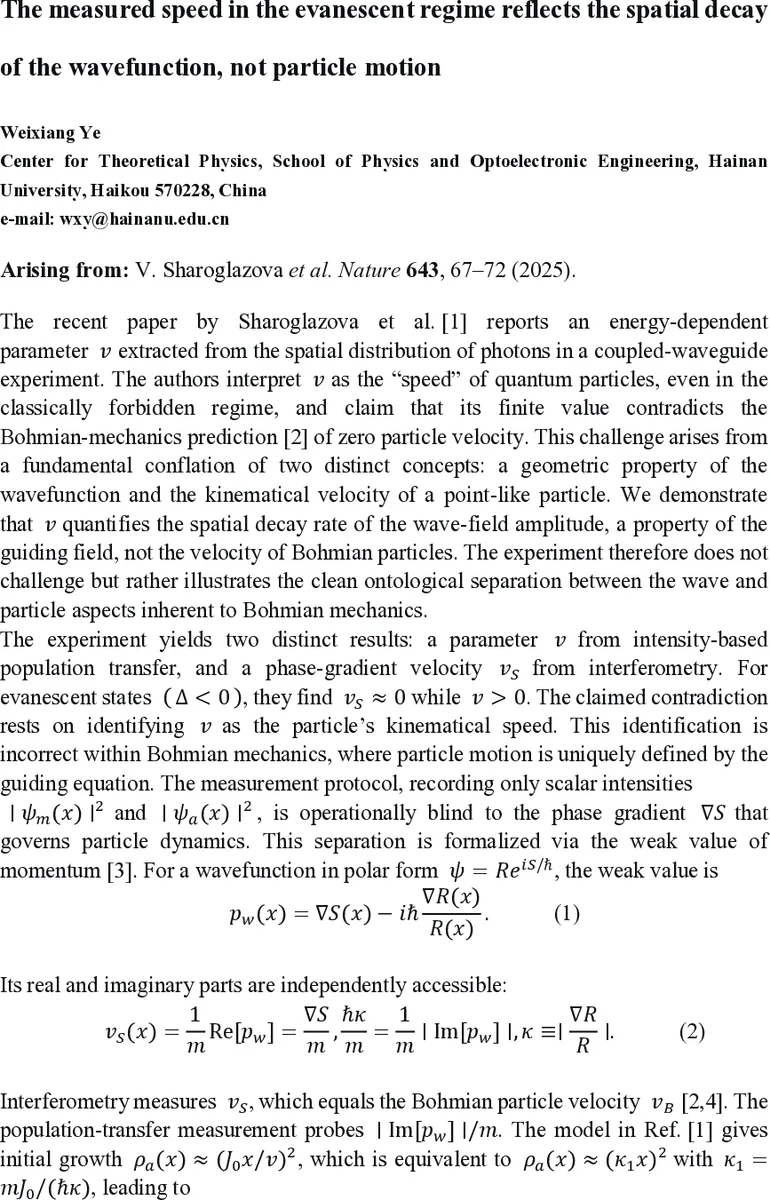
The recent paper by Sharoglazova et al. reports an energy-dependent parameter $ν$ extracted from the spatial distribution of photons in a coupled-waveguide experiment. The authors interpret $ν$ as the speed of quantum particles, even in the classically forbidden regime, and claim that its finite value contradicts the Bohmian mechanics prediction of zero particle velocity. This challenge arises from a fundamental misunderstanding of the operational meaning of v within the Bohmian ontological framework. We demonstrate that v quantifies the spatial gradient of the wavefunctions amplitude, a geometric property of the guiding field, not the kinematical velocity of point-like particles. The experiment therefore does not challenge but rather illustrates the clean ontological separation between the wave and particle aspects inherent to Bohmian mechanics.
💡 Research Summary
The paper by Sharoglazova et al. (Nature 643, 2025) reported an energy‑dependent parameter ν obtained from the spatial intensity distribution of photons propagating in a coupled‑waveguide system. The authors interpreted ν as the “speed” of quantum particles, even when the photons occupy an evanescent (classically forbidden) region, and claimed that the finite value of ν contradicts the Bohmian‑mechanics prediction of zero particle velocity in that region. In the present comment we show that this claim rests on a categorical confusion between two distinct quantities: (i) the geometric decay rate of the wavefunction’s amplitude, and (ii) the kinematical velocity of a point‑like Bohmian particle.
In Bohmian mechanics the particle velocity field is defined by the guiding equation
v = ∇S/m,
where ψ = R e^{iS/ħ} is the polar decomposition of the wavefunction. This definition follows uniquely from the Schrödinger equation together with the continuity equation, guaranteeing equivariance (the statistical agreement between the particle ensemble and |ψ|²). The velocity is therefore determined solely by the phase gradient ∇S, i.e. by the real part of the weak value of the momentum operator.
The experimental protocol, however, measures only scalar intensities I(x) ∝ |ψ(x)|² and extracts ν by fitting the exponential tail of the stationary intensity profile. No interferometric phase information is recorded. Within the weak‑measurement framework the weak value of momentum can be written as
⟨p̂⟩_w = ∇S − iħ∇R/R.
The real part (∇S) gives the Bohmian particle momentum, while the imaginary part (−ħ∇R/R) encodes the spatial decay of the amplitude R. The quantity ν that the authors fit corresponds precisely to the magnitude of this imaginary part (up to a known factor), i.e. to the decay constant κ of the evanescent wave. Consequently ν is a property of the guiding field, not of the particle’s trajectory.
In the evanescent regime the stationary solution of the Schrödinger equation is real (or has a constant phase), so ∇S = 0 and the Bohmian velocity v vanishes identically. The amplitude, however, decays as e^{−κx}, giving κ > 0 and thus ν > 0. The apparent “non‑zero speed” therefore reflects the wave’s geometry, not motion of the particle.
The authors also discuss a second parameter ν_∥ obtained from interferometry, which indeed measures the phase‑gradient velocity and coincides with the Bohmian v. By contrast, the population‑transfer measurement that yields ν is blind to the phase and can only access the decay rate. The paper’s Supplementary Information derives the relation ν = κ from the coupled‑mode equations, confirming that ν is mathematically identical to the spatial decay constant.
We further address the dwell‑time analysis. The experimentally constructed time τ_ℓ is built from the geometric parameters κ and a length scale ℓ, both extracted from the stationary wavefunction. Standard quantum‑mechanical calculations of the dwell time τ_dwell, which involve a decomposition of the standing wave into incoming and reflected components, happen to produce an expression numerically similar to τ_ℓ because both rely on the same Schrödinger‑equation structure. This numerical coincidence does not imply that ν represents a particle transit time.
Finally, we critique proposals to modify the guiding equation so that Bohmian particles acquire a non‑zero velocity in evanescent regions. Such modifications generally break quantum equilibrium (the preservation of the |ψ|² distribution), violate Galilean covariance, and introduce arbitrary divergence‑free flows not determined by the wavefunction. Hence they constitute entirely new theories rather than legitimate extensions of Bohmian mechanics.
In summary, the parameter ν measured by Sharoglazova et al. is the spatial decay rate of the evanescent wavefunction, i.e. the magnitude of the imaginary part of the weak momentum value. It is not the kinematical speed of Bohmian particles, which remains zero in the forbidden region. The experiment therefore does not challenge Bohmian mechanics; on the contrary, it illustrates the clear ontological separation between wave‑field geometry and particle dynamics that is a hallmark of the Bohmian interpretation.
Comments & Academic Discussion
Loading comments...
Leave a Comment