The Jordan canonical form of the Fréchet derivative of a matrix function
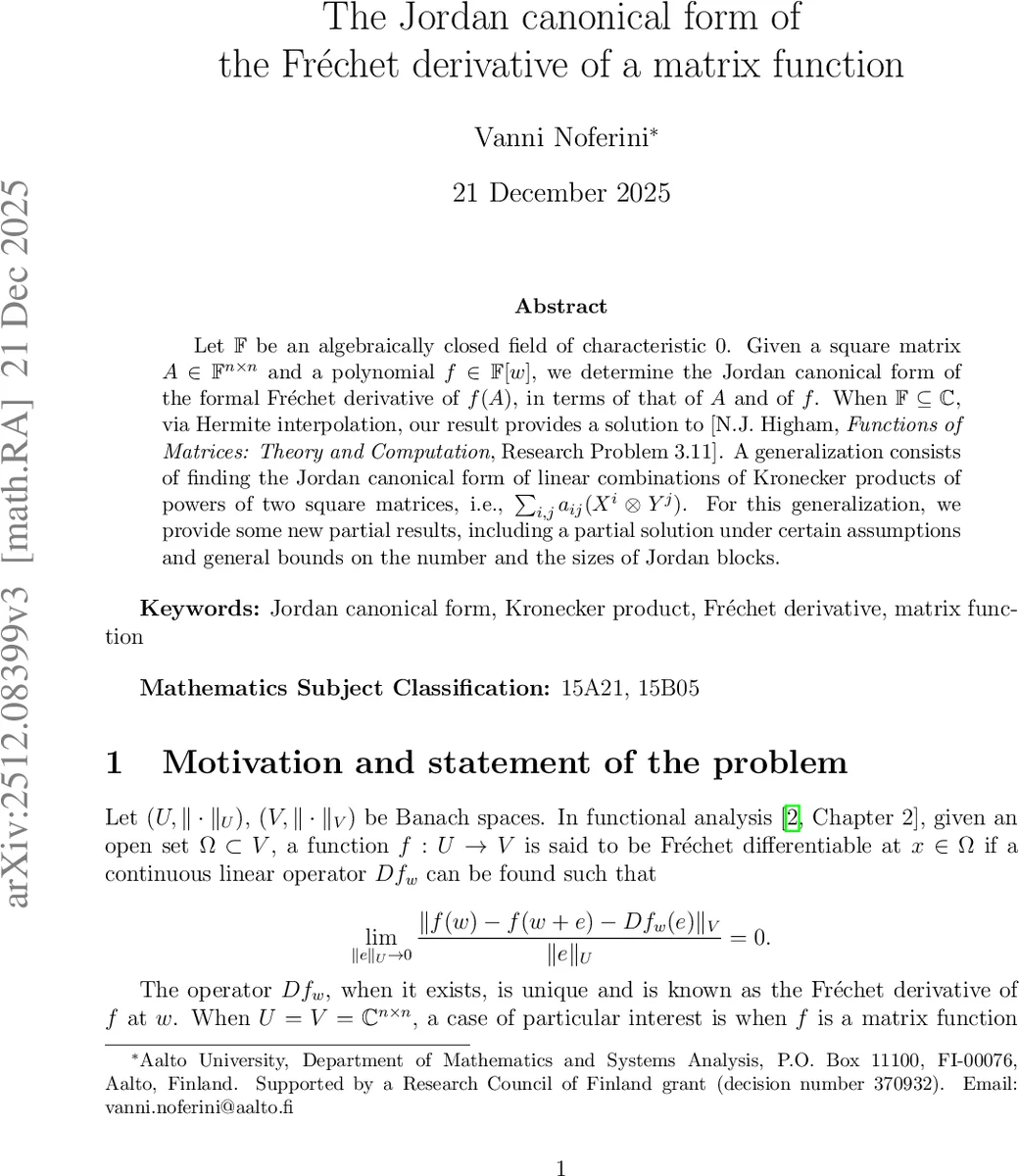
Let $\mathbb{F}$ be an algebraically closed field of characteristic $0$. Given a square matrix $A \in \mathbb{F}^{n \times n}$ and a polynomial $f \in \mathbb{F}[w]$, we determine the Jordan canonical form of the formal Fréchet derivative of $f(A)$, in terms of that of $A$ and of $f$. When $\mathbb{F}\subseteq \mathbb{C}$, via Hermite interpolation, our result provides a solution to [N.J. Higham, \emph{Functions of Matrices: Theory and Computation}, Research Problem 3.11]. A generalization consists of finding the Jordan canonical form of linear combinations of Kronecker products of powers of two square matrices, i.e., $\sum_{i,j} a_{ij} (X^i \otimes Y^j)$. For this generalization, we provide some new partial results, including a partial solution under certain assumptions and general bounds on the number and the sizes of Jordan blocks.
💡 Research Summary
The paper addresses the long‑standing problem of determining the Jordan canonical form (JCF) of the Fréchet derivative of a matrix function. Working over an algebraically closed field (\mathbb{F}) of characteristic zero, the authors first observe that for a polynomial (f) the Fréchet derivative (Df(A)) can be written as a Kronecker‑product linear combination \
Comments & Academic Discussion
Loading comments...
Leave a Comment