On Listwise Reranking for Corpus Feedback
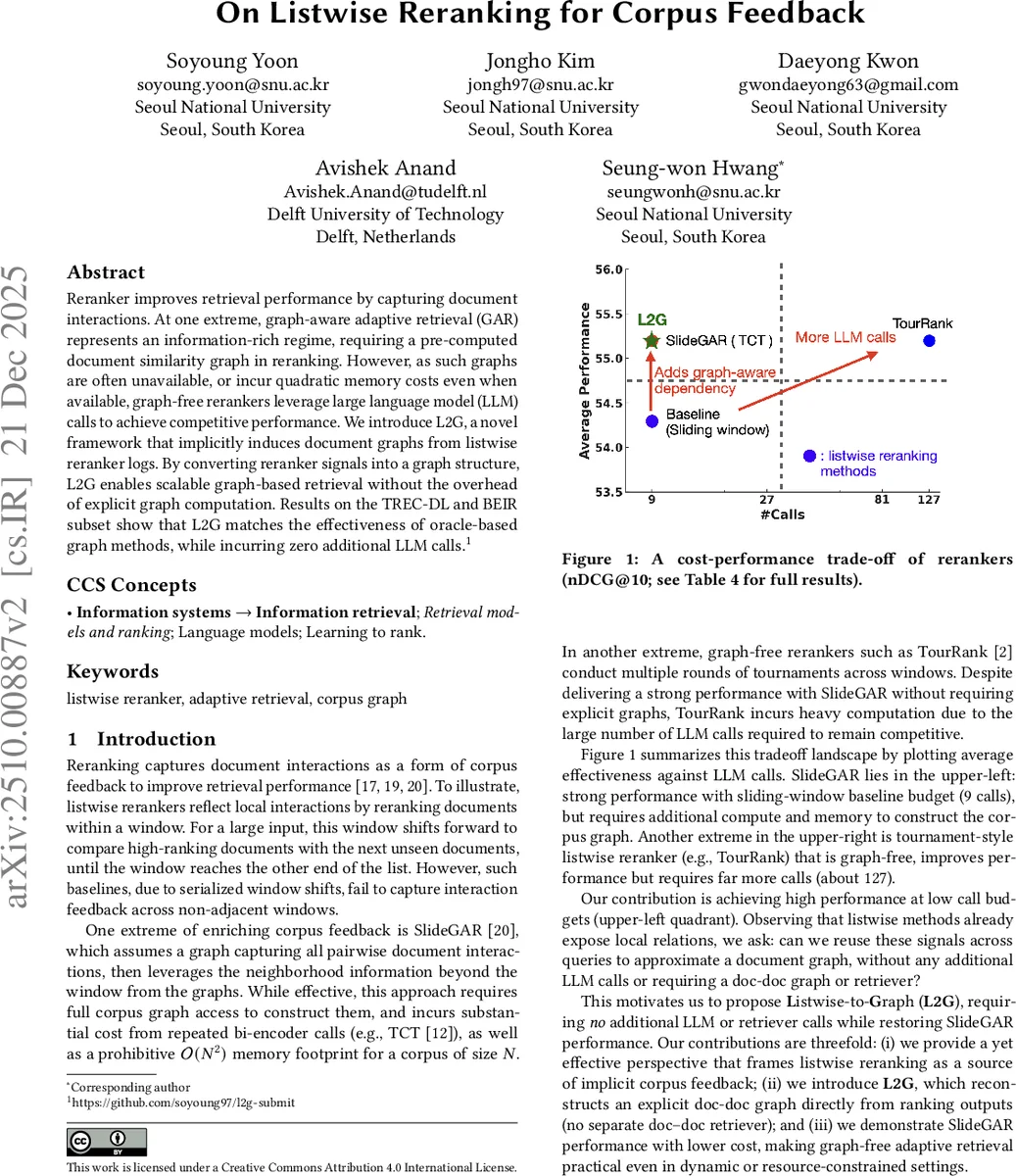
Reranker improves retrieval performance by capturing document interactions. At one extreme, graph-aware adaptive retrieval (GAR) represents an information-rich regime, requiring a pre-computed document similarity graph in reranking. However, as such graphs are often unavailable, or incur quadratic memory costs even when available, graph-free rerankers leverage large language model (LLM) calls to achieve competitive performance. We introduce L2G, a novel framework that implicitly induces document graphs from listwise reranker logs. By converting reranker signals into a graph structure, L2G enables scalable graph-based retrieval without the overhead of explicit graph computation. Results on the TREC-DL and BEIR subset show that L2G matches the effectiveness of oracle-based graph methods, while incurring zero additional LLM calls.
💡 Research Summary
The paper tackles a fundamental trade‑off in modern information retrieval: graph‑aware adaptive retrieval (GAR) methods such as SlideGAR achieve strong effectiveness by exploiting a pre‑computed document‑document similarity graph, but they require O(N²) memory and repeated bi‑encoder calls, which are prohibitive for large corpora. On the opposite end, graph‑free rerankers (e.g., TourRank) avoid the graph construction cost but rely on many large‑language‑model (LLM) invocations, inflating latency and computational expense.
The authors propose L2G (Listwise‑to‑Graph), a framework that extracts an implicit document graph directly from the outputs of listwise rerankers, thereby eliminating any additional LLM calls or external doc‑doc retrievers. For each query qᵢ, a listwise reranker receives a candidate set Cᵢ and returns a permutation πᵢ. This permutation is transformed into a dense score vector aᵢ ∈ ℝ^{|D|}, where aᵢ
Comments & Academic Discussion
Loading comments...
Leave a Comment