Anomalous Superfluid Density in Pair-Density-Wave Superconductors
Pair-density-wave (PDW) states are a long-sought-after phase of quantum materials, with the potential to unravel the mysteries of high-$T_c$ cuprates and other strongly correlated superconductors. Yet, surprisingly, a key signature of stable superconductivity, namely the positivity of the superfluid density, $n_s(T)$, has not yet been demonstrated. Here, we address this central issue by calculating $n_s(T)$ for a generic model two-dimensional PDW superconductor. We uncover a surprisingly large region of intrinsic instability, associated with negative $n_s(T)$, revealing that a significant portion of the parameter space thought to be physical cannot support a pure PDW order. In the remaining stable regime, we predict two striking and observable fingerprints: a small longitudinal superfluid response and an unusual temperature dependence for $n_s(T)$. These generally model-independent, as well as experimentally relevant findings suggest that the fragility of the superfluid density poses a significant problem for the formation of stable, finite temperature PDW superconductivity.
💡 Research Summary
**
The paper addresses a fundamental question about pair‑density‑wave (PDW) superconductors: can they sustain a positive superfluid density, (n_s(T)), which is required for thermodynamic stability? Using a generic two‑dimensional tight‑binding model with nearest‑neighbor attractive interaction, the authors self‑consistently solve the Gor’kov equations for a unidirectional PDW order parameter (\Delta(\mathbf r)\sim\cos(\mathbf Q\cdot\mathbf r)). Both s‑wave and d‑wave components are allowed to mix, and the optimal pairing momentum (\mathbf Q) is determined by minimizing the ground‑state energy.
The superfluid density is decomposed into a fermionic quasiparticle contribution (n_0) and a collective Higgs‑mode contribution (n_{\text{col}}). The fermionic term (Eq. 4) contains the product of current vertices (J_i(\mathbf p)=\partial_{p_i}\xi(\mathbf p)) evaluated at momenta shifted by (\pm\mathbf Q). For the longitudinal direction (parallel to (\mathbf Q)), the factor (\cos Q_x-\cos p_x) can become negative, producing a destructive interference that dramatically suppresses (n_{xx}^0). In contrast, the transverse component (n_{yy}^0) retains a positive sign because the analogous interference is absent.
The Higgs‑mode contribution is always negative, reflecting the energetic cost of amplitude fluctuations of the PDW condensate in an external vector potential. When the fermionic longitudinal term is already small, the negative Higgs term nearly cancels it, leaving the total longitudinal superfluid density (n_{xx}^s) close to zero. This two‑step suppression explains why the PDW phase exhibits an extremely fragile superfluid response along the pairing direction while remaining robust transversely.
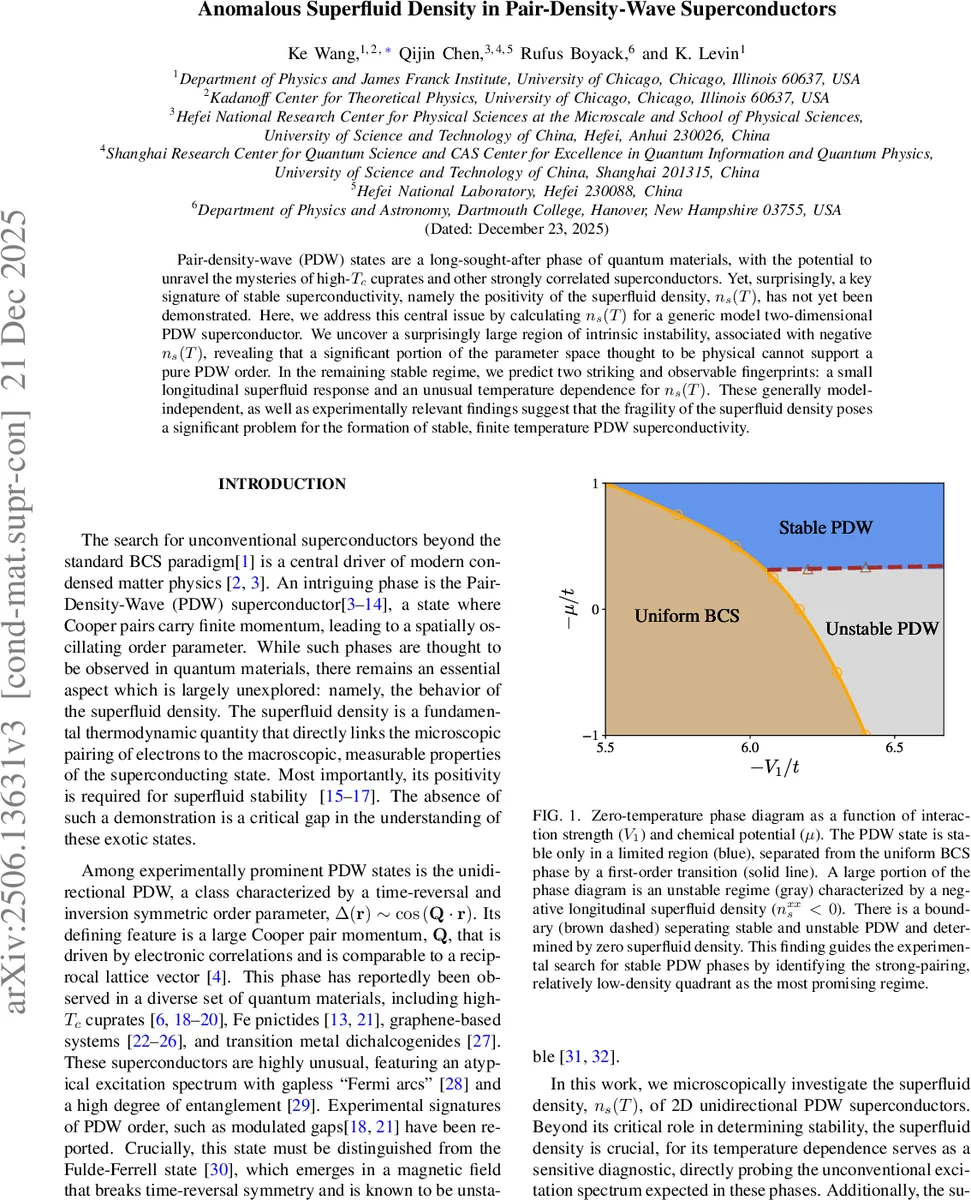
A phase diagram in the interaction‑strength ((V_1)) versus chemical potential ((\mu)) plane shows a first‑order transition between uniform BCS and PDW states. The PDW is stable only within a narrow region where the pairing momentum satisfies (|\mathbf Q|<Q_c\approx0.44\pi/a); beyond this critical momentum the longitudinal superfluid density becomes negative, signalling an intrinsic instability. Thus a large portion of the parameter space previously thought to host PDW order is actually unstable.
Temperature dependence provides a second distinctive fingerprint. Because the PDW generates a Bogoliubov Fermi surface and a van Hove singularity near the Fermi level, the current‑weighted density of states (D_i(E)) is non‑monotonic. A Sommerfeld expansion yields a low‑temperature correction (n_i^0(T)-n_i^0(0)\simeq -\pi^2 T^2/6, D_i’’(0)). The curvature (D_i’’(0)) has opposite signs for longitudinal and transverse directions, leading to (n_{xx}^s\propto -T^2) (further suppression) and (n_{yy}^s\propto +T^2) (enhancement). This behavior is starkly different from the exponential decay of an s‑wave superconductor or the linear decrease of a d‑wave superconductor, and directly reflects the gapless excitations inherent to the PDW state.
Experimentally, the authors propose probing the predicted anisotropy via optical conductivity measurements, especially THz time‑domain spectroscopy. The f‑sum rule implies that a reduced superfluid weight redistributes spectral weight to finite frequencies, so one should observe a pronounced disparity (\sigma_{xx}(\omega)\gg\sigma_{yy}(\omega)). Additionally, tracking the temperature evolution of the longitudinal superfluid density can provide an upper bound for the true critical temperature, since (n_{xx}^s) vanishes at a temperature (T_0) well below the mean‑field gap scale.
In summary, the work demonstrates that a PDW superconductor can only be stable in a limited region of parameter space where the pairing momentum is sufficiently small. The combination of destructive interference from finite (\mathbf Q) and a negative Higgs‑mode contribution leads to an anomalously small and highly anisotropic superfluid density, while the low‑temperature (T^2) dependence with opposite signs in orthogonal directions offers a clear, experimentally accessible signature of PDW order.
Comments & Academic Discussion
Loading comments...
Leave a Comment