Investigating the Impact of Project Risks on Employee Turnover Intentions in the IT Industry of Pakistan
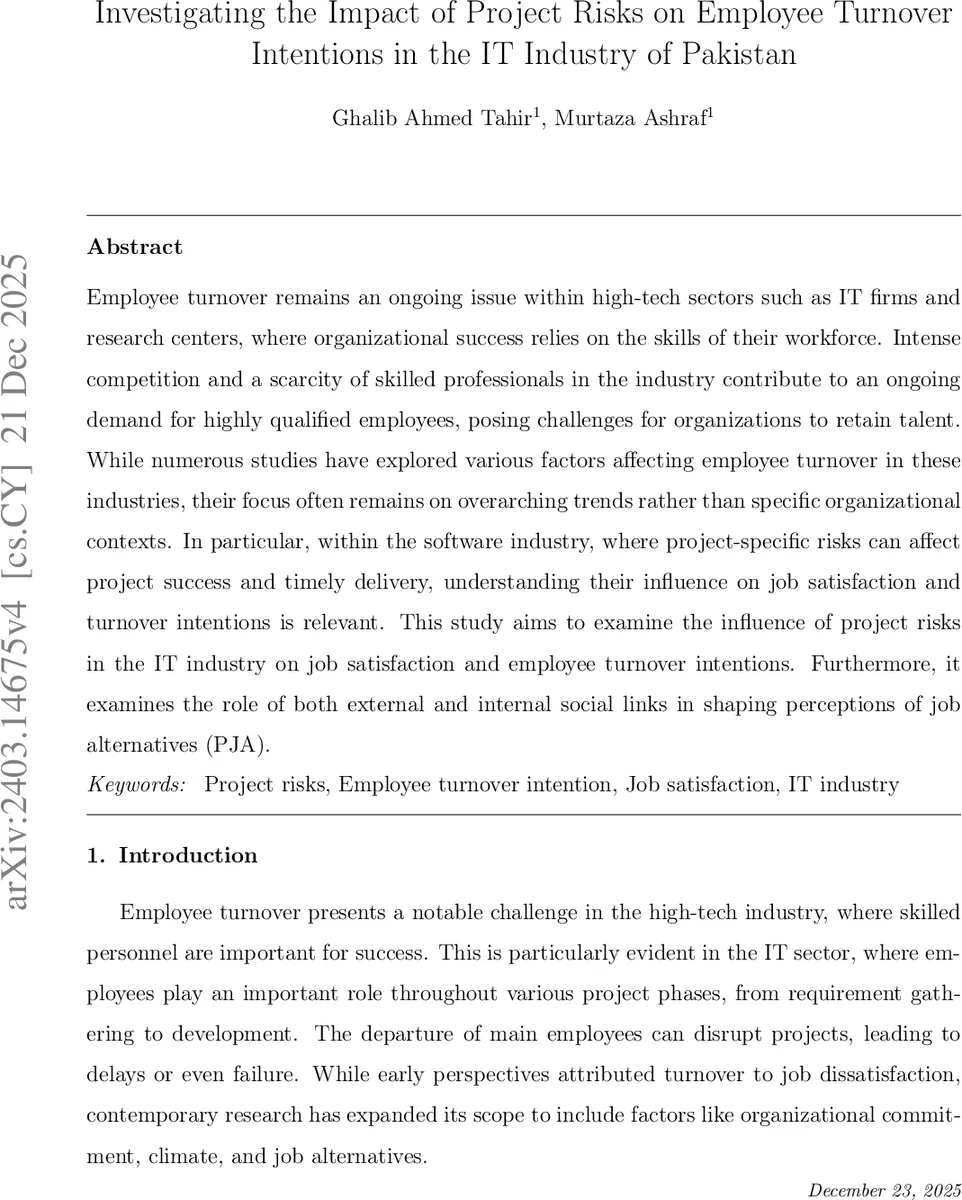
Employee turnover remains a pressing issue within high-tech sectors such as IT firms and research centers, where organizational success heavily relies on the skills of their workforce. Intense competition and a scarcity of skilled professionals in the industry contribute to a perpetual demand for highly qualified employees, posing challenges for organizations to retain talent. While numerous studies have explored various factors affecting employee turnover in these industries, their focus often remains on overarching trends rather than specific organizational contexts. In particular, within the software industry, where projectspecific risks can significantly impact project success and timely delivery, understanding their influence on job satisfaction and turnover intentions is crucial. This study aims to investigate the influence of project risks in the IT industry on job satisfaction and employee turnover intentions. Furthermore, it examines the role of both external and internal social links in shaping perceptions of job satisfaction.
💡 Research Summary
The paper investigates how project‑specific risks affect employee turnover intentions within Pakistan’s information‑technology (IT) sector, and how external and internal social networks shape employees’ perceptions of job alternatives (PJA), thereby influencing the risk‑turnover relationship. Drawing on a broad review of turnover theories—from classic organizational equilibrium and expectancy models to more recent social‑capital and job‑embeddedness frameworks—the authors argue that the high uncertainty inherent in software projects (tight deadlines, ambiguous requirements, technical complexity) constitutes a distinct risk factor that can erode job satisfaction and trigger turnover intentions.
To test these propositions, the researchers designed a structured questionnaire incorporating validated scales for five constructs: project risk (five items), job satisfaction (four items), external social network (three items), internal social network (three items), perceived job alternatives (four items), and turnover intention (three items). The survey was administered to 350 employees (project managers and developers) from leading Pakistani IT firms. After conducting exploratory and confirmatory factor analyses to ensure measurement validity, the authors employed structural equation modeling (SEM) to examine the hypothesized paths.
Key findings are as follows: (1) Project risk has a strong negative effect on job satisfaction (β = ‑0.42, p < 0.001). Lower satisfaction, in turn, significantly raises turnover intention (β = ‑0.35, p < 0.001), confirming that risky project environments diminish employee well‑being and increase the likelihood of leaving. (2) Both external and internal social networks positively influence perceived job alternatives (β = 0.28 and 0.31 respectively, p < 0.001). Higher PJA directly raises turnover intention (β = 0.27, p < 0.001), indicating that awareness of alternative employment options amplifies the impact of dissatisfaction. (3) Social networks partially mediate the risk‑satisfaction‑turnover chain; internal networks, in particular, provide emotional support that buffers the negative effect of project risk on satisfaction. (4) PJA moderates the direct link between project risk and turnover intention: employees who perceive many viable alternatives are more likely to translate risk‑induced dissatisfaction into actual turnover intentions.
The discussion emphasizes that risk management in IT projects must extend beyond schedule and budget control to include employee psychological safety and social support. Strengthening internal networks through mentorship, team‑building, and knowledge‑sharing platforms can sustain job satisfaction even under high‑risk conditions. Enhancing external networks—by encouraging participation in industry conferences, professional communities, and career‑development programs—helps employees stay informed about market opportunities, which can be leveraged to reduce abrupt turnover. Managing PJA involves transparent career‑path communication, internal mobility options, and clear promotion criteria, thereby mitigating the “pull” of external alternatives when project risk spikes.
The study contributes a novel integrated model linking project risk, job satisfaction, social capital, and perceived job alternatives to turnover intention, specifically within a developing‑country IT context. It offers actionable insights for managers seeking to retain talent while delivering complex software projects. Limitations include the geographic confinement to Pakistan and reliance on self‑reported survey data, which constrain causal inference and generalizability. The authors recommend longitudinal designs and cross‑cultural comparisons to further validate and extend the model.
Comments & Academic Discussion
Loading comments...
Leave a Comment