📝 Original Info
- Title: DASH: Deception-Augmented Shared Mental Model for a Human-Machine Teaming System
- ArXiv ID: 2512.18616
- Date: 2025-12-21
- Authors: Researchers from original ArXiv paper
📝 Abstract
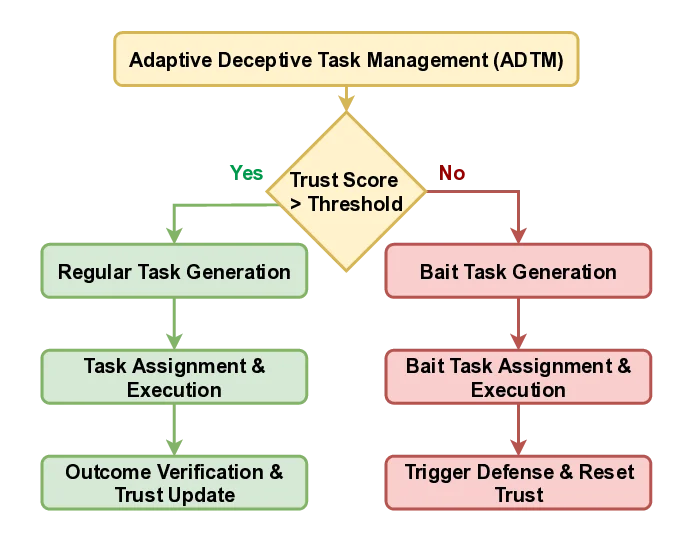
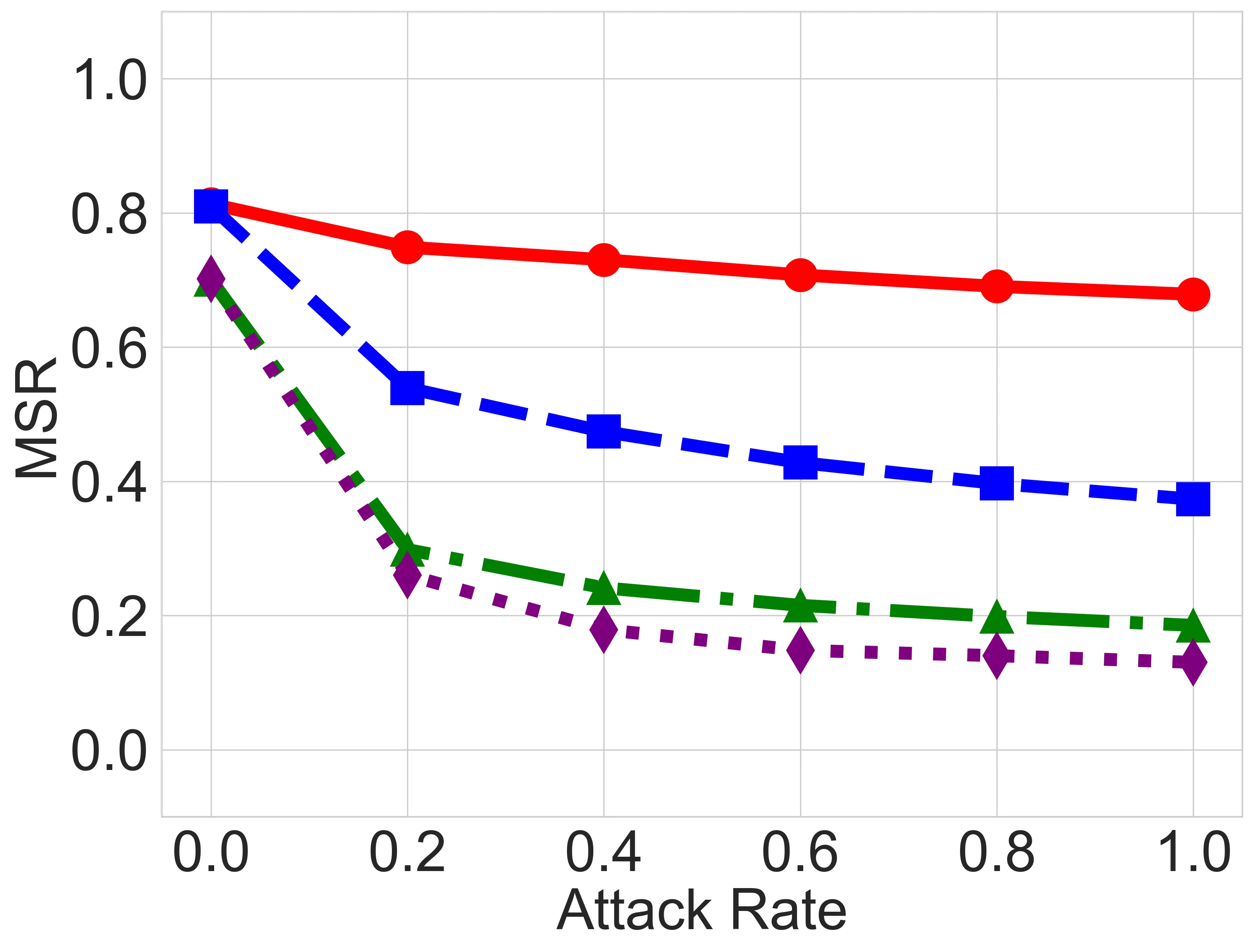
We present DASH (Deception-Augmented Shared mental model for Human-machine teaming), a novel framework that enhances mission resilience by embedding proactive deception into Shared Mental Models (SMM). Designed for mission-critical applications such as surveillance and rescue, DASH introduces "bait tasks" to detect insider threats, e.g., compromised Unmanned Ground Vehicles (UGVs), AI agents, or human analysts, before they degrade team performance. Upon detection, tailored recovery mechanisms are activated, including UGV system reinstallation, AI model retraining, or human analyst replacement. In contrast to existing SMM approaches that neglect insider risks, DASH improves both coordination and security. Empirical evaluations across four schemes (DASH, SMM-only, no-SMM, and baseline) show that DASH sustains approximately 80% mission success under high attack rates, eight times higher than the baseline. This work contributes a practical human-AI teaming framework grounded in shared mental models, a deception-based strategy for insider threat detection, and empirical evidence of enhanced robustness under adversarial conditions. DASH establishes a foundation for secure, adaptive human-machine teaming in contested environments.
💡 Deep Analysis
Deep Dive into DASH: Deception-Augmented Shared Mental Model for a Human-Machine Teaming System.
We present DASH (Deception-Augmented Shared mental model for Human-machine teaming), a novel framework that enhances mission resilience by embedding proactive deception into Shared Mental Models (SMM). Designed for mission-critical applications such as surveillance and rescue, DASH introduces “bait tasks” to detect insider threats, e.g., compromised Unmanned Ground Vehicles (UGVs), AI agents, or human analysts, before they degrade team performance. Upon detection, tailored recovery mechanisms are activated, including UGV system reinstallation, AI model retraining, or human analyst replacement. In contrast to existing SMM approaches that neglect insider risks, DASH improves both coordination and security. Empirical evaluations across four schemes (DASH, SMM-only, no-SMM, and baseline) show that DASH sustains approximately 80% mission success under high attack rates, eight times higher than the baseline. This work contributes a practical human-AI teaming framework grounded in shared ment
📄 Full Content
IEEE TRANSACTIONS ON HUMAN-MACHINE SYSTEMS, VOL. XX, NO. X, XXX 2025
1
DASH: Deception-Augmented Shared Mental
Model for a Human-Machine Teaming System
Zelin Wan, Han Jun Yoon, Nithin Alluru, Terrence J. Moore, Frederica F. Nelson, Seunghyun Yoon, Hyuk Lim,
Dan Dongseong Kim, and Jin-Hee Cho, Senior Member, IEEE
Abstract—We present DASH (Deception-Augmented Shared
mental model for Human-machine teaming), a novel frame-
work that enhances mission resilience by embedding proactive
deception into Shared Mental Models (SMM). Designed for
mission-critical applications such as surveillance and rescue,
DASH introduces “bait tasks” to detect insider threats, e.g.,
compromised Unmanned Ground Vehicles (UGVs), AI agents, or
human analysts, before they degrade team performance. Upon
detection, tailored recovery mechanisms are activated, including
UGV system reinstallation, AI model retraining, or human
analyst replacement. In contrast to existing SMM approaches
that neglect insider risks, DASH improves both coordination
and security. Empirical evaluations across four schemes (DASH,
SMM-only, no-SMM, and baseline) show that DASH sustains
approximately 80% mission success under high attack rates,
eight times higher than the baseline. This work contributes
a practical human-AI teaming framework grounded in shared
mental models, a deception-based strategy for insider threat
detection, and empirical evidence of enhanced robustness under
adversarial conditions. DASH establishes a foundation for secure,
adaptive human-machine teaming in contested environments.
Index Terms—Human-machine teaming, shared mental model,
cyber deception, unmanned ground vehicles, trust
I. INTRODUCTION
Why human-machine teaming (HMT) systems? As HMT
systems are increasingly deployed in high-stakes operations,
ensuring secure and efficient collaboration among human an-
alysts, AI agents, and UGVs is critical [1]. A well-established
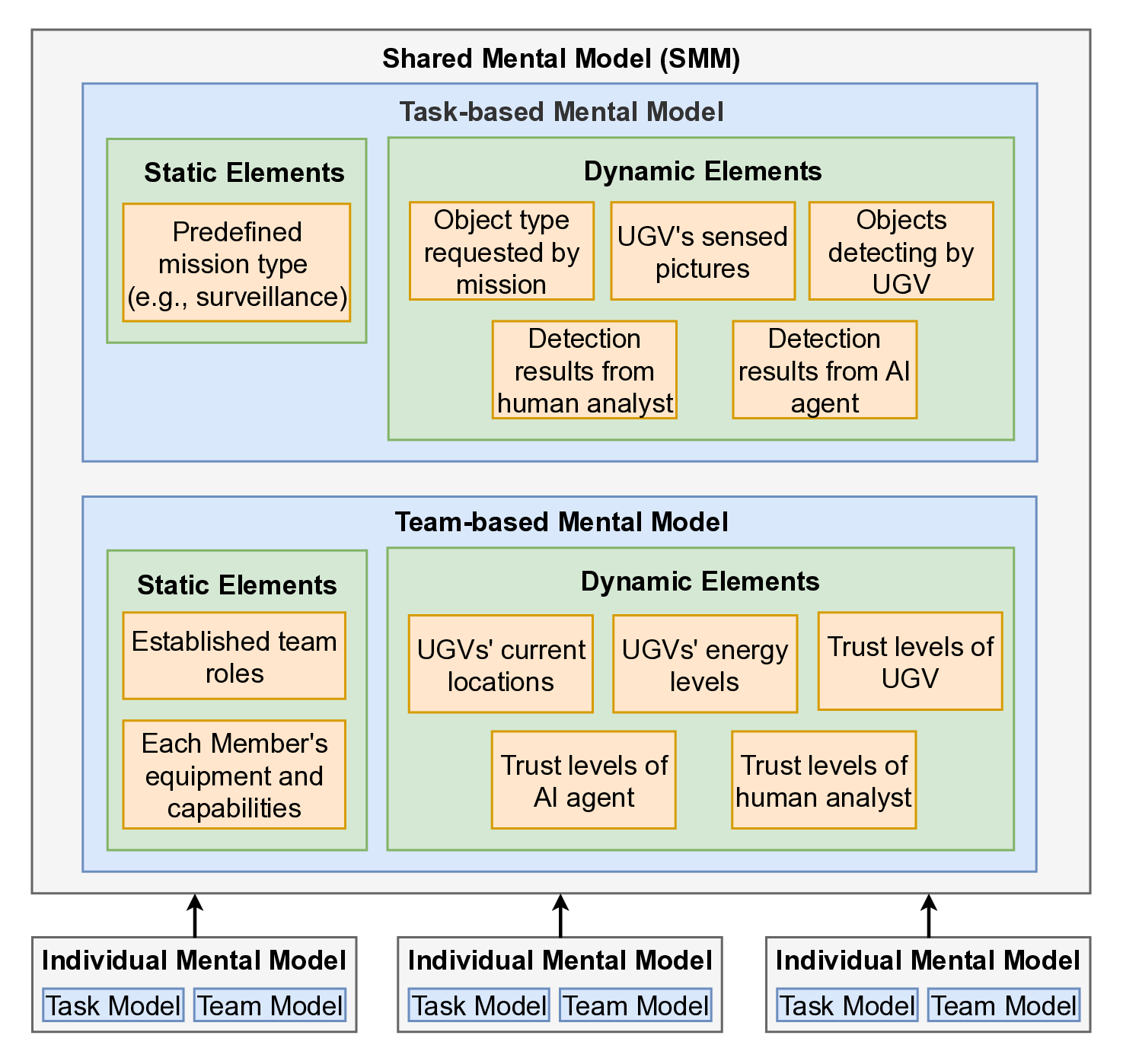
Shared Mental Model (SMM) enhances coordination by syn-
chronizing tasks, fosters verification and validation, promotes
adaptation to dynamic conditions, and mitigates failures. With-
out an effective SMM, miscommunication, inefficient task
This research is partially supported by the DEVCOM ARL Army Research
Office (ARO) Award (W911NF-24-2-0241), the National Science Foundation
(NSF) Secure and Trustworthy Cyberspace (SaTC) Award (2330940), and
the Virtual Institutes for Cyber and Electromagnetic Spectrum Research and
Employment (VICEROY) program under the Air Force Research Laboratory
(AFRL) initiatives through The Griffiss Institute (419890). The views and
conclusions contained in this document are those of the authors and should
not be interpreted as representing the official policies, either expressed
or implied, of the Army Research Laboratory or the U.S. Government.
The U.S. Government is authorized to reproduce and distribute reprints
for Government purposes, notwithstanding any copyright notation herein.
(Corresponding author: Zelin Wan). Zelin Wan, Han Jun Yoon, Nithin Alluru,
and Jin-Hee Cho are with the Department of Computer Science, Virginia
Tech, Arlington, VA, USA. Email: {zelin, godzmdi93, nithin, jicho}@vt.edu.
Terrence J. Moore and Frederica F. Nelson are with the US Army DEVCOM
Army Research Laboratory, Adelphi, MD, USA. Email: {terrence.j.moore.civ,
frederica.f.nelson.civ}@army.mil. Seunghyun Yoon and Hyuk Lim are with
the Korea Institute of Energy Technology (KENTECH), Naju-si, Jeollanam-
do, Republic of Korea. Email: {syoon, hlim}@kentech.ac.kr. Dan Dongseong
Kim is with the University of Queensland, Brisbane, Queensland, Australia.
Email: dan.kim@uq.edu.au.
allocation, and increased risks of mission failure arise [2].
Moreover, adversaries can exploit inconsistencies in trust and
coordination, underscoring the need for a security-aware HMT
framework that strengthens both collaboration and resilience.
Why are SMMs critical? According to Cannon-Bowers’
team mental model framework [3, 4], an SMM is known to
establish a shared understanding that enhances coherent task
execution and adaptability. However, their application in HMT
systems remains underdeveloped [5]. Existing models [6, 7]
fail to capture the dynamic interactions between human and
AI teammates, and security remains largely unaddressed. Tra-
ditional static defenses [8] are insufficient against adversaries
manipulating trust dynamics or selectively targeting system
components. To ensure mission integrity, a security-aware
SMM is essential for proactively detecting and mitigating these
evolving threats.
Cyber deception in HMT systems. Cyber deception has
emerged as a promising proactive defense strategy [9], offering
unique advantages in securing HMT systems. Unlike con-
ventional security mechanisms focusing solely on perimeter
defense or reactive threat detection [10, 11], cyber decep-
tion actively manipulates an adversary’s perception, inducing
suboptimal decisions [9]. This is particularly valuable in
HMT environments, where the diverse attack
…(Full text truncated)…
📸 Image Gallery
Reference
This content is AI-processed based on ArXiv data.