Casimir operators for the relativistic quantum phase space symmetry group
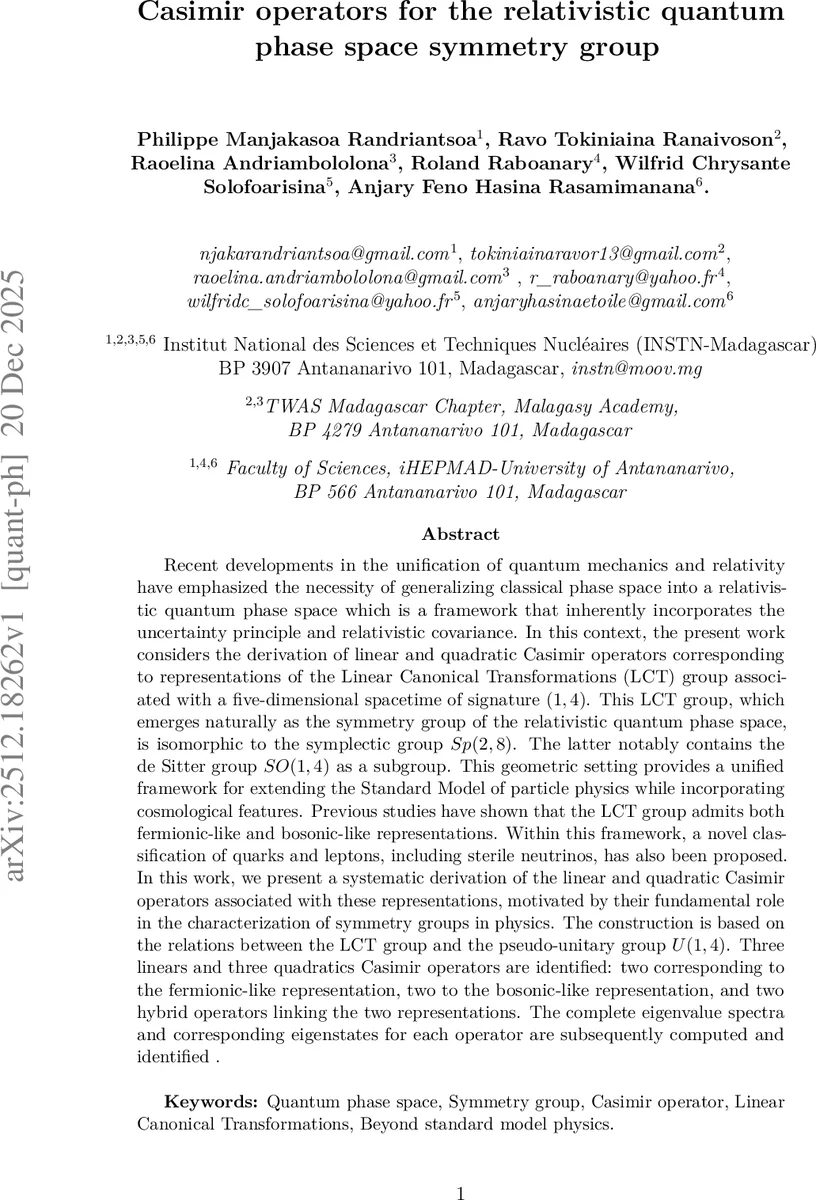
Recent developments in the unification of quantum mechanics and relativity have emphasized the necessity of generalizing classical phase space into a relativistic quantum phase space which is a framework that inherently incorporates the uncertainty principle and relativistic covariance. In this context, the present work considers the derivation of linear and quadratic Casimir operators corresponding to representations of the Linear Canonical Transformations (LCT) group associated with a five-dimensional spacetime of signature (1,4). This LCT group, which emerges naturally as the symmetry group of the relativistic quantum phase space, is isomorphic to the symplectic group Sp(2,8). The latter notably contains the de Sitter group SO(1,4) as a subgroup. This geometric setting provides a unified framework for extending the Standard Model of particle physics while incorporating cosmological features. Previous studies have shown that the LCT group admits both fermionic-like and bosonic-like representations. Within this framework, a novel classification of quarks and leptons, including sterile neutrinos, has also been proposed. In this work, we present a systematic derivation of the linear and quadratic Casimir operators associated with these representations, motivated by their fundamental role in the characterization of symmetry groups in physics. The construction is based on the relations between the LCT group and the pseudo-unitary group U(1,4). Three linears and three quadratics Casimir operators are identified: two corresponding to the fermionic-like representation, two to the bosonic-like representation, and two hybrid operators linking the two representations. The complete eigenvalue spectra and corresponding eigenstates for each operator are subsequently computed and identified
💡 Research Summary
The paper investigates the symmetry structure of a relativistic quantum phase space (QPS) by focusing on the group of Linear Canonical Transformations (LCT) defined on a five‑dimensional spacetime with signature (1,4). The authors show that this LCT group is isomorphic to the symplectic group Sp(2,8), which can also be identified with the pseudo‑unitary group U(1,4). Because Sp(2,8) is non‑compact and its Lie algebra is not semisimple, the usual construction of Casimir operators via the Killing form is not applicable. To overcome this, the paper exploits the isomorphism between the LCT representations and the Lie algebra u(1,4), which decomposes as u(1)⊕su(1,4); the simple part su(1,4) permits the definition of invariant operators.
Three types of representations are treated:
-
Fermionic (spin) representation – Clifford generators αμ and βμ are introduced, and combined into complex operators ζμ = (αμ + iβμ)/2. From these, the su(1,4) generators Ξμν = ½(ζμ†ζν – ζν†ζμ) are built. The linear Casimir C⁽¹⁾_F = η^{μν}Ξμν and the quadratic Casimir C⁽²⁾_F = η^{μρ}η^{νσ}ΞμνΞρσ are derived. By relating Ξμν to the number operators Σμν = ζμ†ζν, the eigenvalues are found to be C⁽¹⁾_F|f⟩ = (|f| – 5/2)|f⟩ and C⁽²⁾_F|f⟩ = 5/4|f⟩, where |f| is the sum of the five internal occupation numbers. These eigenvalues characterize the fermionic sector and reflect the presence of a central u(1) element.
-
Bosonic representation – Complex combinations of momentum and coordinate operators, zμ = (pμ + i xμ)/√2, and their Hermitian conjugates are defined. The symmetric generators Υμν = ½(zμ†zν + zν†zμ) again realize u(1,4). The corresponding Casimirs C⁽¹⁾_B = η^{μν}Υμν and C⁽²⁾_B = η^{μρ}η^{νσ}ΥμνΥρσ are obtained. Acting on the Fock states |n⟩ built from the creation operators (zμ†)ⁿμ, the eigenvalues become C⁽¹⁾_B|n⟩ = (N + 5/2)|n⟩ and C⁽²⁾_B|n⟩ = (N² + 5N + 5)/4|n⟩, where N = Σμ nμ is the total boson number. This reproduces the familiar spectrum of a five‑dimensional harmonic oscillator.
-
Hybrid representation – An operator Z₋ = (αμ pμ + βμ xμ)/√2 is introduced, which mixes the fermionic and bosonic sectors. Its square decomposes as Z₋² = ℵ + Σ, where ℵ = δ^{μν}zμ†zν (bosonic invariant) and Σ = δ^{μν}ζμ†ζν (fermionic invariant). Consequently Z₋ provides a bridge between the two sectors and yields mixed invariants that are quadratic in the underlying generators.
The paper emphasizes the physical relevance of the (1,4) signature: the de Sitter group SO(1,4) appears as a subgroup of the LCT group, linking the construction to a spacetime with a positive cosmological constant Λ. Within this geometric framework, sterile (right‑handed, gauge‑singlet) neutrinos emerge naturally from the fermionic spin representation, offering a group‑theoretic origin for these particles without ad‑hoc extensions of the Standard Model.
While the mathematical derivation of the six Casimir operators (three linear, three quadratic) is clear and the eigenvalue spectra are explicitly computed, several issues remain. The treatment of the central u(1) part is largely formal; its impact on physical observables such as mass splittings or mixing angles is not explored. The paper does not address domain and convergence questions for the unbounded operators on a Hilbert space, which is essential for a rigorous quantum‑theoretic formulation. Moreover, concrete phenomenological predictions—e.g., specific mass relations for quarks, leptons, or sterile neutrinos, or testable signatures in cosmology—are absent, leaving the connection to experiment speculative.
In summary, the work provides a systematic construction of linear and quadratic Casimir operators for the LCT symmetry of a relativistic quantum phase space, unifies fermionic, bosonic, and hybrid representations via the isomorphism with U(1,4), and suggests intriguing links to de Sitter cosmology and sterile neutrino physics. It lays a solid algebraic foundation for future model building that aims to extend the Standard Model within a covariant phase‑space framework, but further work is needed to translate these algebraic results into concrete physical predictions and to address the mathematical subtleties of non‑compact, non‑semisimple symmetry groups.
Comments & Academic Discussion
Loading comments...
Leave a Comment