Boundary Stabilization of a Degenerate Euler-Bernoulli Beam under Axial Force and Time Delay
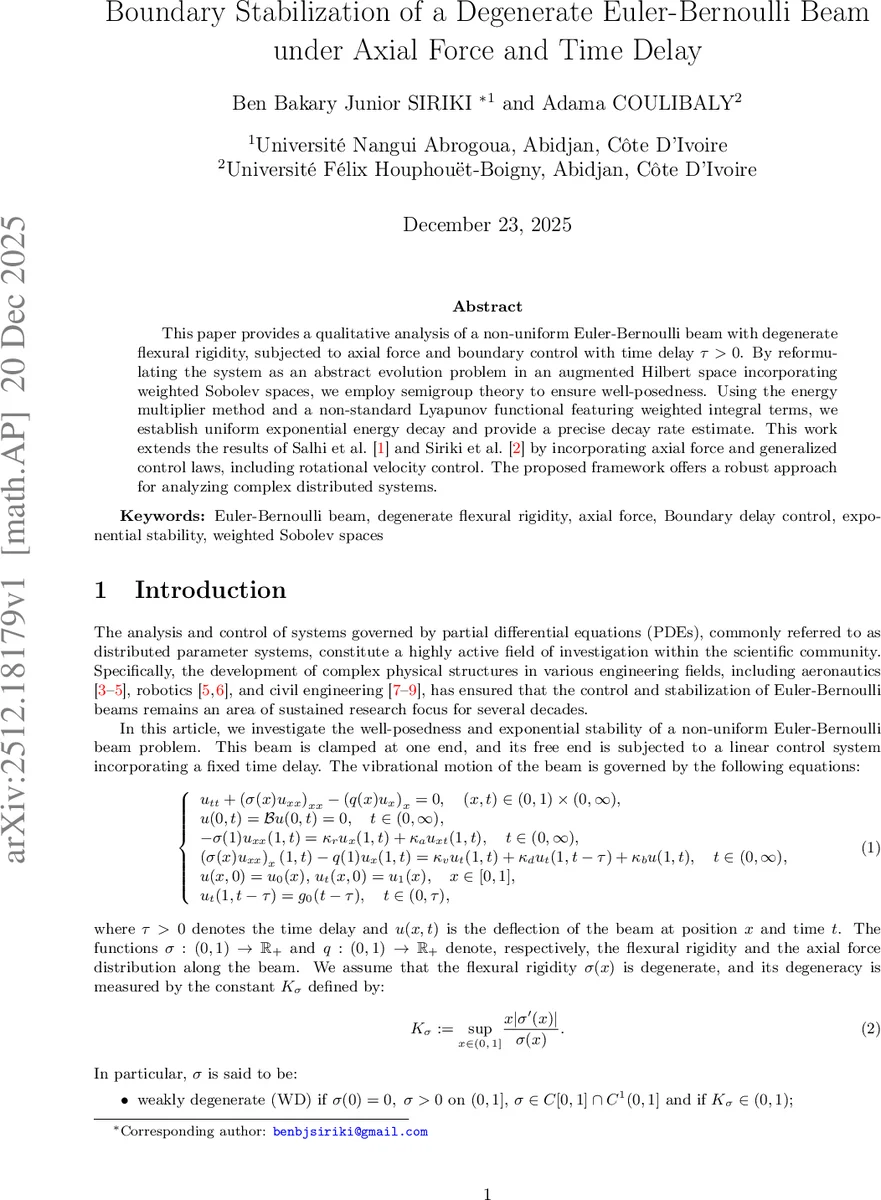
This paper provides a qualitative analysis of a non-uniform Euler-Bernoulli beam with degenerate flexural rigidity, subjected to axial force and boundary control with time delay $τ> 0$. By reformulating the system as an abstract evolution problem in an augmented Hilbert space incorporating weighted Sobolev spaces, we employ semigroup theory to ensure well-posedness. Using the energy multiplier method and a non-standard Lyapunov functional featuring weighted integral terms, we establish uniform exponential energy decay and provide a precise decay rate estimate. This work extends the results of Salhi et al. \cite{salhi2025} and Siriki et al. \cite{siriki2025} by incorporating axial force and generalized control laws, including rotational velocity control. The proposed framework offers a robust approach for analyzing complex distributed systems.
💡 Research Summary
The paper investigates a non‑uniform Euler‑Bernoulli beam whose flexural rigidity σ(x) may degenerate at the left endpoint, while also being subjected to an axial force distribution q(x). The beam is clamped at x=0 and its right end (x=1) is equipped with a linear boundary feedback that includes a proportional term, a rotational‑velocity term, and a delayed term with a fixed delay τ>0. The governing PDE and boundary conditions are
u_{tt} + (σ(x) u_{xx}){xx} – (q(x) u_x)x = 0, (x,t)∈(0,1)×(0,∞),
u(0,t)=0, B u(0,t)=0,
−σ(1)u{xx}(1,t)=κ_r u_x(1,t)+κ_a u{xt}(1,t),
(σ u_{xx})_x(1,t)−q(1)u_x(1,t)=κ_v u_t(1,t)+κ_d u_t(1,t−τ)+κ_b u(1,t).
The degeneracy is quantified by K_σ = sup_{x∈(0,1]} x|σ′(x)|/σ(x). Two regimes are distinguished: weakly degenerate (0<K_σ<1) and strongly degenerate (1≤K_σ<2). Because the operator loses uniform ellipticity, the authors introduce weighted Sobolev spaces V^2_σ(0,1) and H^2_{σ,0}(0,1) equipped with the norm ‖u‖{2,σ}= (‖√σ u{xx}‖_2^2+‖u_x‖_2^2+‖u‖_2^2)^{1/2}. These spaces are tailored to the degeneracy and guarantee completeness.
To handle the delay, the auxiliary variable w(s,t)=u_t(1,t−sτ) (s∈(0,1)) is introduced, satisfying the transport equation τ w_t + w_s = 0. The full state is U=(u,v,w) with v=u_t, and the evolution is written as a first‑order abstract Cauchy problem \dot U = A U in the Hilbert space
𝓗 = H^2_{σ,0}(0,1) × L^2(0,1) × L^2(0,1).
The operator A is defined by
A(u,v,w) = (v, (q u_x)x – (σ u{xx})_{xx}, –τ^{-1} w_s)
together with the boundary coupling conditions that involve the control gains κ_r, κ_a, κ_v, κ_d, κ_b. Its domain D(A) incorporates the weighted spaces and the appropriate boundary constraints (u(0)=0, B u(0)=0, and the relations linking v(1), w(0), w(1) to the physical boundary terms).
The first major result is the well‑posedness of the system. By computing ⟨AU,U⟩ and using the inequality |κ_d|<κ_v together with a parameter γ satisfying |κ_d|<γ<2κ_v−|κ_d|, the authors prove that A is dissipative:
⟨AU,U⟩ ≤ –(κ_v−γ)‖w(0)‖^2 – (κ_v−γ)‖w(1)‖^2 – κ_a‖v_x(1)‖^2 – κ_d w(0)w(1) ≤ 0.
They then establish the surjectivity of I−A via a variational formulation, applying the Lax‑Milgram theorem to a coercive bilinear form that incorporates the weighted Sobolev inner product and the boundary terms. Consequently, A is m‑dissipative and generates a C₀‑contraction semigroup on 𝓗. The Cauchy problem admits a unique global solution U∈C(
Comments & Academic Discussion
Loading comments...
Leave a Comment