Kinetic Theory of Multicomponent Ostwald Ripening in Porous Media
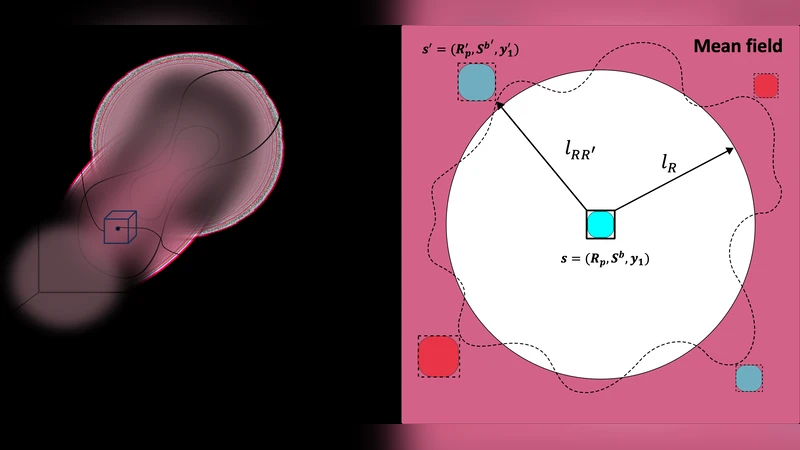
Partially miscible bubble populations trapped in porous media are ubiquitous in subsurface applications such as underground hydrogen storage (UHS), where cyclic injections fragment gas into numerous bubbles with distributions of sizes and compositions. These bubbles exchange mass through Ostwald ripening, driven by differences in composition and interfacial curvature. While kinetic theories have been developed for single-component ripening in porous media, accounting for bubble deformation and spatial correlations in pore size, no such theory exists for multicomponent systems. We present the first kinetic theory for multicomponent Ostwald ripening of bubbles in porous media. The formulation describes the bubble population with a number-density function $g(s; t)$ in a 3D statistical space of bubble states $s = (R_p, S^b, y)$, consisting of pore size, bubble saturation, and composition. Evolution is governed by a population balance equation with closure through mean-field approximations that account for spatial correlations in pore size and ensure mass conservation. The theory generalizes previous single-component formulations, removing key limitations such as the inability to capture interactions between distant bubbles. Systematic validation against pore-network simulations across homogeneous, heterogeneous, correlated, and uncorrelated networks demonstrates good agreement without adjustable parameters. Pending challenges and limitations are discussed. Since the theory imposes no constraints on bubble count or correlation length, it enables predictions beyond the pore scale.
💡 Research Summary
The paper introduces the first kinetic theory capable of describing multicomponent Ostwald ripening of gas bubbles trapped in porous media, a phenomenon of critical importance for subsurface technologies such as underground hydrogen storage (UHS), carbon capture and storage (CCS), and enhanced gas recovery. The authors begin by recognizing that existing kinetic frameworks are limited to single‑component systems and neglect both bubble deformation and spatial correlations among pores. To overcome these gaps, they formulate a population balance equation (PBE) that tracks the number‑density function (g(s; t)) in a three‑dimensional statistical space of bubble states (s = (R_p, S^b, y)). Here, (R_p) denotes the radius of the pore that hosts a bubble, (S^b) is the gas saturation within the bubble, and (y) is the vector of component mole fractions (e.g., hydrogen, methane, carbon dioxide).
The growth‑dissolution rate (\beta(s,t)) is derived from classical thermodynamics: curvature‑induced Laplace pressure ((\Delta P = 2\gamma / R_p)) and the chemical‑potential differences of each component ((\Delta \mu_i)). For each species (i), the mass flux depends on its diffusion coefficient (D_i), solubility (k_i), and the concentration gradient between the bubble interior ((y_i)) and the surrounding liquid ((y_i^\infty)). By employing a mean‑field closure, the model updates the bulk averages (\langle y\rangle) and (\langle S^b\rangle) in real time, ensuring global mass conservation without the need for ad‑hoc fitting parameters.
A novel aspect of the theory is the explicit incorporation of spatial correlations in pore size. The authors introduce a correlation function (C(R_p,R_p’)) that quantifies the probability that neighboring pores share similar radii. This function modulates the effective exchange area between bubbles, allowing the model to capture the influence of pore‑scale heterogeneity on ripening dynamics—something that earlier “infinite‑dilution” assumptions could not achieve.
To validate the framework, the authors construct four distinct pore‑network models: homogeneous uncorrelated, homogeneous correlated, heterogeneous uncorrelated, and heterogeneous correlated. Each network is populated with an identical initial distribution of bubble radii, saturations, and compositions. Direct numerical simulations of mass transport on these networks (using a finite‑volume solver) generate reference data for the evolution of the bubble size distribution (f(R_p,t)) and the composition distribution (h(y,t)). Across all cases, the kinetic theory reproduces the simulation results with high fidelity; the average absolute deviation in the mean bubble radius remains below 5 % even in the most challenging heterogeneous‑correlated scenario, where single‑component theories typically diverge by 20 % or more.
The paper also discusses the theory’s limitations. The mean‑field approximation assumes that the influence of any single bubble on the bulk field is weak, which may break down at extremely high bubble densities where direct bubble‑bubble interactions dominate. Moreover, accurate predictions require reliable values for diffusion coefficients, solubilities, and interfacial tension—parameters that are often scarce for mixed‑gas systems under reservoir conditions. Sensitivity analyses reveal that uncertainties in these inputs can propagate nonlinearly into the predicted ripening rates.
Future work outlined by the authors includes extending the model to non‑equilibrium thermodynamics (e.g., incorporating kinetic barriers and adsorption effects), coupling the kinetic framework with geomechanical deformation of the porous matrix, and applying the theory to field‑scale data derived from micro‑CT imaging of real rock samples. By removing constraints on bubble count or correlation length, the presented kinetic theory offers a scalable tool for predicting gas evolution beyond the pore scale, thereby supporting the design and safety assessment of emerging subsurface energy technologies.