Constrained Cuts, Flows, and Lattice-Linearity
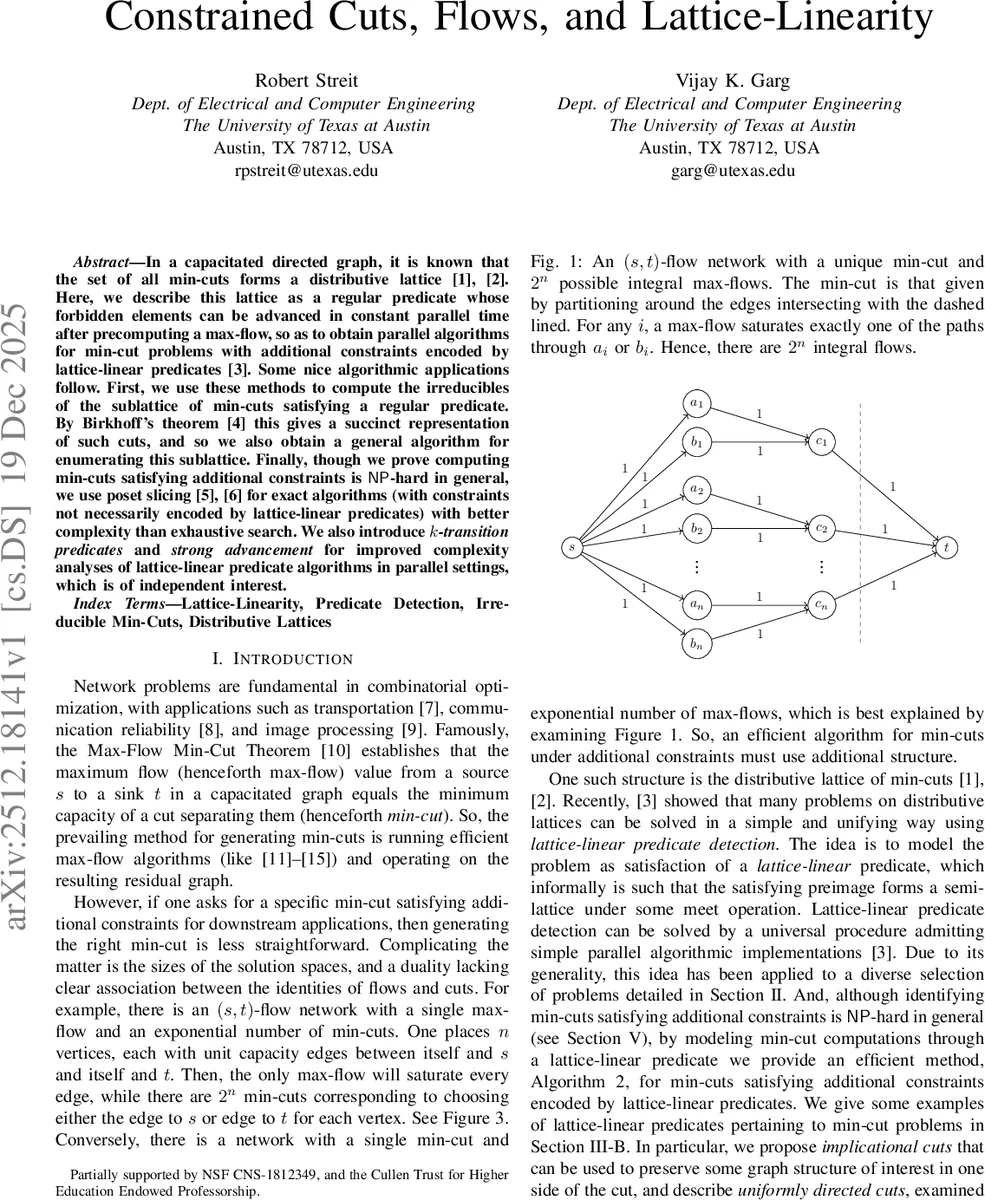
In a capacitated directed graph, it is known that the set of all min-cuts forms a distributive lattice [1], [2]. Here, we describe this lattice as a regular predicate whose forbidden elements can be advanced in constant parallel time after precomputing a max-flow, so as to obtain parallel algorithms for min-cut problems with additional constraints encoded by lattice-linear predicates [3]. Some nice algorithmic applications follow. First, we use these methods to compute the irreducibles of the sublattice of min-cuts satisfying a regular predicate. By Birkhoff’s theorem [4] this gives a succinct representation of such cuts, and so we also obtain a general algorithm for enumerating this sublattice. Finally, though we prove computing min-cuts satisfying additional constraints is NP-hard in general, we use poset slicing [5], [6] for exact algorithms with constraints not necessarily encoded by lattice-linear predicates) with better complexity than exhaustive search. We also introduce $k$-transition predicates and strong advancement for improved complexity analyses of lattice-linear predicate algorithms in parallel settings, which is of independent interest.
💡 Research Summary
The paper investigates the structure of minimum s‑t cuts in a capacitated directed graph and leverages the fact that all minimum cuts form a distributive lattice. By interpreting this lattice as a regular predicate—a predicate whose satisfying set is closed under both meet and join—the authors show that after a single max‑flow computation the set of “forbidden” vertices (coordinates that must be increased to satisfy the predicate) can be identified and advanced in constant parallel time. This yields a generic parallel framework for finding minimum cuts that satisfy additional constraints expressed as lattice‑linear predicates.
Key technical contributions
-
Regular‑predicate formulation (Theorem IV.2).
The authors prove that the collection of minimum cuts can be captured by a regular predicate on the Boolean lattice of vertex subsets. Forbidden vertices are exactly those that belong to the source side of the residual graph after a max‑flow, and they can be computed in O(1) parallel time per vertex. -
NP‑hardness of constrained min‑cut.
They demonstrate that imposing arbitrary constraints on minimum cuts (e.g., requiring certain vertices to lie on a particular side) makes the problem NP‑hard, establishing a theoretical limit for general-purpose algorithms. -
Algorithm 2 – Lattice‑linear predicate detection.
When constraints are lattice‑linear, the algorithm iteratively advances all currently forbidden vertices in parallel until no forbidden state remains. The parallel time is O(T_MF + n·T_B) and the total work is O(W_MF + n·(m + W_B)), where T_MF/W_MF are the time and work of the initial max‑flow, and T_B/W_B are the cost of computing forbidden vertices. -
k‑transition predicates and strong advancement.
The paper introduces k‑transition predicates, a subclass where each round can resolve at most k new forbidden states. With the strong advancement property (all forbidden states can be advanced to their least non‑forbidden state in a bounded number of steps), Theorem V.3 shows that Algorithm 2 converges in O(k) rounds, improving parallel depth compared to the generic O(k·T_B) bound. -
Algorithm 3 – Computing irreducibles of a sublattice.
For any regular predicate, the authors compute the set of irreducible elements (join‑irreducibles) of the induced sublattice of minimum cuts. This step costs O(T_MF + n·T_B) time and O(W_MF + n²·(m + n + W_B)) work. The irreducibles serve as a compact representation of the sublattice via Birkhoff’s representation theorem. -
Algorithm 4 – Enumeration via ideals.
Using the irreducibles, the algorithm enumerates all cuts satisfying a regular predicate by traversing the ideals of the poset of irreducibles. The delay between successive outputs is O(log n) (amortized) or O(n²) per cut if the full representation is materialized. This method is uniform: the same code enumerates unconstrained cuts, uniformly directed cuts, or any other regular‑predicate‑defined family. -
Algorithm 5 – Poset slicing for general constraints.
For constraints that are not lattice‑linear, the authors apply poset‑slicing techniques to prune the search space. The algorithm’s complexity is O(T_MF + n·T_reg + (R·log n)·T_B) time and O(W_MF + n²·m + n + W_reg + (R·n²)·W_B) work, where R is the number of cuts satisfying the (possibly non‑linear) constraint. This improves over naïve exhaustive search.
Complexity summary (Table I).
The table lists parallel time (T) and total work (W) for each algorithm, separating the cost of the max‑flow phase (T_MF, W_MF) from the cost of handling forbidden vertices (T_B, W_B). Notably, the enumeration algorithm’s per‑cut delay is polylogarithmic, and the irreducible‑computation step remains within a factor of n of the max‑flow cost.
Implications and applications.
By casting constrained min‑cut problems into the lattice‑linear predicate framework, the paper provides a unified method that works for a wide variety of practical constraints (e.g., preserving certain subgraph structures, uniformly directed cuts, reliability‑oriented cuts). The strong advancement and k‑transition concepts give tighter parallel depth guarantees, making the approach attractive for modern multicore or GPU platforms. Moreover, the irreducible‑based representation enables compact storage and fast enumeration, which can be useful in reliability analysis, network design, and image segmentation where many feasible cuts must be examined.
Overall assessment.
The work bridges combinatorial optimization (max‑flow/min‑cut theory) with distributed‑systems‑inspired predicate detection, delivering both theoretical insights (regular‑predicate characterization, NP‑hardness proof) and practical algorithmic tools (parallel detection, irreducible computation, enumeration, poset slicing). It extends the applicability of lattice‑linear predicate detection beyond previously studied domains (scheduling, stable marriage, etc.) into network flow problems, and introduces novel analytical tools (k‑transition predicates, strong advancement) that may inspire further research on parallel algorithms for constrained combinatorial optimization.
Comments & Academic Discussion
Loading comments...
Leave a Comment