Relative analytic reciprocity laws
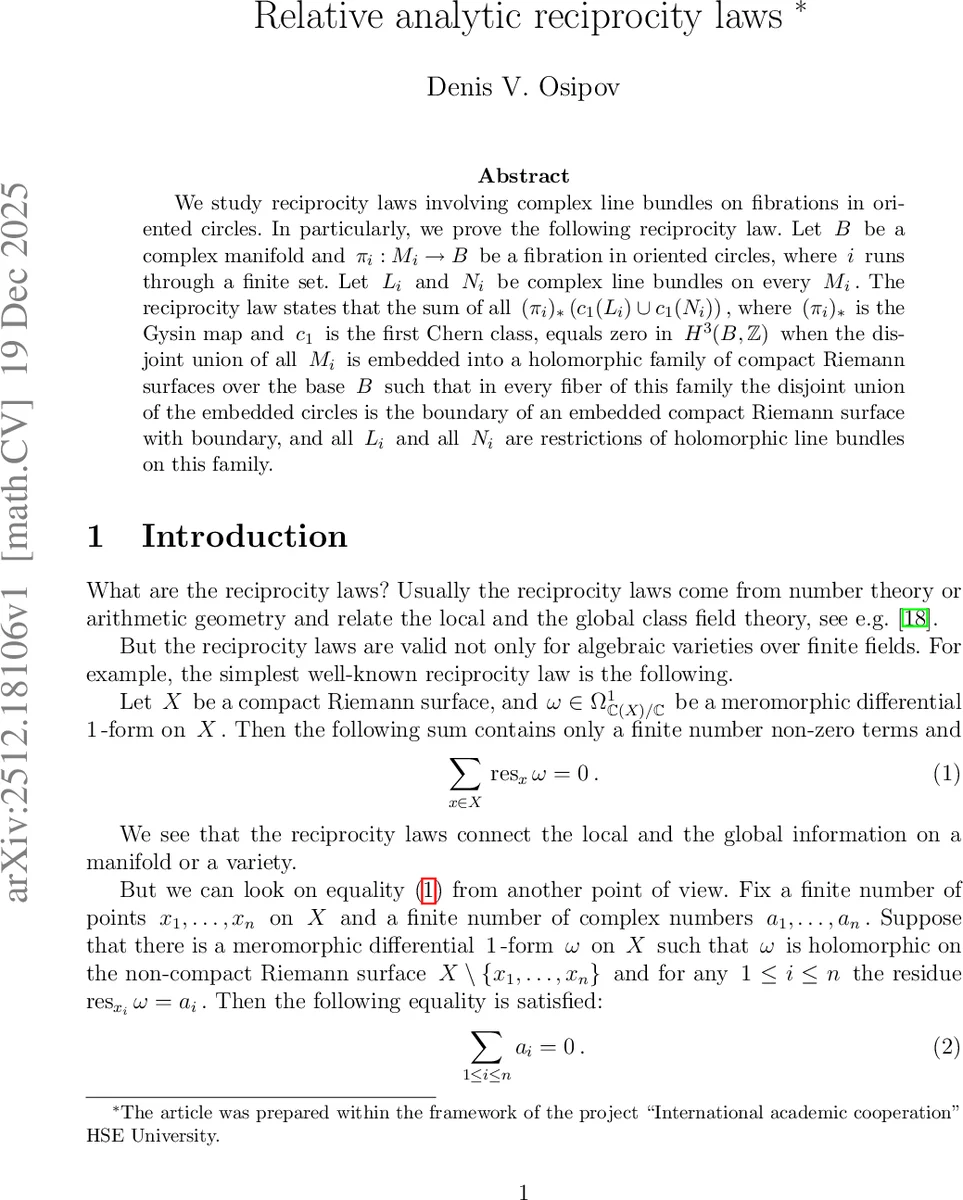
We study reciprocity laws involving complex line bundles on fibrations in oriented circles. In particularly, we prove the following reciprocity law. Let $B$ be a complex manifold and $π_i : M_i \to B$ be a fibration in oriented circles, where $i$ runs through a finite set. Let $L_i$ and $N_i$ be complex line bundles on every $M_i$. The reciprocity law states that the sum of all $(π_i)* \left(c_1(L_i) \cup c_1(N_i) \right)$, where $(π_i)*$ is the Gysin map and $c_1$ is the first Chern class, equals zero in $H^3(B, {\mathbb Z})$ when the disjoint union of all $M_i$ is embedded into a holomorphic family of compact Riemann surfaces over the base $B$ such that in every fiber of this family the disjoint union of the embedded circles is the boundary of an embedded compact Riemann surface with boundary, and all $L_i$ and all $N_i$ are restrictions of holomorphic line bundles on this family.
💡 Research Summary
The paper investigates a topological invariant arising from circle fibrations equipped with complex line bundles and shows that its vanishing is governed by holomorphic geometry. Let B be a (complex) manifold and for each index i a smooth fibration π_i : M_i → B whose fibers are oriented circles S¹. On each total space M_i two complex line bundles L_i and N_i are given. Their first Chern classes c₁(L_i), c₁(N_i) lie in H²(M_i,ℤ); their cup product lives in H⁴(M_i,ℤ). The Gysin (push‑forward) map (π_i)_* : H⁴(M_i,ℤ) → H³(B,ℤ) integrates along the circle fibers, producing an element \
Comments & Academic Discussion
Loading comments...
Leave a Comment