Designing the Community Infrastructure for ESO's Next Transformational Facility. Equitable Governance and Sustainable Teams for 2040s Astronomy
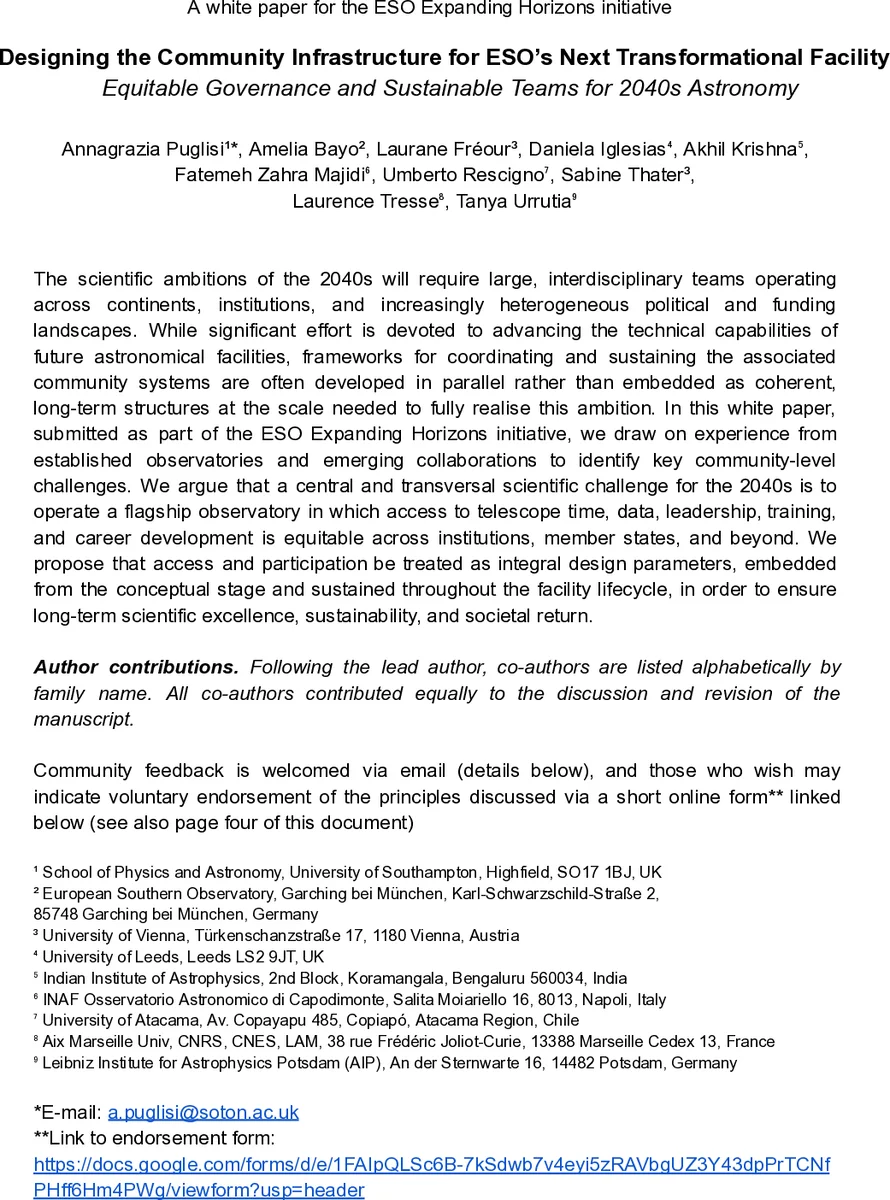
The scientific ambitions of the 2040s will require large, interdisciplinary teams operating across continents, institutions, and increasingly heterogeneous political and funding landscapes. While significant effort is devoted to advancing the technical capabilities of future astronomical facilities, frameworks for coordinating and sustaining the associated community systems are often developed in parallel rather than embedded as coherent, long-term structures at the scale needed to fully realise this ambition. In this white paper, submitted as part of the ESO Expanding Horizons initiative, we draw on experience from established observatories and emerging collaborations to identify key community-level challenges. We argue that a central and transversal scientific challenge for the 2040s is to operate a flagship observatory in which access to telescope time, data, leadership, training, and career development is equitable across institutions, member states, and beyond. We propose that access and participation be treated as integral design parameters, embedded from the conceptual stage and sustained throughout the facility lifecycle, in order to ensure long-term scientific excellence, sustainability, and societal return.
💡 Research Summary
The white paper argues that the scientific ambitions of the 2040s—characterized by massive, interdisciplinary, and trans‑national collaborations—cannot be realized by focusing solely on the technical design of new observatories. Instead, equitable governance, sustainable team structures, and inclusive community infrastructure must be embedded from the very conceptual stage of any flagship facility. Drawing on lessons from SDSS, ALMA, JWST, Rubin/LSST and other large‑scale projects, the authors identify five systemic barriers that currently limit participation: (1) structural and personal obstacles faced by junior scientists, caregivers, people with disabilities, and other under‑represented groups; (2) uneven institutional capacity that concentrates expertise in a few well‑funded centres; (3) career precarity caused by short‑term contracts, which forces researchers to choose between contributing to future facilities and securing immediate employment; (4) insufficient engagement with local and Indigenous communities, risking cultural conflict and loss of social licence; and (5) the undervaluation of equity, diversity, and inclusion (EDI) work, which is often shouldered by early‑career staff without recognition or protected time.
To overcome these challenges, the paper proposes six design principles for the next ESO facility:
-
Equitable access, redistribution, and reward mechanisms – Time‑allocation and data‑access policies should explicitly account for institutional size and resources, incorporating co‑PI structures, mentorship pairings, and onboarding programmes that lower entry barriers for smaller institutes and technical contributors such as software developers.
-
Transparent governance and equitable leadership pathways – Open calls, clear selection criteria, fixed‑term appointments, and systematic rotation of leadership roles should be codified. Shadowing, co‑leadership, and mentorship models would create structured routes for early‑career researchers and under‑represented groups to assume visible leadership positions.
-
Integrated EDI and community‑governance structures – Dedicated budget lines, reporting hierarchies, and safe‑reporting mechanisms (e.g., ombudspersons) must be institutionalised. Contributions to EDI and community service should be formally recognised in promotion, hiring, and service‑time frameworks, with protected fractions of paid time to avoid over‑burdening a small subset of individuals.
-
Accountability, transparency, and community‑health data – Regular, centrally organised surveys on inclusion, climate, and access—conducted with robust ethical and GDPR‑compliant safeguards—should feed into public dashboards that track leadership demographics, participation patterns, and emerging inequities, enabling timely corrective actions.
-
Engagement with local and Indigenous communities – Dialogue with host‑region stakeholders must begin at the planning stage, influencing decisions such as energy sourcing, environmental mitigation, and benefit‑sharing. This approach safeguards the facility’s social licence and promotes culturally and environmentally sustainable operations.
-
Open, multi‑channel communication with the broader community – Multiple engagement pathways (public consultations, dedicated forums for marginalized groups, open‑membership calls) are essential to capture the full spectrum of perspectives and ensure that governance evolves responsively.
On the technical side, the authors recommend concrete community‑enabling infrastructures: a unified collaboration platform that centralises communication, documentation, training, and decision‑making; data archives that extend ESO and ALMA models to guarantee fair, efficient access and provide targeted support for less‑resourced institutes; and analytics tools that monitor community health while respecting privacy.
By treating access, participation, and equity as core design parameters rather than optional add‑ons, ESO can create a flagship observatory that not only pushes the frontiers of astrophysics but also delivers maximal scientific and societal return. Embedding these principles structurally—rather than relying on voluntary or local initiatives—will protect the project from volatile national politics and ensure long‑term resilience, talent retention, and innovative scientific output across the 2040s and beyond.
Comments & Academic Discussion
Loading comments...
Leave a Comment