Non-Abelian topological superconductivity from melting Abelian fractional Chern insulators
Fractional Chern insulators (FCI) are exotic phases of matter realized at partial filling of a Chern band that host fractionally charged anyon excitations. Recent numerical studies in several microscopic models reveal that increasing the bandwidth in an FCI can drive a direct transition into a charge-2e superconductor rather than a conventional Fermi liquid. Motivated by this surprising observation, we propose a theoretical framework that captures the intertwinement between superconductivity and fractionalization in a lattice setting. Leveraging the duality between three field-theoretic descriptions of the Jain topological order, we find that bandwidth tuning can drive a single parent FCI at $ν= 2/3$ into five different superconductors, some of which are intrinsically non-Abelian and support Majorana zero modes. Our results reveal a rich landscape of exotic superconductors with no normal state Fermi surface and predict novel higher-charge superconductors coexisting with neutral non-Abelian topological order at more general filling fractions $ν= p/(2p+1)$.
💡 Research Summary
The paper addresses a striking phenomenon observed in recent density‑matrix renormalization group (DMRG) studies: increasing the bandwidth of a fractional Chern insulator (FCI) at filling ν = 2/3 can drive a direct quantum phase transition into a charge‑2e superconductor, bypassing the expected Fermi‑liquid metal. Motivated by this, the authors develop a unified field‑theoretic framework that captures the interplay between superconductivity and fractionalization on a lattice.
Starting from the Jain FCI at ν = 2/3, they first construct three equivalent low‑energy topological quantum field theories (TQFTs) using parton decompositions of the electron operator. The most transparent description employs three fermionic partons f₁, f₂, f₃ with Chern numbers (1, 1, −2), leading to a U(2) Chern‑Simons theory with level (−1, 6). By rearranging the parton mean‑field ansatz they obtain two additional U(2) theories (one with an extra U(1) factor) and the familiar U(1) × U(1) description. All three reproduce the hallmark topological data of the Jain state: Hall conductance σ_xy = 2/3, chiral central charge c₋ = 0, and three‑fold ground‑state degeneracy on the torus.
The central insight is that the nature of the quantum critical point (QCP) is dictated by which quasiparticle gap closes when the bandwidth is tuned. Two broad classes emerge:
-
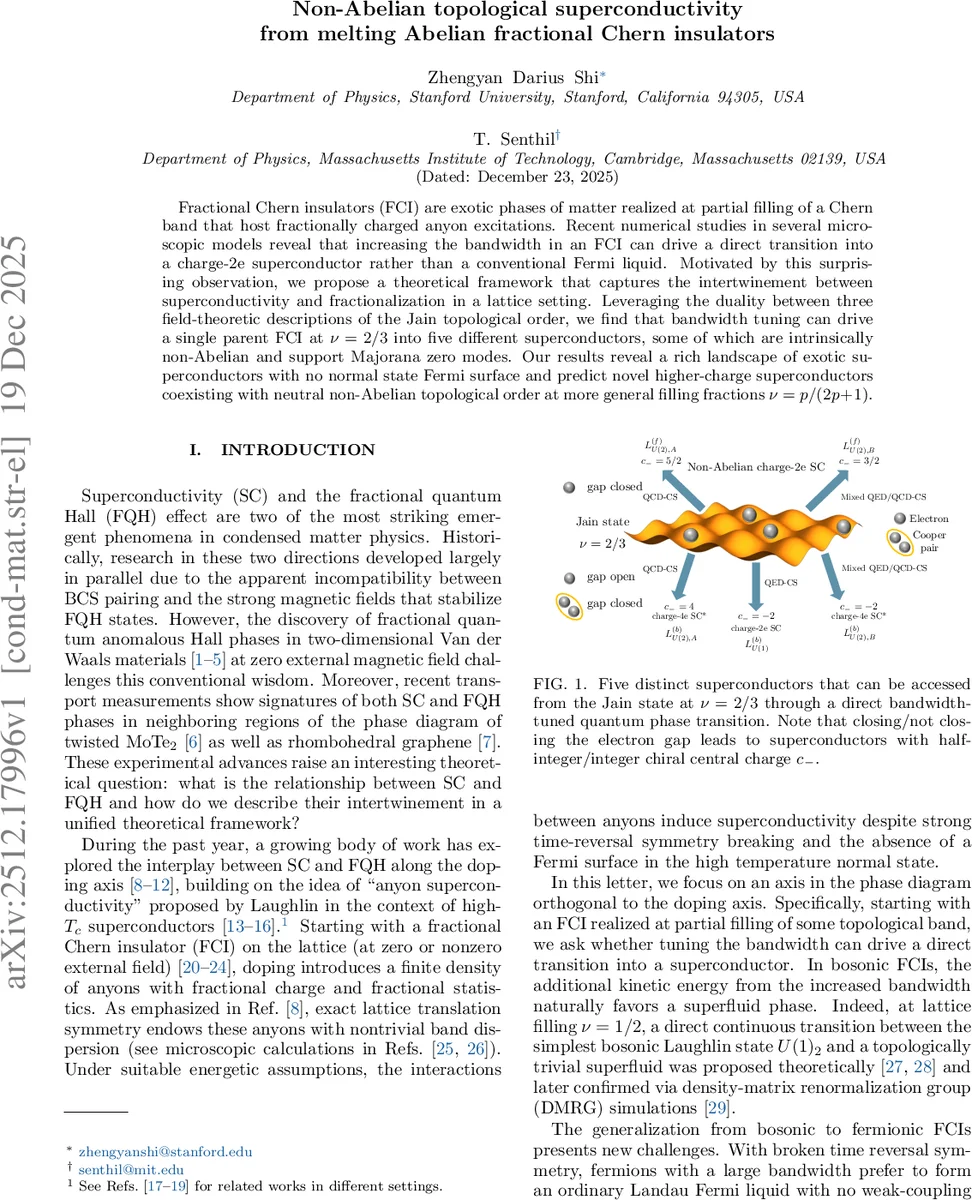
Bosonic QCP – the gap of the 2/3 anyon (Δ₂/₃) vanishes while the 1/3 anyon remains gapped. In the parton language this corresponds to a band inversion of f₁ and/or f₂, changing their Chern numbers by ±3 while keeping f₃ fixed. The electron stays gapped, and the only low‑energy charge‑2 object is a Cooper pair. The critical theory is a massless QED‑CS with N_f = 3 Dirac fermions coupled to a U(1) gauge field (the “QED‑CS” fixed point). Integrating out the massive partons yields a chiral charge‑2e superconductor with chiral central charge c₋ = −2 (Fig. 1, lower‑middle panel).
-
Fermionic (non‑Abelian) QCP – the gap of the 1/3 anyon (Δ₁/₃) closes, forcing both the electron and the charge‑4 Cooper pair to become gapless. In the U(2) description this requires a simultaneous shift of C₁ and C₂ by +3, moving from (1, 1, −2) to (4, 4, −2). The resulting TQFT is U(2)₋₄,0 × U(1)₆⁻¹, which describes a charge‑4e “SC*” phase: a superconductor coexisting with a residual SU(2)₋₄/Z₂ non‑Abelian topological order. The QCP is a QCD‑CS theory with gauge group U(2) and three flavors of Dirac fermions (N_f = 3).
A third parton construction, c = Φ_σ ε_{σσ′} f_{σ′}, introduces bosonic fields Φ that carry SU(2) spin ½. When Φ experiences a band inversion that changes its Hall conductance by 6, a distinct charge‑4e SC* with chiral central charge c₋ = −2 and SU(2)₄/Z₂ topological order emerges (Fig. 1, lower‑left panel).
Collectively, the authors identify five distinct superconducting phases reachable from the ν = 2/3 Jain FCI by bandwidth tuning:
- A charge‑2e chiral superconductor (c₋ = −2) with a gapped electron.
- A charge‑4e SC* (c₋ = 4) coexisting with an Abelian topological order.
- A charge‑2e topological superconductor with c₋ = 3/2 (electron gap closed).
- A charge‑2e topological superconductor with c₋ = 5/2 (electron gap closed).
- A charge‑4e SC* (c₋ = −2) with non‑Abelian SU(2)₄/Z₂ order.
The framework naturally extends to the whole Jain series ν = p/(2p + 1). For arbitrary integer p, analogous bandwidth‑driven transitions produce higher‑charge superconductors (charge = 2(p + 1)e, 2p e, or 4e) that coexist with neutral non‑Abelian topological orders. The resulting “Jain‑SC” landscape is illustrated in Fig. 2 and predicts exotic superconductors lacking any normal‑state Fermi surface.
The work thus provides a concrete, analytically tractable mechanism for “melting” an Abelian fractional Chern insulator into a variety of unconventional superconductors, some of which host Majorana zero modes in vortex cores. It bridges the gap between fractional quantum Hall physics and superconductivity, offering clear experimental signatures (e.g., chiral edge thermal conductance, quantized vortex bound states) and guiding future numerical and material‑realization efforts in twisted moiré systems and other two‑dimensional platforms.
Comments & Academic Discussion
Loading comments...
Leave a Comment