Witnessing Entanglement in Mixed-Particle Quantum Systems
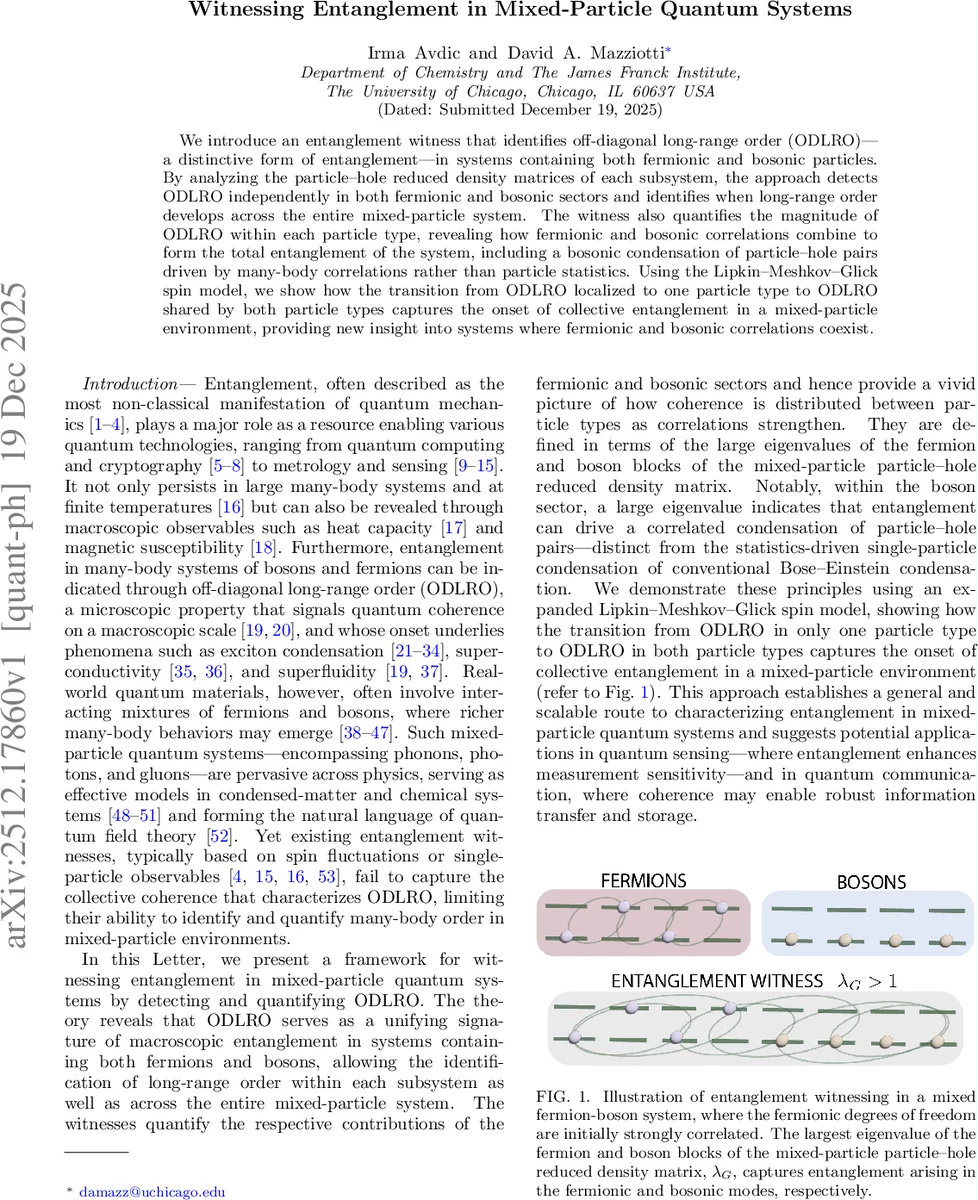
We introduce an entanglement witness that identifies off-diagonal long-range order (ODLRO) – a distinctive form of entanglement – in systems containing both fermionic and bosonic particles. By analyzing the particle-hole reduced density matrices of each subsystem, the approach detects ODLRO independently in both fermionic and bosonic sectors and identifies when long-range order develops across the entire mixed-particle system. The witness also quantifies the magnitude of ODLRO within each particle type, revealing how fermionic and bosonic correlations combine to form the total entanglement of the system, including a bosonic condensation of particle-hole pairs driven by many-body correlations rather than particle statistics. Using the Lipkin-Meshkov-Glick spin model, we show how the transition from ODLRO localized to one particle type to ODLRO shared by both particle types captures the onset of collective entanglement in a mixed-particle environment, providing new insight into systems where fermionic and bosonic correlations coexist.
💡 Research Summary
In this work the authors introduce a novel entanglement witness that directly targets off‑diagonal long‑range order (ODLRO), a specific form of quantum coherence that manifests as macroscopic entanglement in many‑body systems. By focusing on the particle–hole two‑point reduced density matrix (2 G), they show that the largest eigenvalue λ_G of this positive‑semidefinite matrix exceeds unity whenever multiple particle–hole pairs occupy the same excitonic mode, i.e., when ODLRO is present. Crucially, the method works for both fermionic and bosonic degrees of freedom: after tracing out one species, the fermionic (2 f G) and bosonic (2 b G) sub‑blocks are obtained, and their respective leading eigenvalues λ_G^f and λ_G^b serve as independent witnesses for ODLRO in each sector. The authors also derive a general upper bound λ_G ≤ N(r‑N)/r, which for a mixed system of N fermions and N bosons occupying 2N single‑particle levels reduces to λ_G ≤ N², confirming that the witness scales at most linearly with particle number.
To demonstrate the practical utility of the witness, the paper extends the exactly solvable Lipkin‑Meshkov‑Glick (LMG) model to a hybrid fermion‑boson setting. The conventional LMG Hamiltonian H_f describes N spin‑½ fermions in two degenerate levels with a pair‑scattering interaction V_f. An analogous bosonic Hamiltonian H_b is built by replacing fermionic operators with bosonic ones and using an interaction strength V_b. A cross‑species coupling term H_i = (μ/2N)∑_{p,q}(f†_p f_p b†_q b_q + h.c.) is added, allowing simultaneous excitation of one species and de‑excitation of the other; μ controls the strength of fermion‑boson particle‑hole exchange.
Numerical calculations are performed for systems of up to 12 particles (6 fermions + 6 bosons) in 24 orbitals. Heat‑maps of λ_G^f and λ_G^b as functions of the intra‑fermion interaction V_f and the inter‑species coupling μ reveal several key trends:
-
Fermionic ODLRO grows with |V_f|, but reaches its maximal value only when μ is non‑zero. At μ = 0 the fermions remain weakly correlated even for large |V_f|, indicating that inter‑species exchange is essential for the emergence of collective order.
-
Bosonic ODLRO is robust across the parameter space because V_b is set to a strong attractive value (V_b = –2). Consequently λ_G^b stays high irrespective of μ, illustrating that a bosonic subsystem can sustain ODLRO independently.
-
When μ is increased, initially uncorrelated fermions develop ODLRO in a manner that mirrors the bosonic sector, confirming that λ_G acts as a unified entanglement witness capable of tracking the transfer of coherence from one particle type to the other.
The authors also explore a more realistic electron‑phonon scenario where the two species have markedly different single‑particle energies (ε_e ≫ ε_p). Two initial conditions are compared: (i) both sectors start uncorrelated (λ_G = 1) and require strong coupling (μ > 0.5) to reach λ_G ≈ 3; (ii) both sectors are already partially correlated (λ_G ≈ 2) and achieve the same maximal λ_G at a much lower coupling threshold (μ > 0.2). This demonstrates that pre‑existing intra‑species correlations lower the interaction strength needed for cross‑species ODLRO, and that the energy gap between species influences the order in which each subsystem develops long‑range coherence.
The discussion emphasizes that λ_G is insensitive to particle statistics; a large bosonic eigenvalue signals a condensation of particle‑hole pairs driven by many‑body correlations rather than by Bose‑Einstein statistics. Hence the witness captures a broader class of macroscopic quantum phenomena, including exciton condensation, superconductivity, and superfluidity, in mixed‑particle environments.
In the concluding section the authors outline potential applications. In quantum memory, the ability to detect and quantify ODLRO could guide the design of hybrid spin‑photon storage devices. In quantum computing, the framework may inform the development of fermion‑boson analog simulators (e.g., silicon dopant arrays). In quantum sensing, monitoring how λ_G responds to external fields could provide a new route to high‑sensitivity measurements that exploit collective entanglement across different particle species. Finally, the work establishes a scalable, experimentally accessible tool for characterizing macroscopic entanglement in realistic mixed‑particle systems, opening avenues for future studies on larger lattices, dynamical processes, and material‑specific implementations.
Comments & Academic Discussion
Loading comments...
Leave a Comment