Roughness-induced effects on the thermomicropolar fluid flow through a thin domain
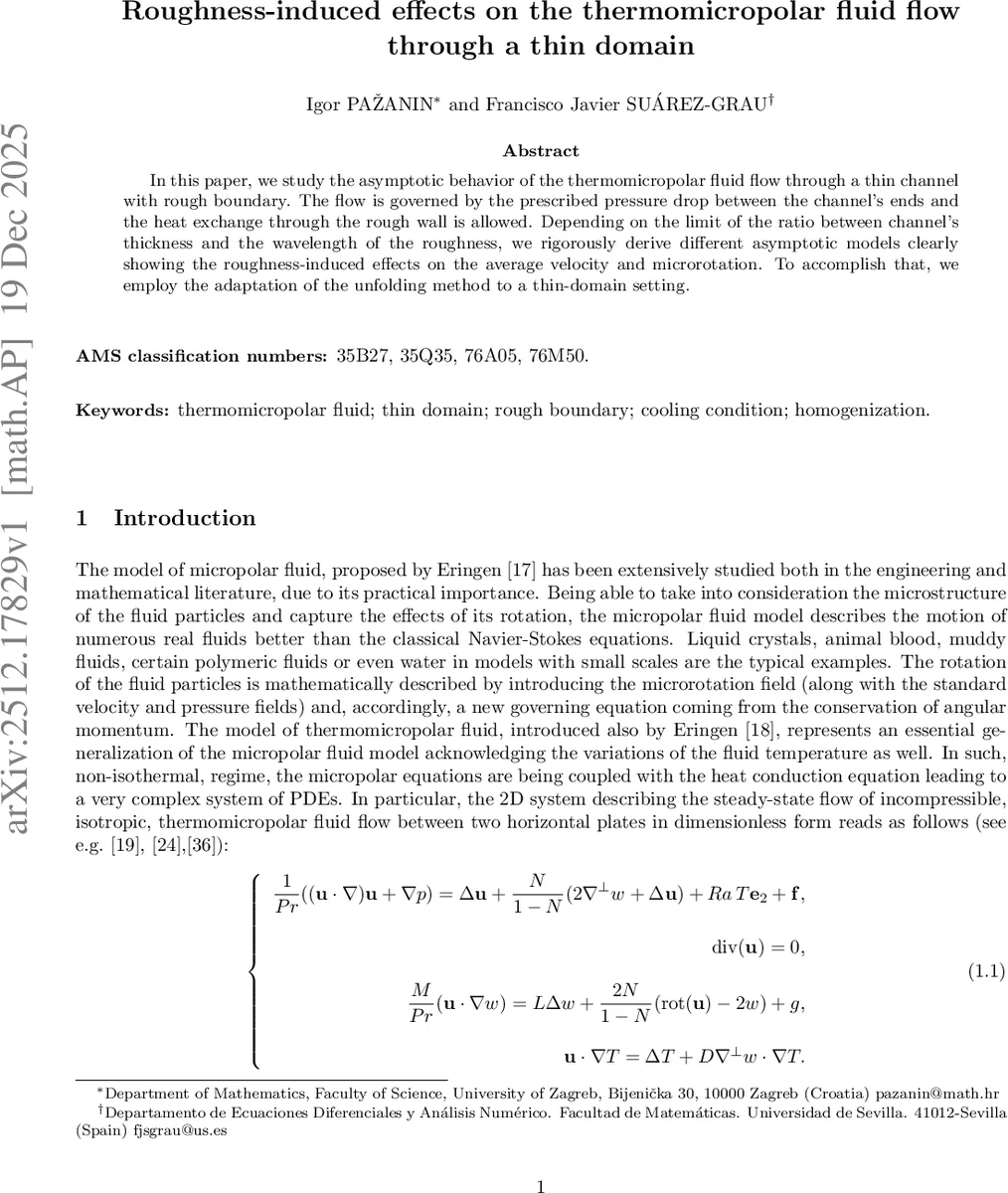
In this paper, we study the asymptotic behavior of the thermomicropolar fluid flow through a thin channel with rough boundary. The flow is governed by the prescribed pressure drop between the channel’s ends and the heat exchange through the rough wall is allowed. Depending on the limit of the ratio between channel’s thickness and the wavelength of the roughness, we rigorously derive different asymptotic models clearly showing the roughness-induced effects on the average velocity and microrotation. To accomplish that, we employ the adaptation of the unfolding method to a thin-domain setting.
💡 Research Summary
The paper investigates the asymptotic behavior of a steady, incompressible, non‑isothermal thermomicropolar fluid flowing through a thin two‑dimensional channel whose upper wall exhibits rapid periodic roughness. The governing equations are the dimensionless Eringen thermomicropolar system, coupling the Navier–Stokes‑type momentum balance, a microrotation equation, and a heat equation with a micro‑rotation‑dependent convection term. The channel geometry is defined by
\
Comments & Academic Discussion
Loading comments...
Leave a Comment