Zeros of polynomial powers under the heat flow
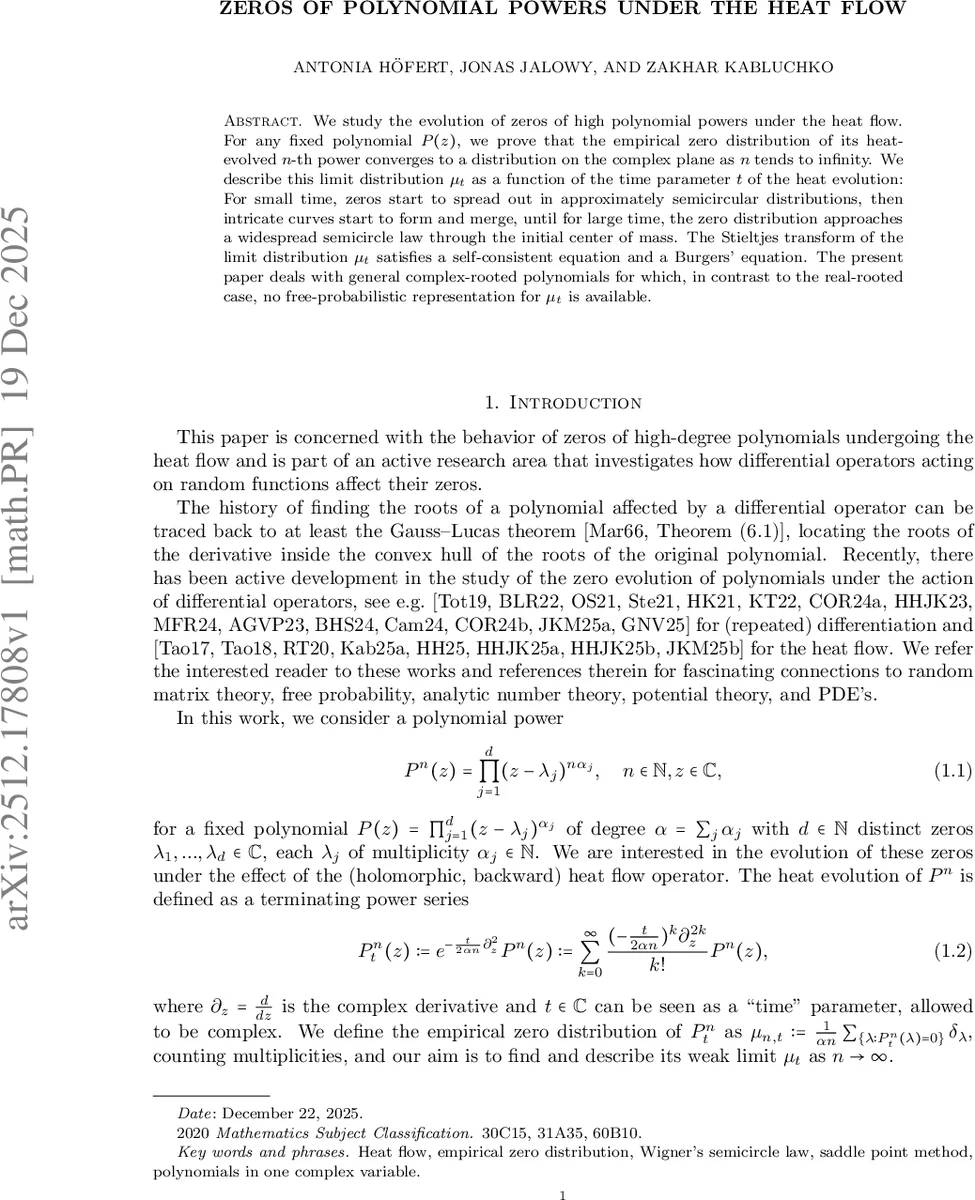
We study the evolution of zeros of high polynomial powers under the heat flow. For any fixed polynomial $P(z)$, we prove that the empirical zero distribution of its heat-evolved $n$-th power converges to a distribution on the complex plane as $n$ tends to infinity. We describe this limit distribution $μ_t$ as a function of the time parameter $t$ of the heat evolution: For small time, zeros start to spread out in approximately semicircular distributions, then intricate curves start to form and merge, until for large time, the zero distribution approaches a widespread semicircle law through the initial center of mass. The Stieltjes transform of the limit distribution $μ_t$ satisfies a self-consistent equation and a Burgers’ equation. The present paper deals with general complex-rooted polynomials for which, in contrast to the real-rooted case, no free-probabilistic representation for $μ_t$ is available.
💡 Research Summary
This paper investigates the asymptotic behavior of the zeros of high‑degree polynomial powers when they are subjected to the (backward) heat flow. Starting from a fixed polynomial
(P(z)=\prod_{j=1}^{d}(z-\lambda_{j})^{\alpha_{j}})
with possibly complex roots (\lambda_{j}) and multiplicities (\alpha_{j}), the authors consider its (n)-th power (P_{n}(z)=P(z)^{n}) of degree (\alpha n) and apply the holomorphic heat operator
(P_{n,t}(z)=e^{-t^{2}\alpha n\partial_{z}^{2}}P_{n}(z)=\sum_{k\ge0}\frac{(-t^{2}\alpha n)^{k}}{k!}\partial_{z}^{2k}P_{n}(z)).
For each fixed time (t\in\mathbb{C}) they define the empirical zero measure
(\mu_{n,t}= \frac{1}{\alpha n}\sum_{P_{n,t}(\zeta)=0}\delta_{\zeta})
(counting multiplicities) and prove that, as (n\to\infty), (\mu_{n,t}) converges weakly to a compactly supported probability measure (\mu_{t}) on (\mathbb{C}). The limit is singular with respect to Lebesgue measure and, remarkably, its support consists of finitely many smooth curves (plus possible endpoints).
The core of the analysis is a saddle‑point method applied to an integral representation of (P_{n,t}). The relevant real‑valued function is
(G(z,u)=\frac{1}{\alpha}\sum_{j=1}^{d}\alpha_{j}\log|u-\lambda_{j}|+\Re\frac{(z-u)^{2}}{2t}).
Critical points satisfy the algebraic equation
(u+t\sum_{j=1}^{d}\frac{\alpha_{j}}{u-\lambda_{j}}=z)
which has at most (d+1) solutions (u_{1}^{t}(z),\dots,u_{d+1}^{t}(z)). By selecting a particular branch (u_{t}^{}(z)) (the one minimizing (G)), the authors obtain an explicit formula for the Stieltjes transform of the limit measure:
(m_{t}(z)=\frac{1}{t}\frac{1}{z-u_{t}^{}(z)}), (z) in a domain (D_{t}) where the branches are distinct. This transform satisfies the self‑consistent equation
(m_{t}(z)=\frac{1}{\alpha}\sum_{j=1}^{d}\frac{\alpha_{j}}{z-t,m_{t}(z)-\lambda_{j}}).
When all (\lambda_{j}) are real, this reduces to the well‑known free‑convolution description (\mu_{t}=\mu_{0}\boxplus\mathrm{sc}{t}) (the free additive convolution of the initial zero distribution with the semicircle law). For general complex roots, the same algebraic structure persists, providing a new description of (\mu{t}) beyond free probability.
The logarithmic potential (U_{t}(z)=G(z,u_{t}^{*}(z))) satisfies a Hamilton‑Jacobi PDE
(\partial_{t}U_{t}(z)=-(\partial_{z}U_{t}(z))^{2}),
and, via the relation (m_{t}=2\partial_{z}U_{t}), the Stieltjes transform obeys the inviscid Burgers equation
(\partial_{t}m_{t}(z)=-\frac12\partial_{z}(m_{t}(z)^{2})).
These PDEs explain the formation of “shock curves”—the support curves of (\mu_{t})—as time evolves.
The paper details the geometric evolution of the support for different time regimes:
-
Small time (t\to0): Near each initial zero (\lambda_{j}) the rescaled measure converges to a semicircle law of total mass (\alpha_{j}/\alpha). Explicitly, after the affine map (T_{j}(z)=z-\lambda_{j}) and scaling by (t^{\alpha_{j}/\alpha}), one obtains (\mu_{t}\Rightarrow (\alpha_{j}/\alpha),\mathrm{sc}_{1}). Thus the zeros initially spread out as tiny semicircles.
-
Moderately small (t): The support lies inside a union of disks centered at the (\lambda_{j}) with radii ((2+\varepsilon)\sqrt{t,\alpha_{j}/\alpha}). The zeros are still clustered around their origins.
-
Arbitrary positive (t): The support collapses onto finitely many smooth curves (and possibly endpoints). The Stieltjes transform’s branch points correspond precisely to the points where two branches of the saddle‑point equation give the same value of (G); these are the shock locations.
-
Large time (t\to\infty): After global scaling by (\sqrt{t}) the measure converges to the standard semicircle law (\mathrm{sc}{1}). Locally, within any fixed disk around the center of mass (\frac{1}{\alpha}\sum{j}\alpha_{j}\lambda_{j}), the support becomes a single horizontal curve that, in the Hausdorff metric, approaches a straight line through that center as (t) grows.
The authors also discuss the relation to previous work on repeated differentiation of polynomial powers and on random polynomials with independent coefficients. Their results extend the free‑probabilistic picture to the fully complex setting and demonstrate that the saddle‑point framework remains robust even when the initial zeros are highly clustered (as in polynomial powers).
Methodologically, the paper combines complex analysis (multivalued holomorphic functions, branch selection), asymptotic analysis (steepest‑descent/saddle‑point), and probabilistic potential theory (logarithmic potentials, Stieltjes transforms). The rigorous proof of weak convergence proceeds by showing convergence of logarithmic potentials on the complement of the support, then invoking the distributional Laplacian to obtain the limiting measure.
In conclusion, the paper provides a comprehensive description of the zero dynamics of heat‑evolved polynomial powers, identifies the limiting distribution (\mu_{t}) via explicit algebraic equations, and connects it to classical PDEs (Hamilton‑Jacobi and Burgers). It opens several avenues for future research, such as the behavior when the number of distinct roots (d) grows with (n), or the detailed topology of the support curves for intermediate times.
Comments & Academic Discussion
Loading comments...
Leave a Comment