Convergence of Empirical Measures for i.i.d. samples in $W^{-α, p}$
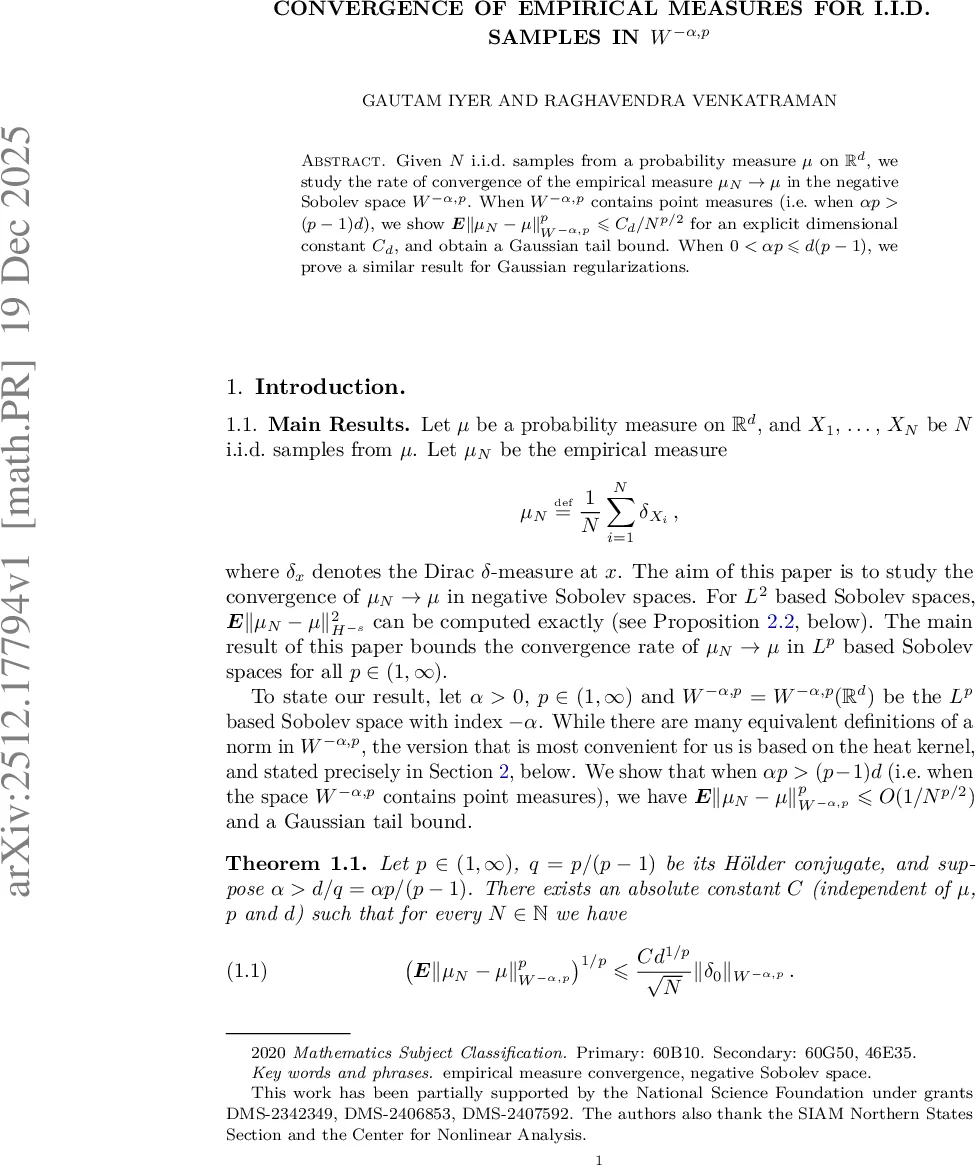
Given $N$ i.i.d. samples from a probability measure $μ$ on $\mathbf{R}^d$, we study the rate of convergence of the empirical measure $μ_N \to μ$ in the negative Sobolev space $W^{-α, p}$. When $W^{-α, p}$ contains point measures (i.e. when $αp > (p-1)d$), we show $\mathbf{E} | μ_N - μ|_{W^{-α, p}}^p \leq C_d / N^{p/2}$ for an explicit dimensional constant $C_d$, and obtain a Gaussian tail bound. When $0 < αp \leq d(p-1)$, we prove a similar result for Gaussian regularizations.
💡 Research Summary
The paper investigates the convergence of empirical measures built from independent and identically distributed (i.i.d.) samples in the negative Sobolev space (W^{-\alpha,p}(\mathbb{R}^d)). Let (\mu) be a probability measure on (\mathbb{R}^d) and let (X_1,\dots,X_N) be i.i.d. draws from (\mu). The empirical measure is (\mu_N = \frac1N\sum_{i=1}^N \delta_{X_i}). The authors aim to quantify how fast (\mu_N) approaches (\mu) when the distance is measured in the (L^p)-based negative Sobolev norm.
Choice of norm.
Instead of the usual dual definition, the authors adopt a heat‑kernel based norm:
\
Comments & Academic Discussion
Loading comments...
Leave a Comment