A linear upper bound for zero-sum Ramsey numbers of bounded degree graphs
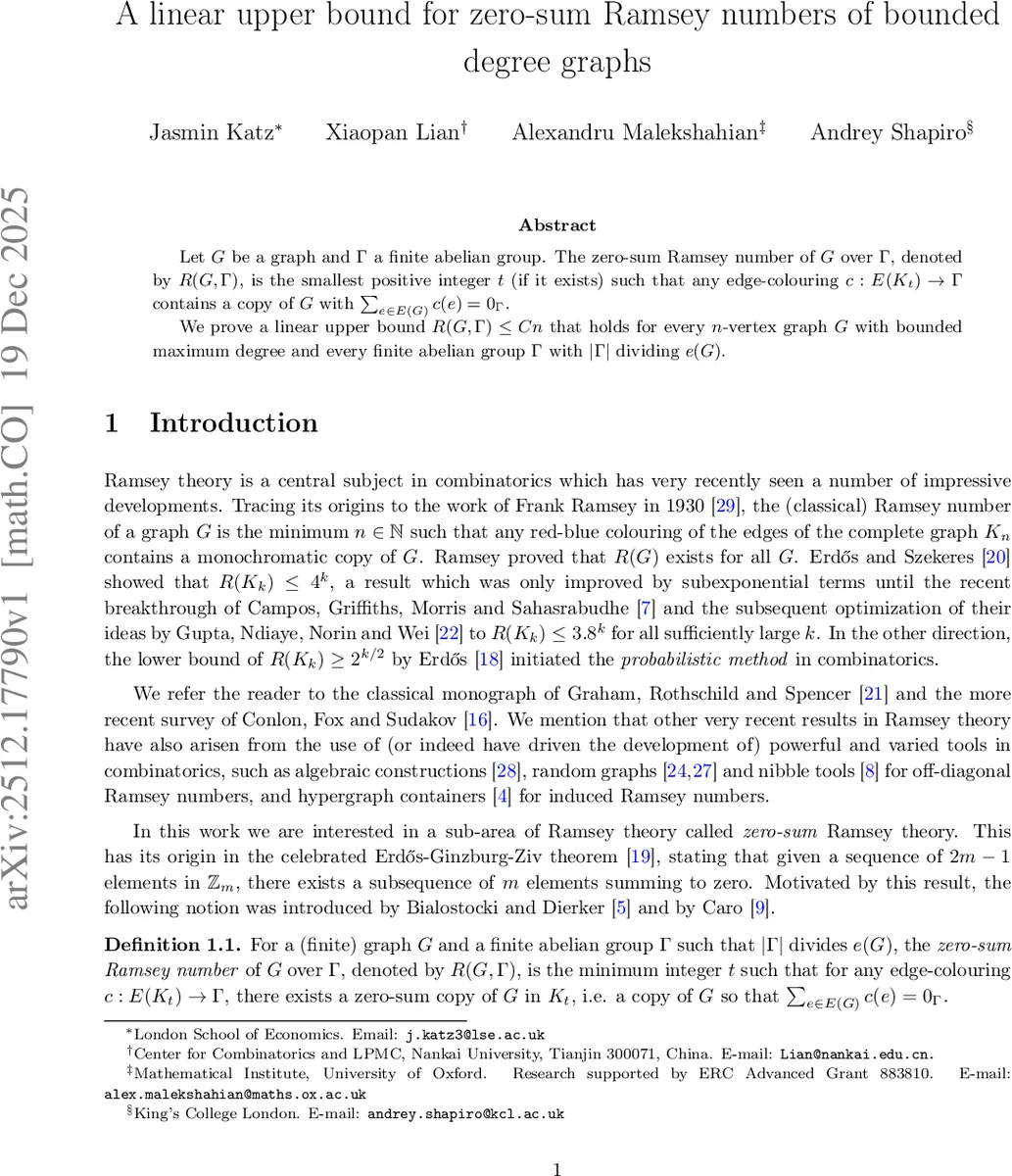
Let $G$ be a graph and $Γ$ a finite abelian group. The zero-sum Ramsey number of $G$ over $Γ$, denoted by $R(G, Γ)$, is the smallest positive integer $t$ (if it exists) such that any edge-colouring $c:E(K_t)\toΓ$ contains a copy of $G$ with $\sum_{e\in E(G)}c(e)=0_Γ$. We prove a linear upper bound $R(G, Γ)\leq Cn$ that holds for every $n$-vertex graph $G$ with bounded maximum degree and every finite abelian group $Γ$ with $|Γ|$ dividing $e(G)$.
💡 Research Summary
The paper investigates the zero‑sum Ramsey number R(G, Γ), defined for a finite simple graph G and a finite abelian group Γ whose order divides the number of edges e(G). R(G, Γ) is the smallest integer t such that every edge‑colouring of the complete graph K_t with colours from Γ contains a copy of G whose edge‑colours sum to the identity element of Γ. The authors prove that for any n‑vertex graph G with bounded maximum degree Δ and any finite abelian group Γ with |Γ| | e(G), the zero‑sum Ramsey number is at most C·n, where C depends only on Δ. This establishes a linear upper bound that holds uniformly over all groups Γ satisfying the divisibility condition.
The work builds on several strands of combinatorial theory. Classical Ramsey theory studies monochromatic copies of a graph in r‑colourings of K_t; the classical r‑colour Ramsey number R_r(G) is known to be linear in |V(G)| for bounded‑degree graphs (Chvátal, Rödl, Szemerédi, Trotter). Zero‑sum Ramsey theory, motivated by the Erdős‑Ginzburg‑Ziv theorem, replaces monochromaticity with the algebraic condition that the sum of colours along the edges of a copy of G equals zero in Γ. Prior results gave exact values only for very special cases (e.g., cycles, forests, or cyclic groups Z_k) and general bounds such as R(K_n, Z_k) ≤ n + c(k) (Alon–Caro). However, zero‑sum Ramsey numbers are not monotone under subgraph inclusion, and no general linear bound was known for arbitrary bounded‑degree graphs.
The proof strategy is intricate and combines combinatorial, algebraic, and probabilistic ideas. The authors first reduce to the case |Γ| = e(G) = n, because any group of order dividing e(G) can be embedded into a group of order exactly e(G). They then introduce two new structural concepts:
-
Blueprints and Blueprint Pairs – For each vertex v of degree d in G, the induced subgraph on its neighbourhood N(v) is called a blueprint of type d, with v designated as the “free vertex.” A blueprint pair consists of two adjacent blueprints (N(x), N(y)) together with the overlap of their neighbourhoods. By assigning to each edge xy the colour gcd(deg(x), deg(y)), the authors identify a colour κ′ that appears most frequently; the corresponding blueprint pairs form a large collection K′. A maximal set of pairwise disjoint blueprint pairs K′′ has size at least n/Δ.
-
Gadgets – A gadget is a concrete embedding of a blueprint pair into the host complete graph R₀ (the candidate K_t) together with a set of auxiliary vertices {w₁,…,w_β}. The edges from the free vertices to the auxiliary vertices are coloured so that the β sums c(uw_i v) are pairwise distinct elements of Γ. The parameter β (chosen as a function of Δ) controls the “multiplicity” of each gadget and ensures that each gadget contributes at least β+1 distinct sums.
The authors then chain many gadgets together. If M gadgets are available, the set of possible sums along a path that traverses the gadgets in order is a sumset of the form A₁ + c(v₁u₂) + A₂ + … + A_M, where each A_i contains β distinct elements. To analyse the growth of such sumsets they employ Kneser’s Theorem, a generalisation of the Cauchy–Davenport theorem to arbitrary finite abelian groups. Kneser’s theorem guarantees that either the sumset is large (at least min{|Γ|, Σ|A_i| – (M−1)}) or it contains a full coset of a non‑trivial subgroup H ≤ Γ. When a coset appears, the authors quotient the colourings by H, effectively reducing the problem to a smaller group and repeating the gadget‑building process. By iterating this procedure, they eventually generate the whole group Γ, thereby obtaining a zero‑sum copy of G.
A further complication is that for general groups Γ the “well‑behaved” colourings need not be monochromatic. The authors define a notion of Δ‑well‑behaved colourings: there exists a vertex‑colouring of the host set such that the colour of any edge is determined (up to a fixed offset) by the colours of its endpoints. This structure emerges naturally when the sumset contains a coset of a subgroup; the quotient colouring inherits the Δ‑well‑behaved property. The algorithm always works with a minimal counterexample (with respect to the size of the subgroup) so that the required gadgets can be found.
The proof also relies on the classical linear bound for r‑colour Ramsey numbers (Theorem 1.3). By taking r = 200Δ¹², the authors obtain a constant C′(r, Δ) from the Chvátal–Rödl–Szemerédi–Trotter result, and then set C(Δ) ≤ Δ⁴²Δ⁶·C′, which is a very large but explicit function of Δ. The authors acknowledge that the dependence on Δ is far from optimal, largely because the regularity lemma underlies the proof of Theorem 1.3.
The paper concludes with a discussion of related independent work by Colucci and D’Emidio, who obtained a sharper bound for forests over prime cyclic groups, and with remarks on possible improvements of the constant C and extensions to graphs with unbounded degree or to hypergraphs.
In summary, the authors establish the first general linear upper bound for zero‑sum Ramsey numbers of bounded‑degree graphs over arbitrary finite abelian groups, introducing novel combinatorial constructions (blueprints, gadgets) and leveraging additive combinatorics (Kneser’s theorem) to control sumsets. This result bridges a gap between classical Ramsey theory and zero‑sum combinatorics, opening avenues for further refinement of constants and broader generalisations.
Comments & Academic Discussion
Loading comments...
Leave a Comment