Recursive state estimation via approximate modal paths
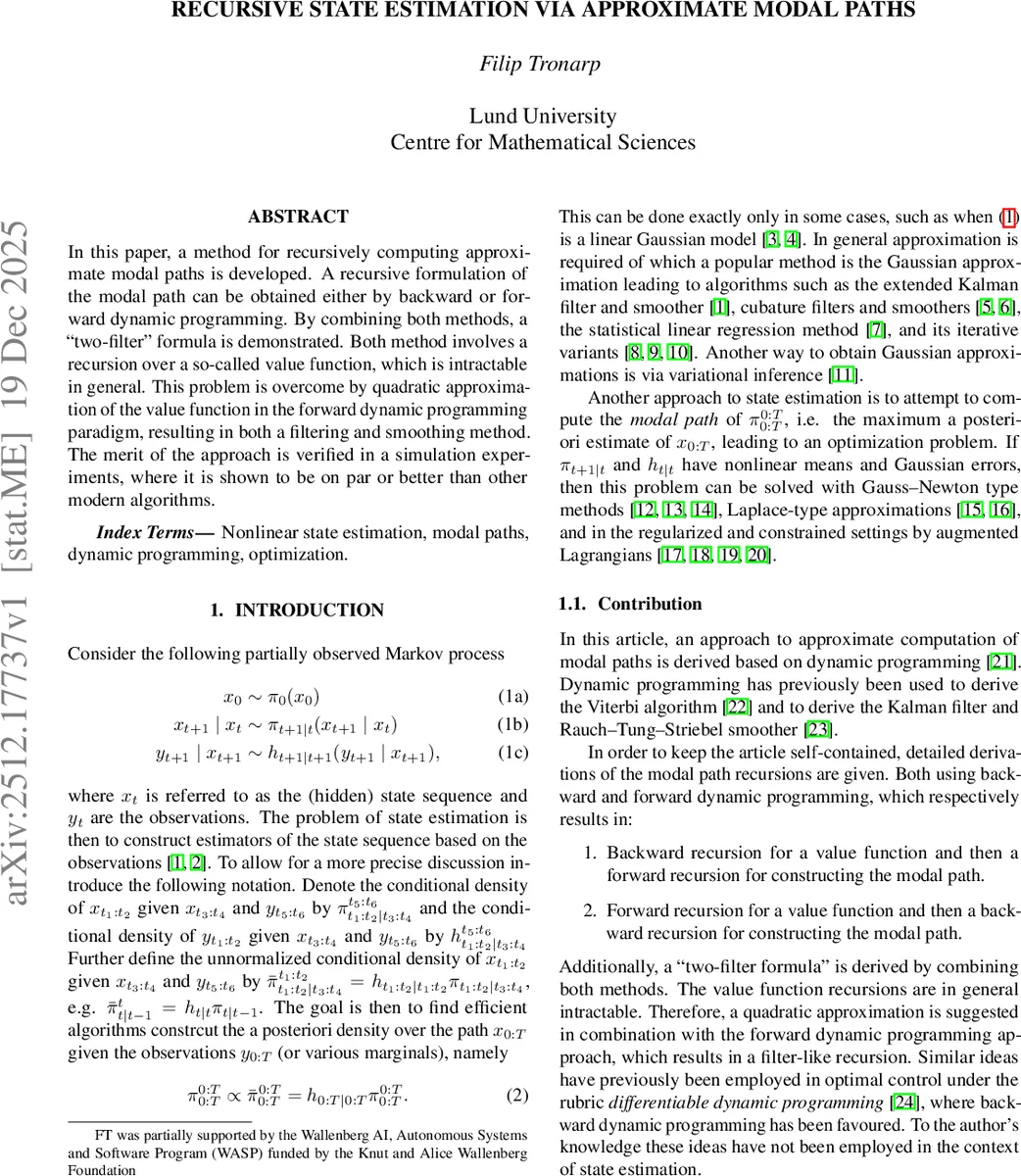
In this paper, a method for recursively computing approximate modal paths is developed. A recursive formulation of the modal path can be obtained either by backward or forward dynamic programming. By combining both methods, a ``two-filter’’ formula is demonstrated. Both method involves a recursion over a so-called value function, which is intractable in general. This problem is overcome by quadratic approximation of the value function in the forward dynamic programming paradigm, resulting in both a filtering and smoothing method. The merit of the approach is verified in a simulation experiments, where it is shown to be on par or better than other modern algorithms.
💡 Research Summary
The paper introduces a novel recursive framework for computing the modal path—the maximum a posteriori (MAP) trajectory—of a partially observed Markov process. Unlike conventional Bayesian filtering, which approximates the full posterior distribution, the modal‑path approach directly seeks the most probable state sequence, offering a potentially more efficient solution for highly nonlinear and non‑Gaussian models.
Problem formulation
The hidden state sequence (x_{0:T}) evolves according to transition densities (\pi_{t+1|t}(x_{t+1}|x_t)) and produces observations (y_{t+1}) through likelihoods (h_{t+1|t+1}(y_{t+1}|x_{t+1})). The unnormalized joint density is (\bar\pi_{0:T}=h_{0:T|0:T},\pi_{0:T|0:T}). Taking logarithms yields (\gamma_{0:T}=\log\bar\pi_{0:T}), and the modal path is defined as
\
Comments & Academic Discussion
Loading comments...
Leave a Comment