Internal Waves Control Bulk Flow in Silos
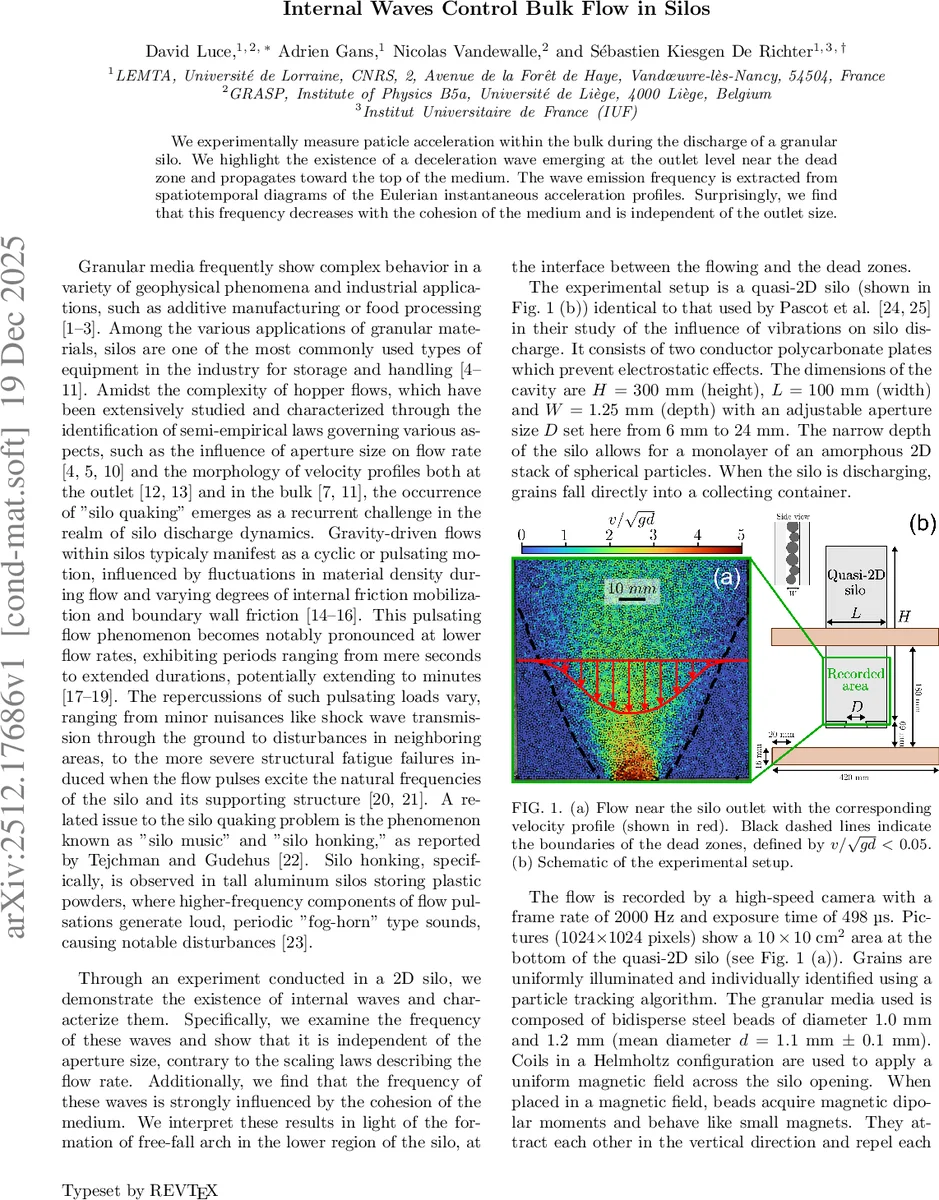
We experimentally measure paticle acceleration within the bulk during the discharge of a granular silo. We highlight the existence of a deceleration wave emerging at the outlet level near the dead zone and propagates toward the top of the medium. The wave emission frequency is extracted from spatiotemporal diagrams of the Eulerian instantaneous acceleration profiles. Surprisingly, we find that this frequency decreases with the cohesion of the medium and is independent of the outlet size.
💡 Research Summary
In this paper the authors investigate the microscopic dynamics of granular flow during silo discharge by directly measuring particle accelerations in the bulk of a quasi‑2D silo. Using a high‑speed camera (2000 fps) and particle‑tracking algorithms, they obtain Eulerian acceleration fields with sufficient temporal resolution to construct spatio‑temporal diagrams of the vertical acceleration a_y(x = 0, y, t). The experiments are performed with a bidisperse mixture of steel beads (mean diameter d ≈ 1.1 mm) in a silo of height H = 300 mm, width L = 100 mm and depth W = 1.25 mm. The outlet size D is varied from 6 mm to 24 mm, and cohesion is introduced by applying a uniform magnetic field via Helmholtz coils, which induces magnetic dipoles in the beads. The magnetic Bond number B₀ (ratio of magnetic to gravitational force) is tuned from 0 to 51.1.
First, the authors confirm that the mean discharge rate Q follows the classic Beverloo law (Q ∝ (D − kd)^{5/2}) and that the central solid fraction φ_c behaves as expected. Importantly, the presence of magnetic cohesion does not significantly alter Q, the mean velocity profile, or the density profile at the outlet; these remain self‑similar and parabolic across all D and B₀.
The novel observation emerges from the instantaneous acceleration field. In the absence of cohesion (B₀ = 0) clear, periodic deceleration waves originate just above the outlet, at heights of roughly 5–20 particle diameters, and propagate upward through the dead zones (regions where the local velocity is less than 0.05 √(gd)). These waves appear as alternating bands of positive and negative acceleration in the spatio‑temporal diagram. Power‑spectral analysis of each vertical line yields a dominant frequency of about 25 Hz. When cohesion is increased (B₀ ≈ 51), the same wave pattern persists but the acceleration phases become longer and the dominant frequency drops to roughly 8 Hz. The frequency is remarkably independent of the outlet diameter D, indicating that the mechanism is not governed by the usual scaling of discharge rate with D.
The authors link the wave generation to transient dynamic arches that form at the edges of the dead zones. Velocity‑fluctuation maps (v′ = (v − ⟨v⟩)/√(gd)) reveal that these arches are associated with contours of constant acceleration a ≈ g. As D increases, the arches form higher in the silo, and as B₀ increases, the arches become less stable and persist longer. Measurements of the arch height hₐ and the corresponding acceleration threshold aₐ show systematic trends with both D and B₀.
To rationalize the dependence of the wave frequency on cohesion, the authors propose a simple geometric model. They assume that magnetic cohesion leads to the formation of vertical particle clusters of characteristic length ξ = d(1 + B₀/B₀c), where B₀c ≈ 7 is a critical Bond number extracted from the data. The characteristic time for a cluster to free‑fall a distance ξ under gravity is τ ≈ √(ξ/g), and the wave frequency scales as f ∼ 1/τ ∝ √(g/ξ). Consequently, the normalized frequency follows f/f₀ = (1 + B₀/B₀c)^{−0.5}, where f₀ is the frequency at zero cohesion (≈ 25.8 Hz). This expression fits the experimental data across all outlet sizes, confirming that the wave period is set by the free‑fall time of the effective cluster rather than by the silo geometry.
The study thus identifies a new class of “traffic‑like” internal waves in granular silo discharge. These waves travel through the dead zones without altering the overall mass flow rate, yet they embody the intermittent formation and collapse of force‑chain arches. Their frequency is dictated by grain size and cohesion, offering a potential non‑intrusive method to infer the effective cohesion of a granular material by measuring the acoustic or acceleration signature during discharge. The work also provides a mechanistic explanation for the long‑known phenomena of “silo quaking”, “silo music”, and “silo honking”, showing that they can arise from bulk internal dynamics rather than wall‑induced resonances.
Limitations include the quasi‑2D geometry, the use of magnetic cohesion as a proxy for more complex inter‑particle forces (e.g., capillary bridges, van der Waals forces), and the lack of direct measurements of wall vibrations or acoustic emissions. Future research should explore three‑dimensional silos, realistic cohesive powders, and the interaction of these internal waves with silo walls and structural resonances. Nonetheless, the paper makes a significant contribution by revealing that bulk internal wave dynamics, controlled by cohesion, coexist with a steady discharge rate, opening new avenues for both fundamental granular physics and industrial process monitoring.
Comments & Academic Discussion
Loading comments...
Leave a Comment