Higher Weight Generalized Dedekind Sums
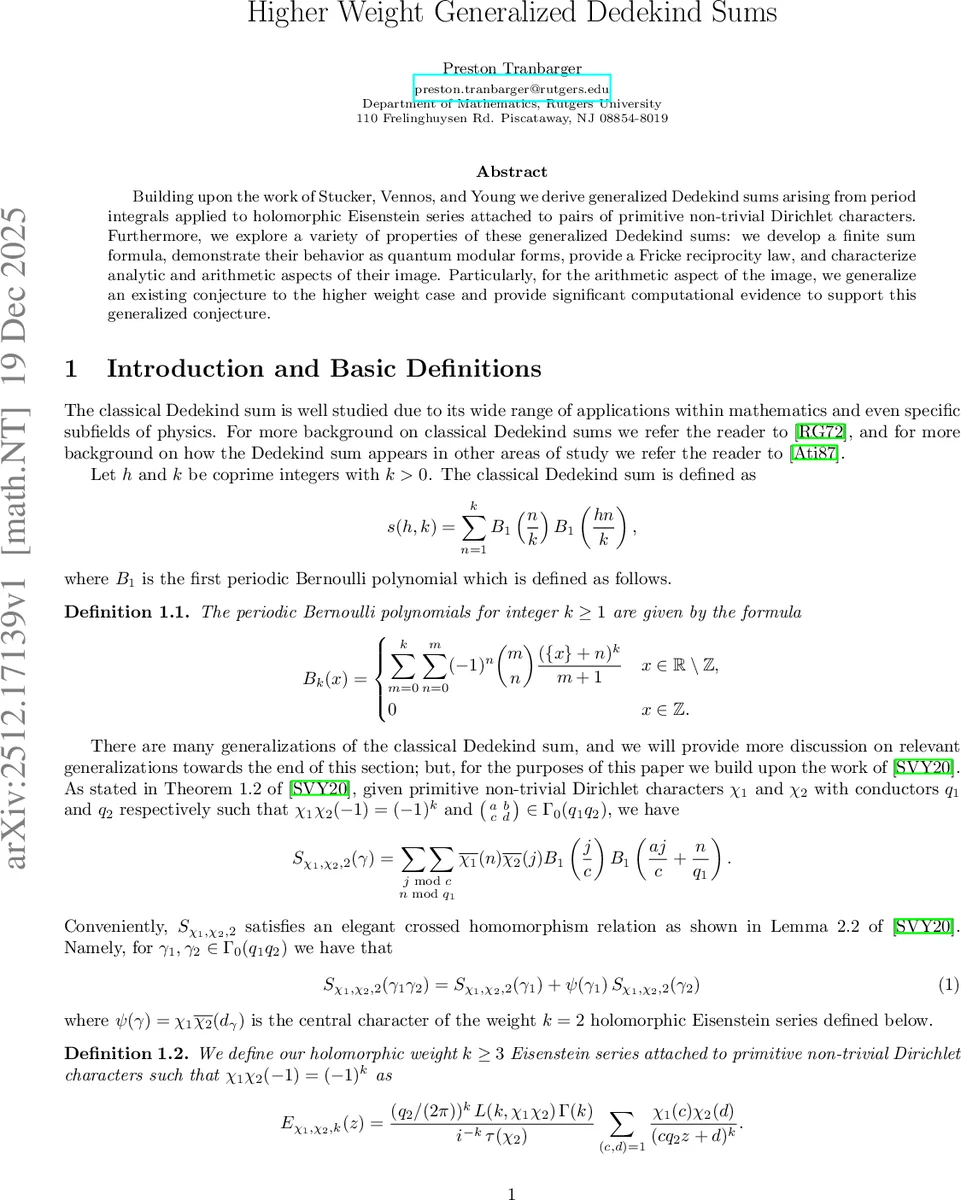
Building upon the work of Stucker, Vennos, and Young we derive generalized Dedekind sums arising from period integrals applied to holomorphic Eisenstein series attached to pairs of primitive non-trivial Dirichlet characters. Furthermore, we explore a variety of properties of these generalized Dedekind sums: we develop a finite sum formula, demonstrate their behavior as quantum modular forms, provide a Fricke reciprocity law, and characterize analytic and arithmetic aspects of their image. Particularly, for the arithmetic aspect of the image, we generalize an existing conjecture to the higher weight case and provide significant computational evidence to support this generalized conjecture.
💡 Research Summary
The paper “Higher Weight Generalized Dedekind Sums” extends the theory of Dedekind sums to a broad family of higher‑weight objects attached to pairs of primitive non‑trivial Dirichlet characters. Building on the recent work of Stucker, Vennos, and Young (SVY20), the author defines a new family of sums (S_{\chi_{1},\chi_{2},k}(\gamma)) for any integer weight (k\ge 2) and any matrix (\gamma=\begin{pmatrix}a&b\c&d\end{pmatrix}) in the congruence subgroup (\Gamma_{0}(q_{1}q_{2})). The construction uses a period integral of a holomorphic Eisenstein series (E_{\chi_{1},\chi_{2},k}(z)) attached to the characters (\chi_{1},\chi_{2}) and a homogeneous polynomial (P_{k-2}(z;X,Y)=(Xz+Y)^{k-2}). Explicitly, \
Comments & Academic Discussion
Loading comments...
Leave a Comment