A New Fast Finite Difference Scheme for Tempered Time Fractional Advection-Dispersion Equation with a Weak Singularity at Initial Time
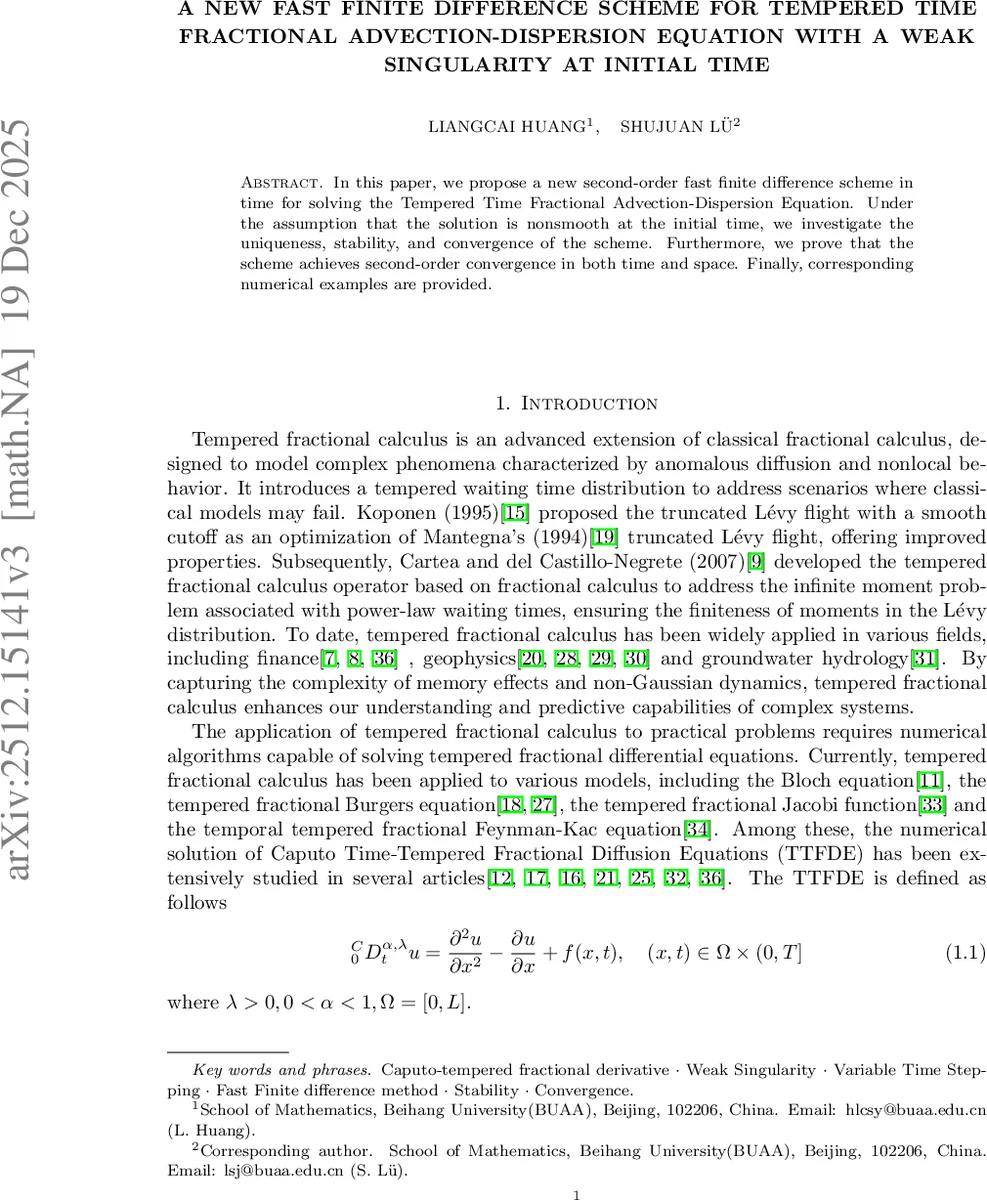
In this paper, we propose a new second-order fast finite difference scheme in time for solving the Tempered Time Fractional Advection-Dispersion Equation. Under the assumption that the solution is nonsmooth at the initial time, we investigate the uniqueness, stability, and convergence of the scheme. Furthermore, we prove that the scheme achieves second-order convergence in both time and space. Finally, corresponding numerical examples are provided.
💡 Research Summary
The paper addresses the numerical solution of the tempered time‑fractional advection‑dispersion equation (TTF‑ADE), a model that combines a first‑order time derivative with a Caputo‑tempered fractional derivative of order α (0 < α < 1) and a spatial advection‑diffusion operator. The presence of the weakly singular kernel (t − s)^{‑α} e^{‑λ(t‑s)} and the possibility of nonsmooth initial data (e.g., u(t) ≈ t^{δ}, 1 < δ < 2) make standard uniform‑grid finite‑difference schemes inefficient and low‑order.
The authors propose a second‑order accurate, fast finite‑difference scheme that integrates three key ideas: (1) a sum‑of‑exponentials (SOE) approximation of the kernel, based on Lemma 2.1, which replaces the convolution kernel by a weighted sum of exponentials; (2) a decomposition of the tempered Caputo derivative into a history part and a local part, allowing the history contribution to be updated recursively via a small set of auxiliary variables U_{his,i}^{n}; (3) a graded time mesh t_n = T (n/N)^r (r ≥ 1) that concentrates points near t = 0, thereby compensating for the initial singularity.
With the SOE representation, the history term requires only O(N_exp) operations per step, where N_exp grows logarithmically with the prescribed tolerance, reducing the overall computational cost from O(N²) to O(N log N). The local term is treated with an L1‑type linear interpolation, yielding an explicit expression involving u(t_n) and u(t_{n+1}). The authors derive coefficients a_{j,n} and b_{j,n} that satisfy positivity and a summation bound, which are crucial for the stability analysis.
Stability is proved in the L₂‑norm by constructing a discrete energy inequality that leverages the non‑expansive nature of the coefficient matrix. Convergence analysis combines the stability result with detailed error estimates for the SOE approximation (Lemma 2.4) and the interpolation error (Lemma 2.5). Under the regularity assumption |∂^l u/∂t^l| ≤ C(1 + t^{δ‑l}) for l = 0,1,2, the truncation error R_{n+½} is shown to be O(τ_n^{min{2‑α, r(1+δ‑α)}}). By choosing the grading parameter r ≥ (2‑α)/(1+δ‑α), the scheme attains genuine second‑order accuracy in time, while second‑order spatial accuracy follows from the standard central difference discretization of the diffusion and advection terms.
Numerical experiments include two benchmark problems: (i) a smooth initial condition with λ = 1, α = 0.6, demonstrating temporal and spatial convergence rates of approximately 2.0; (ii) a nonsmooth initial condition ϕ(x)=x^{0.5}(1‑x), where a higher grading (r = 3) still yields second‑order convergence. Comparisons with traditional L1‑based uniform‑grid schemes reveal a reduction of CPU time by more than 80 % and a substantial decrease in memory consumption, confirming the efficiency of the fast algorithm.
The paper’s contributions are threefold: (1) a rigorous SOE‑based fast evaluation of the tempered Caputo derivative; (2) a graded‑mesh, second‑order accurate discretization that handles weak initial singularities; (3) a complete theoretical framework covering uniqueness, unconditional stability, and optimal convergence. Limitations include restriction to one‑dimensional linear problems and the need for empirical selection of N_exp and the grading exponent r. Future work is suggested on extending the method to multi‑dimensional and nonlinear tempered fractional models, as well as on developing adaptive strategies for automatic parameter selection.
Comments & Academic Discussion
Loading comments...
Leave a Comment