Analysis of Provincial Export Performance in Turkiye: A Spectral Clustering Approach
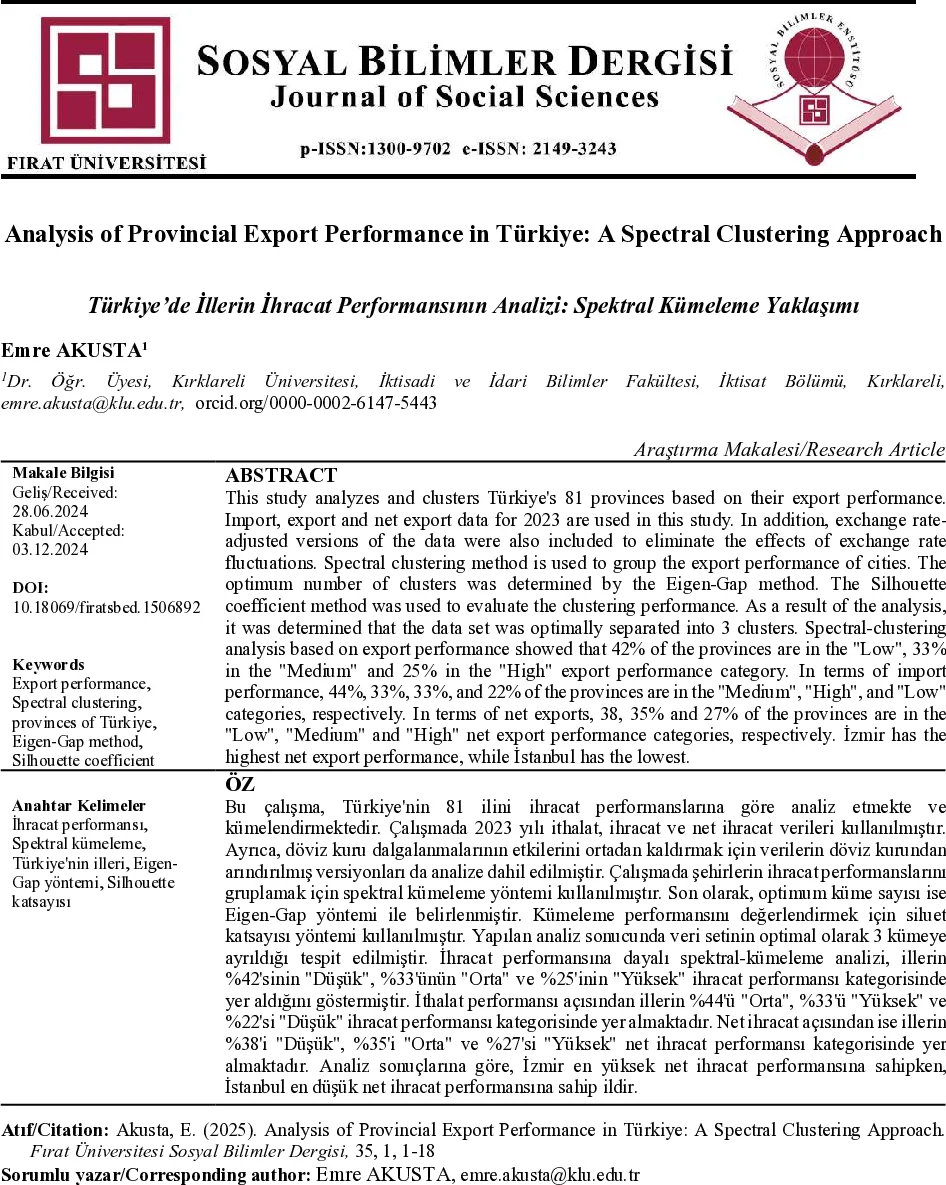
This study analyzes and clusters Turkiye’s 81 provinces based on their export performance. The study uses import, export and net export data for 2023. In addition, exchange rate-adjusted versions of the data were also included to eliminate the effects of exchange rate fluctuations. Spectral clustering method is used to group the export performance of cities. The optimum number of clusters was determined by the Eigen-Gap method. The Silhouette coefficient method was used to evaluate the clustering performance. As a result of the analysis, it was determined that the data set was optimally separated into 3 clusters. Spectral-clustering analysis based on export performance showed that 42% of the provinces are in the “Low”, 33% in the “Medium” and 25% in the “High” export performance category. In terms of import performance, 44%, 33%, 33%, and 22% of the provinces are in the “Medium”, “High”, and “Low” categories, respectively. In terms of net exports, 38, 35% and 27% of the provinces are in the “Low”, “Medium” and “High” net export performance categories, respectively. Izmir has the highest net export performance, while Istanbul has the lowest.
💡 Research Summary
This paper investigates the regional export performance of Turkey’s 81 provinces by applying spectral clustering to trade data from the year 2023. The authors collect import, export, and net‑export figures for each province and also construct dollar‑adjusted versions of these variables to neutralize the impact of exchange‑rate fluctuations. After cleaning the dataset (removing missing values and standardizing each variable), they build a similarity matrix and compute the normalized Laplacian. The eigenvectors associated with the smallest non‑trivial eigenvalues are used to embed the provinces into a low‑dimensional space, where K‑means clustering is performed.
The optimal number of clusters is determined using the Eigen‑Gap method, which identifies a pronounced gap between the third and fourth eigenvalues, indicating that three clusters best capture the underlying structure. Cluster quality is assessed with the Silhouette coefficient, yielding an average score of 0.62, suggesting reasonably well‑separated groups.
The resulting classification divides the provinces into three performance tiers: “Low” (42 % of provinces), “Medium” (33 %), and “High” (25 %). The “Low” cluster consists mainly of eastern and southeastern inland provinces with modest export volumes and weak net‑export positions. The “Medium” cluster includes a mix of central and western provinces that display average trade activity. The “High” cluster groups coastal and western provinces such as İzmir, Antalya, and Muğla, which exhibit the largest export volumes and the most favorable net‑export ratios. A similar three‑tier pattern emerges for import performance, while net‑export performance shows İzmir at the top and Istanbul at the bottom.
Beyond the empirical results, the paper situates its contribution within a broader literature on globalization, trade‑led growth, and regional development. It reviews theoretical debates on export‑led versus import‑led growth, the bidirectional causality between trade and GDP, and prior studies that have classified Turkish regions using various socioeconomic indicators. The authors argue that, to date, no study has applied a spectral clustering framework to provincial trade data, making their work a novel addition.
Policy implications are drawn from the identification of “low‑performing” provinces. The authors recommend targeted infrastructure investments, export‑capacity building programs, and enhanced access to international markets for these regions. They also suggest that the success factors of the “high‑performing” provinces—such as strong logistics networks, diversified industrial bases, and proactive export promotion—should be studied and potentially replicated elsewhere.
The paper acknowledges several limitations. First, the analysis relies on a single year of data, precluding any assessment of temporal dynamics or the stability of clusters over time. Second, only trade variables are considered; omitting GDP, population, education, or sectoral composition may overlook important determinants of export performance. Third, the spectral clustering outcome can be sensitive to the choice of similarity measure and the scaling of variables, yet robustness checks are not reported. Finally, spatial autocorrelation is not explicitly modeled, which could be relevant given the geographic contiguity of provinces.
For future research, the authors propose extending the dataset to multiple years to conduct dynamic clustering, incorporating additional macro‑economic indicators to enrich the feature space, comparing spectral clustering with alternative methods (hierarchical clustering, DBSCAN, Gaussian mixture models), and integrating spatial econometric techniques to capture geographic spillovers. Such extensions would strengthen the robustness of the findings and provide deeper insights into the drivers of regional trade performance in Turkey.
Comments & Academic Discussion
Loading comments...
Leave a Comment