FakeParts: a New Family of AI-Generated DeepFakes
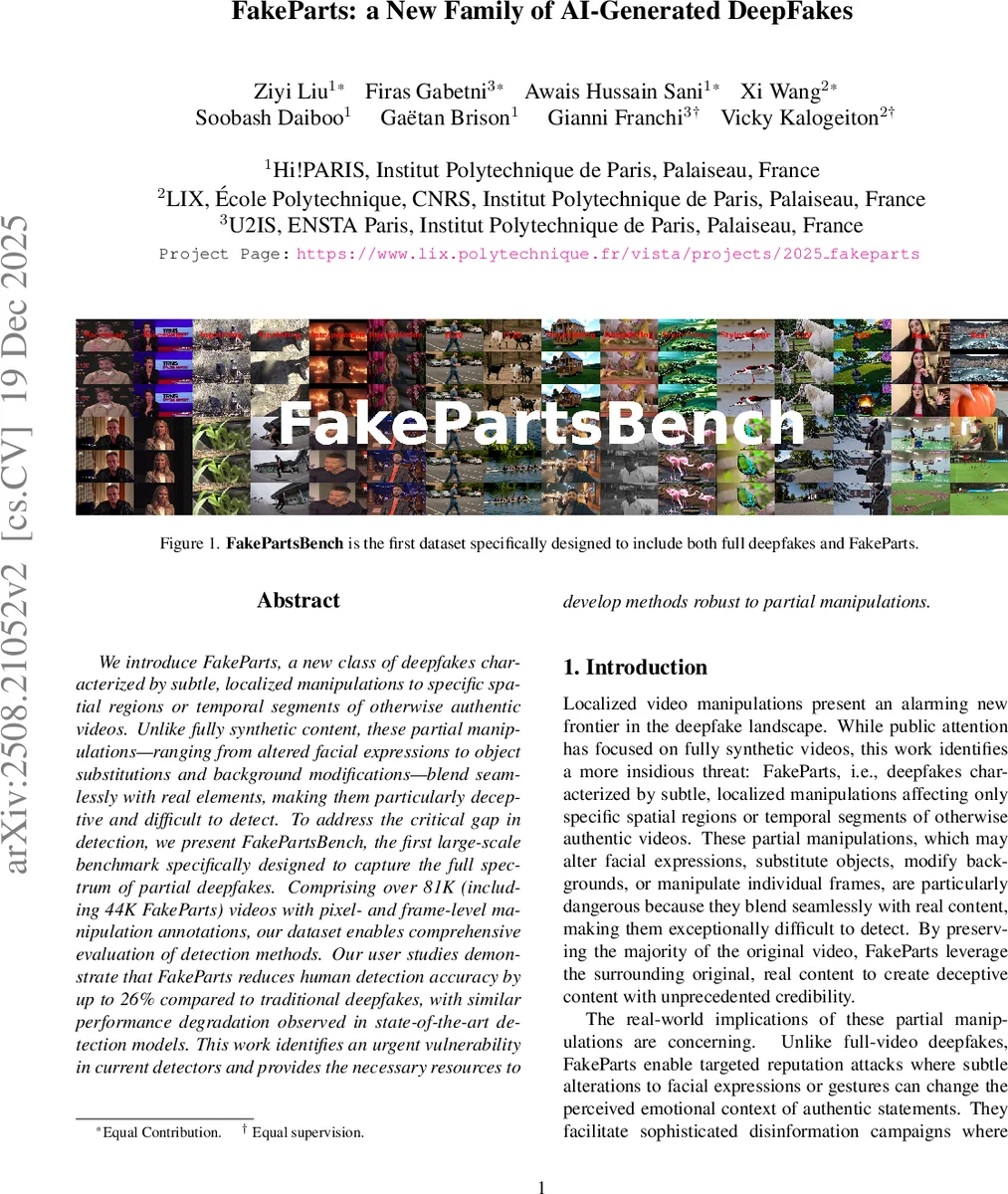
We introduce FakeParts, a new class of deepfakes characterized by subtle, localized manipulations to specific spatial regions or temporal segments of otherwise authentic videos. Unlike fully synthetic content, these partial manipulations - ranging from altered facial expressions to object substitutions and background modifications - blend seamlessly with real elements, making them particularly deceptive and difficult to detect. To address the critical gap in detection, we present FakePartsBench, the first large-scale benchmark specifically designed to capture the full spectrum of partial deepfakes. Comprising over 81K (including 44K FakeParts) videos with pixel- and frame-level manipulation annotations, our dataset enables comprehensive evaluation of detection methods. Our user studies demonstrate that FakeParts reduces human detection accuracy by up to 26% compared to traditional deepfakes, with similar performance degradation observed in state-of-the-art detection models. This work identifies an urgent vulnerability in current detectors and provides the necessary resources to develop methods robust to partial manipulations.
💡 Research Summary
The paper introduces “FakeParts,” a novel class of deepfakes that involve subtle, localized manipulations of specific spatial regions or temporal segments within otherwise authentic videos. Unlike fully synthetic deepfakes, which replace or generate entire frames, FakeParts preserve the majority of the original content, making the alterations blend seamlessly with real footage and thereby posing a heightened risk of deception. The authors argue that this partial‑manipulation threat is especially insidious because it can change the perceived meaning of a statement (e.g., facial expression, gesture) or re‑contextualize an event (e.g., background objects) while leaving most visual cues untouched.
To address the lack of appropriate evaluation resources, the authors present FakePartsBench, the first large‑scale benchmark explicitly designed for partial deepfakes. The dataset comprises over 81,000 video clips, of which 44,000 are FakeParts, 20,000 are full‑synthetic deepfakes, and 17,000 are genuine videos. Each clip is accompanied by fine‑grained pixel‑level masks and frame‑level timestamps that precisely indicate where and when manipulations occur. The videos span a wide range of generation methods (21 distinct models, including open‑source tools such as Sora, Open‑Sora, CogVideoX, and commercial systems like Veo2) and manipulation types: spatial (face swaps, object in‑painting/out‑painting, color/style changes), temporal (frame interpolation, insertion/deletion), and style‑only edits. Resolutions range from 426 × 320 up to 1920 × 1080, with more than 30 % of the dataset exceeding 720p, thereby overcoming the low‑resolution limitation of many existing video deepfake corpora.
Human perception experiments involving 290 participants reveal that FakeParts reduce detection accuracy by up to 26 % compared with traditional full‑video deepfakes. Certain manipulation categories, especially temporal interpolation and subtle style changes, were almost never detected. Parallel evaluations of eight state‑of‑the‑art detection models—covering frequency‑based, structural, temporal, and multimodal (Vision‑Language Model) approaches—show a dramatic performance drop: average accuracy falls from ~78 % on full deepfakes to 40‑50 % on FakeParts. The most pronounced failures occur for manipulations that leave minimal visual artifacts, indicating that current detectors rely heavily on global inconsistencies rather than localized, short‑duration cues.
The paper’s contributions are threefold: (1) formal definition and taxonomy of partial deepfakes (FakeParts); (2) release of FakePartsBench with extensive annotations, high‑resolution content, and diverse manipulation types; (3) comprehensive human and algorithmic studies that quantify the detection gap and establish baseline performance metrics. The authors discuss the implications for future research, emphasizing the need for detectors that operate on a “detection‑resolution” axis (pixel/patch → clip) and can fuse multiple cues (frequency, structural, temporal, multimodal). Potential directions include hybrid architectures that jointly model local spatio‑temporal patterns, self‑supervised learning using the provided masks, and leveraging multimodal consistency (audio‑visual‑text) to flag semantic mismatches introduced by partial edits.
In summary, FakeParts expose a critical vulnerability in current deepfake detection pipelines, and FakePartsBench offers the community a rigorous platform to develop and benchmark robust detection methods capable of handling the nuanced, high‑fidelity forgeries that are likely to dominate real‑world misinformation campaigns in the near future.
Comments & Academic Discussion
Loading comments...
Leave a Comment