Irreducibility of polarized automorphic Galois representations in infinitely many dimensions
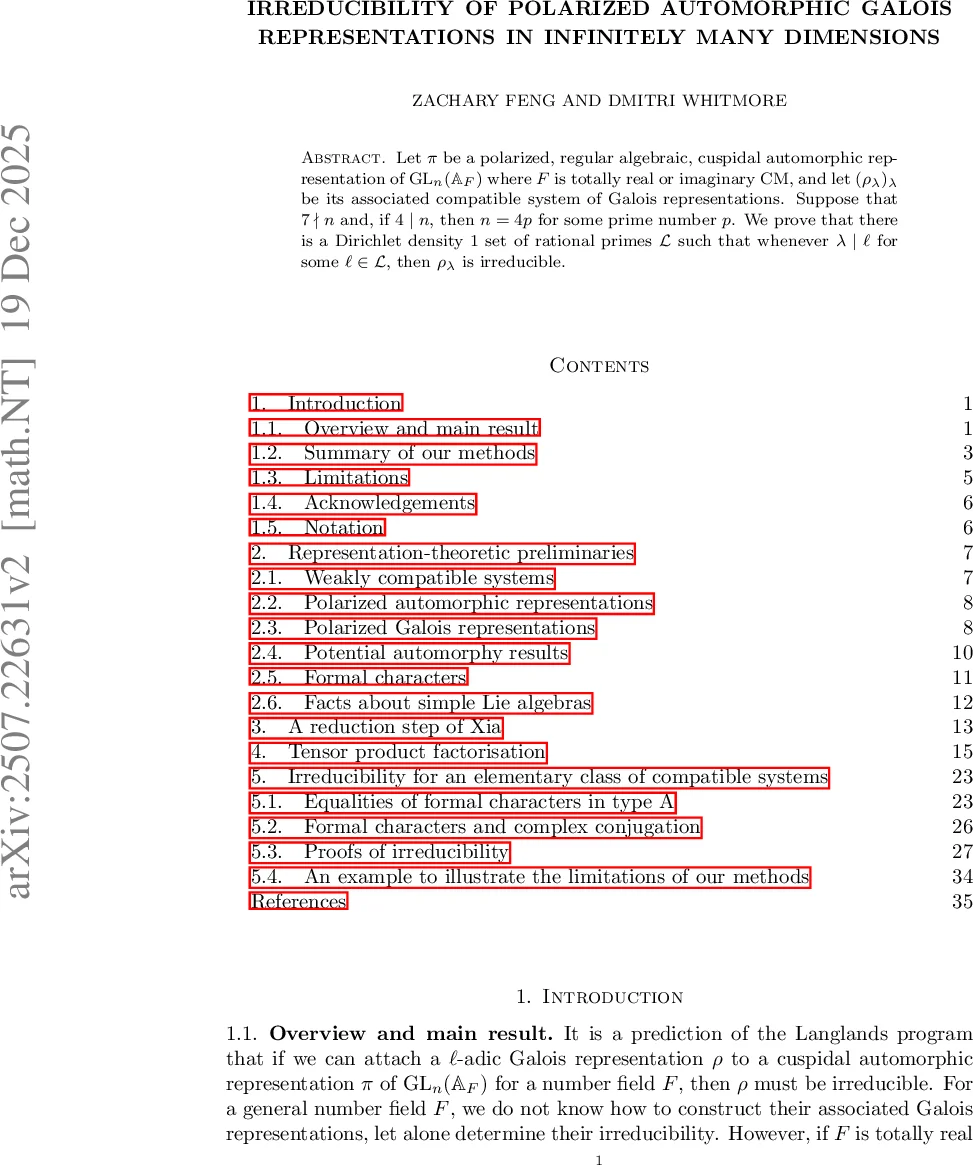
Let $π$ be a polarized, regular algebraic, cuspidal automorphic representation of $\operatorname{GL}_n(\mathbb{A}_F)$ where $F$ is totally real or imaginary CM, and let $(ρ_λ)_λ$ be its associated compatible system of Galois representations. Suppose that $7\nmid n$ and, if $4\mid n$, then $n = 4p$ for some prime number $p$. We prove that there is a Dirichlet density $1$ set of rational primes $\mathcal{L}$ such that whenever $λ\mid \ell$ for some $\ell\in \mathcal{L}$, then $ρ_λ$ is irreducible.
💡 Research Summary
The paper by Feng and Whitmore addresses a long‑standing problem in the Langlands program: proving the irreducibility of the ℓ‑adic Galois representations attached to polarized, regular algebraic, cuspidal automorphic representations π of GLₙ over a totally real or imaginary CM field F. While the existence of such compatible systems (ρ_λ)_λ is now classical (thanks to the work of many authors culminating in BLGGT14), establishing that each ρ_λ is irreducible has only been achieved under rather restrictive hypotheses—typically n ≤ 6, or the “extremely regular weight” condition, or for a set of primes of merely positive Dirichlet density.
The main theorem of the article removes most of these restrictions. Assuming that 7 does not divide n and, in the case 4 | n, that n = 4p for a prime p, the authors prove that there exists a set L of rational primes of Dirichlet density 1 such that for every ℓ ∈ L and every place λ|ℓ, the representation ρ_λ : G_F → GLₙ(ℚ̄_ℓ) is irreducible. As a corollary, the residual representation ρ_λ|_{G_F(ζ_ℓ)} is also irreducible for a density‑1 set of ℓ.
The proof proceeds through several innovative steps:
-
Reduction via Xia’s argument. Using a result of Xia (Section 3), the authors replace π by another polarized cuspidal automorphic representation π₁ on GL_m, where m divides n, such that the irreducibility of ρ_λ and of the system attached to π₁ are equivalent. Moreover, they produce a finite Galois extension E/F⁺ (with F⁺ the maximal totally real subfield of F) such that the Zariski closure of the image of ρ_λ restricted to G_E is connected. This reduction allows one to assume that the CM subextension F/F⁺ is maximal inside E/F⁺.
-
Tensor‑product factorisation. For a carefully chosen prime λ₀ in a positive‑density set L′ (coming from PT15), the authors show that ρ_{λ₀}|{G_E} decomposes uniquely (up to reordering and twisting by characters) as a tensor product ⊗{i=1}^k ρ′i, where each factor has simple derived Lie algebra g_i. By invoking Patrik Scholze’s results (Pat19), each ρ′i can be taken to be geometric, i.e. potentially automorphic. They then prove that the whole representation ρ{λ₀}(G_F) lands inside the image of the Kronecker product map, thereby obtaining a global tensor‑product decomposition ρ{λ₀} ≅ ⊗_{i=1}^k ρ_i.
-
Control of complex conjugation. A delicate analysis of the action of complex conjugation (or any element in the Galois group generated by conjugates of a fixed complex conjugation) yields an isomorphism (ρ′_i)^σ ≅ (ρ′i)^∨ ⊗ χ{σ,i} for each σ in the conjugacy class. This is achieved by selecting auxiliary Frobenius elements with distinct n‑th powers of eigenvalues, using regularity of Hodge–Tate weights, and shrinking L′ if necessary. The resulting relation forces each ρ_i to be polarizable.
-
Potential automorphy of the factors. Applying the powerful potential automorphy theorem of BLGGT14 to each ρ_i, the authors obtain, after possibly passing to a finite CM extension F′/F, polarized regular algebraic cuspidal automorphic representations π_i on GL_{n_i} whose compatible systems match the ρ_i. Goursat’s lemma and the λ‑independence of the rank of the derived Zariski closure guarantee that if each (ρ_{π_i,λ})_λ is irreducible for a density‑1 set of λ, then the original (ρ_λ)_λ is also irreducible.
-
Formal‑character and Lie‑algebra analysis. The heart of the argument lies in comparing the formal characters of the faithful representations t_λ : g_λ → gl_n across different λ. Building on Serre’s ideas and the work of Chun‑Yin Hui, the authors show that the rank and the multiset of weights are λ‑independent, and that multiplicity‑freeness (a consequence of regular Hodge–Tate weights) drastically limits the possible simple Lie algebras g_λ. They treat each possible simple type case‑by‑case (sl_k, so_{2k+1}, sp_{2k}, exceptional types) in Section 5. For large type‑A factors (k ≥ 9 or k = 6) they exploit Hui’s theorem that equal‑rank subalgebras of type A determine the number of such factors, allowing them to rule out reducible scenarios.
-
Limitations. The hypotheses “7 ∤ n” and “if 4 | n then n = 4p” are essential for the current method. When n = 7, the Lie algebra g₂ with its 7‑dimensional representation appears, and its formal character coincides with that of a reducible representation of sl₃, breaking the polarizability argument. When 4 divides n but n ≠ 4p, the oddness of the tensor factors ρ_i cannot be guaranteed, preventing the application of existing potential automorphy theorems. The authors discuss possible ways to relax these conditions (e.g., allowing 8 ∤ n) but note that new potential automorphy results would be required.
In summary, the paper establishes a near‑optimal irreducibility result for a broad class of polarized automorphic Galois representations, extending the density‑one irreducibility from low‑dimensional or extremely regular cases to essentially all dimensions satisfying mild divisibility constraints. The blend of reduction techniques, tensor‑product factorisation, careful control of complex conjugation, potential automorphy, and a refined analysis of formal characters represents a significant methodological advance and opens the door to further extensions once stronger potential automorphy theorems become available.
Comments & Academic Discussion
Loading comments...
Leave a Comment