Conditioned stochastic stability of equilibrium states on uniformly hyperbolic sets
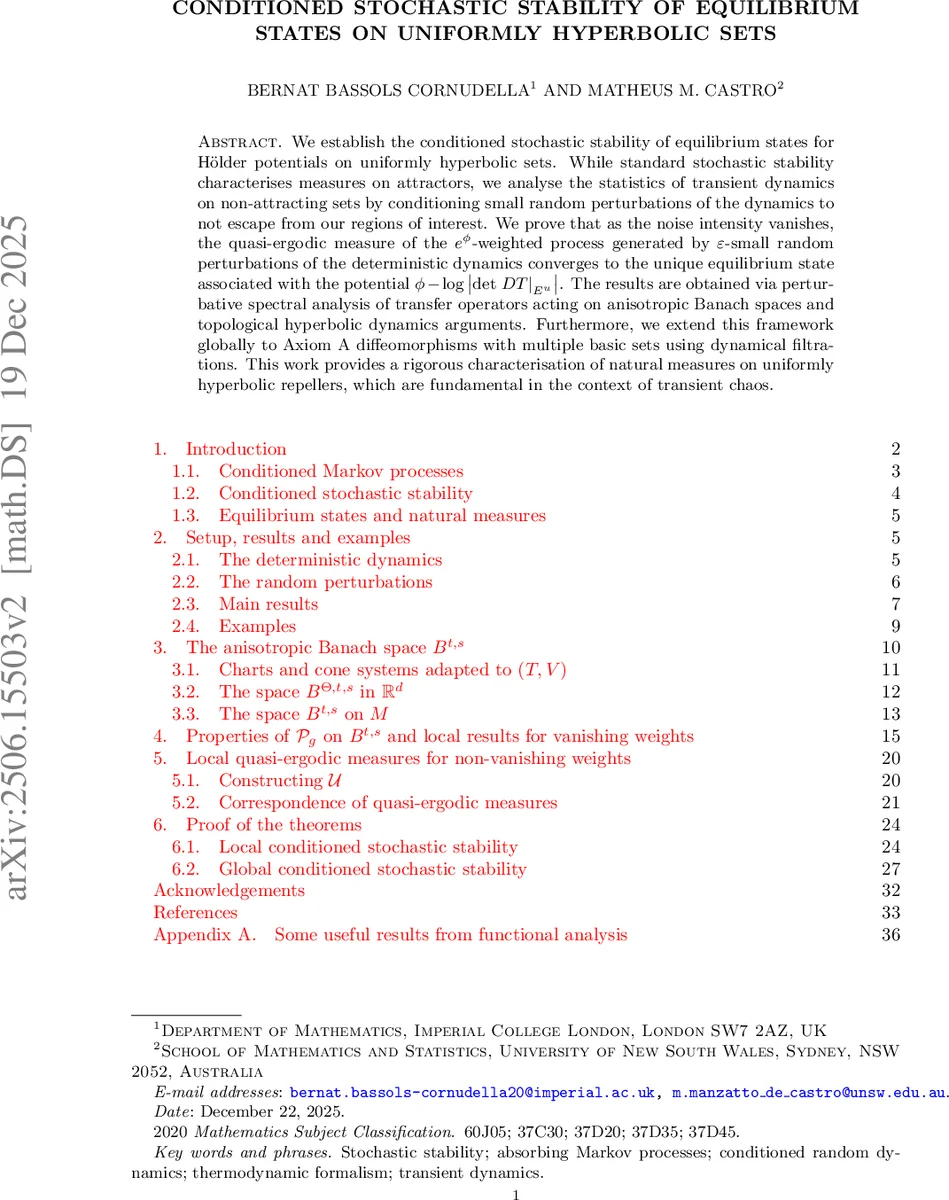
We establish the conditioned stochastic stability of equilibrium states for Hölder potentials on uniformly hyperbolic sets. While standard stochastic stability characterises measures on attractors, we analyse the statistics of transient dynamics on non-attracting sets by conditioning small random perturbations of the dynamics to not escape from our regions of interest. We prove that as the noise intensity vanishes, the quasi-ergodic measure of the $e^ϕ$-weighted process generated by $\e$-small random perturbations of the deterministic dynamics converges to the unique equilibrium state associated with the potential $ϕ- \log \left|\det \left. D T\right|_{E^u}\right|$. The results are obtained via perturbative spectral analysis of transfer operators acting on anisotropic Banach spaces and topological hyperbolic dynamics arguments. Furthermore, we extend this framework globally to Axiom A diffeomorphisms with multiple basic sets using dynamical filtrations. This work provides a rigorous characterisation of natural measures on uniformly hyperbolic repellers, which are fundamental in the context of transient chaos.
💡 Research Summary
This paper introduces and rigorously develops the concept of conditioned stochastic stability for uniformly hyperbolic (including non‑attracting) sets. Classical stochastic stability studies stationary measures of randomly perturbed dynamics, which naturally concentrate on attractors. Consequently, it fails to capture the statistical behavior of repellers or other non‑attracting chaotic sets that are central to transient chaos.
To overcome this limitation, the authors consider a family of ε‑small random perturbations of a diffeomorphism (T) on a compact Riemannian manifold (M). They augment the associated Markov chain with a cemetery state (\partial) representing escape from a prescribed neighbourhood (V) of a hyperbolic basic set (\Lambda). A continuous potential (\varphi) is used to weight trajectories by a factor (e^{\varphi}) at each step, yielding a weighted process (X^{\varphi}{\varepsilon}). Conditioning on the event that the process has not escaped up to time (n) (i.e., (\tau>n)) leads to the definition of a quasi‑ergodic measure (\nu{\varepsilon}), which plays the role of a natural measure for the transient dynamics.
The main results are twofold. First, in the local setting (Theorems 2.6 and 2.7), the authors prove existence, uniqueness, and convergence of (\nu_{\varepsilon}) as (\varepsilon\to0). They show that (\nu_{\varepsilon}) converges in the weak‑* topology to the unique equilibrium state for the potential
\
Comments & Academic Discussion
Loading comments...
Leave a Comment