BattBee: Equivalent Circuit Modeling and Early Detection of Thermal Runaway Triggered by Internal Short Circuits for Lithium-Ion Batteries
Lithium-ion batteries are the enabling power source for transportation electrification. However, in real-world applications, they remain vulnerable to internal short circuits (ISCs) and the consequential risk of thermal runaway (TR). Toward addressing the challenge of ISCs and TR, we undertake a systematic study that extends from dynamic modeling to fault detection in this paper. First, we develop {\em BattBee}, the first equivalent circuit model to specifically describe the onset of ISCs and the evolution of subsequently induced TR. Drawing upon electrochemical modeling, the model can simulate ISCs at different severity levels and predict their impact on the initiation and progression of TR events. With the physics-inspired design, this model offers strong physical interpretability and predictive accuracy, while maintaining structural simplicity to allow fast computation. Then, building upon the BattBee model, we develop fault detection observers and derive detection criteria together with decision-making logics to identify the occurrence and emergence of ISC and TR events. This detection approach is principled in design and fast in computation, lending itself to practical applications. Validation based on simulations and experimental data demonstrates the effectiveness of both the BattBee model and the ISC/TR detection approach. The research outcomes underscore this study’s potential for real-world battery safety risk management.
💡 Research Summary
This paper addresses one of the most hazardous failure modes in lithium‑ion batteries (LiBs)—internal short circuits (ISCs) that can trigger thermal runaway (TR). The authors introduce a novel equivalent‑circuit model called BattBee that captures the coupled electro‑thermal dynamics of a cell during an ISC‑initiated TR event, and they build a model‑based fault‑detection framework that can identify the onset of ISC and the subsequent progression to TR in real time.
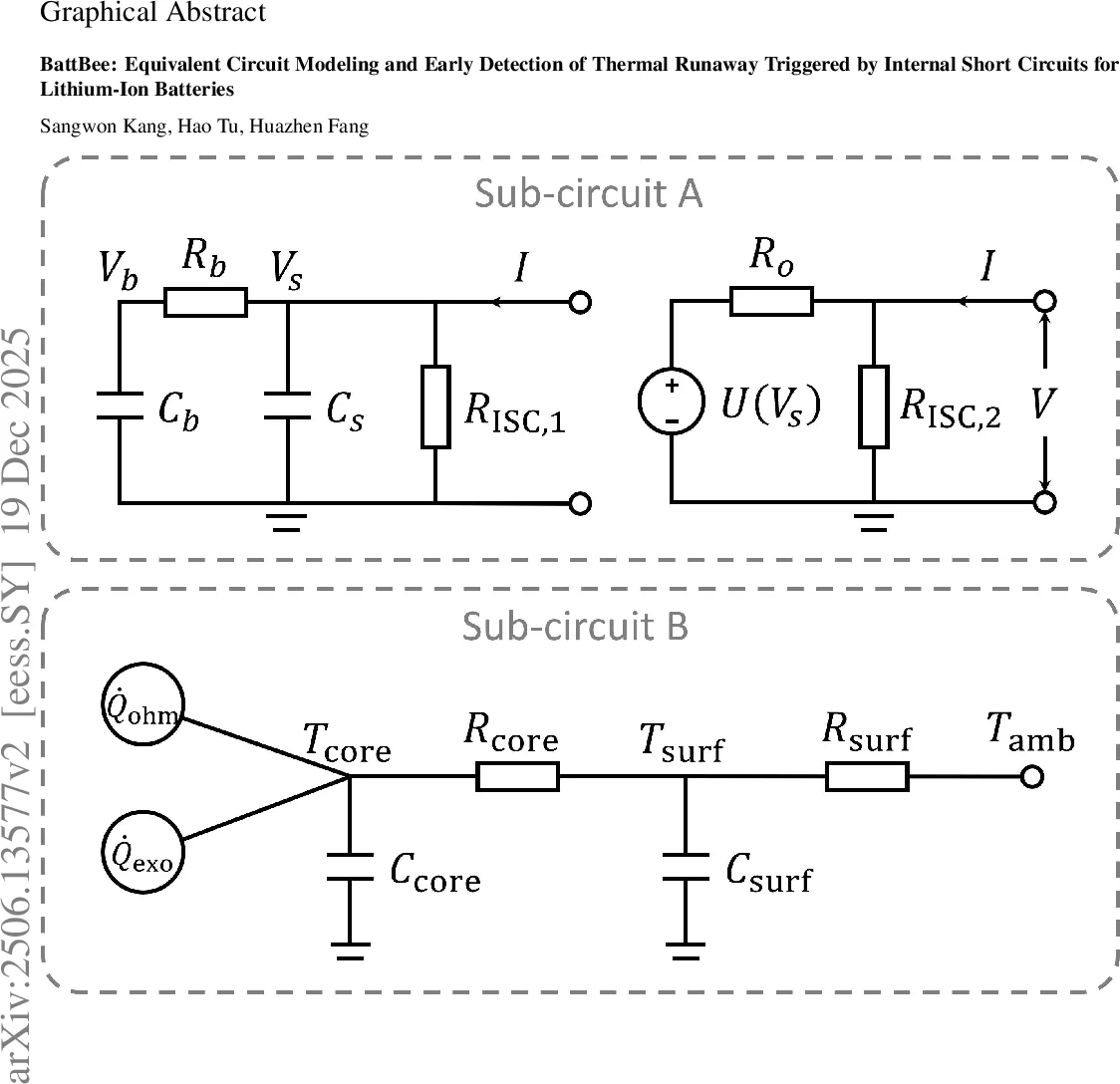
BattBee architecture consists of two sub‑circuits. Sub‑circuit A extends a nonlinear double‑capacitor model by inserting two parallel ISC resistors (RISC₁, RISC₂). Under normal operation these resistors are effectively infinite; when an ISC occurs they drop to low values, causing a rapid voltage collapse and diverting current through the short‑circuit path. Sub‑circuit B is a lumped thermal network that aggregates Joule heating (I²R₀) and exothermic heat from electrolyte, SEI, and cathode decomposition. The heat generation terms are modeled with temperature‑dependent Arrhenius kinetics, reproducing the positive feedback loop where rising temperature accelerates decomposition, which in turn releases more heat. Model parameters (capacitors, resistances, thermal capacitance, reaction enthalpies, etc.) are identified from experimental data, and the ISC resistances are calibrated to represent complete, partial, or self‑discharge scenarios.
The authors validate BattBee through both high‑fidelity simulations and laboratory tests on 18650 cells. By varying RISC values (0.1 Ω, 1 Ω, 10 Ω) they demonstrate that the model accurately reproduces the characteristic voltage dip and temperature surge observed experimentally. The average absolute error between simulated and measured temperature/voltage trajectories is below 3 %, and the model correctly predicts the TR onset temperature (≈150 °C) and the timing of voltage collapse.
For fault detection, the nonlinear BattBee equations are piecewise‑linearized into three operating regimes: normal, early‑ISC, and TR‑progressing. For each linear sub‑model a Luenberger observer (or Kalman filter) is designed, yielding an estimated state vector (\hat{x}(t)) and a residual (e(t)=y_{\text{meas}}(t)-C\hat{x}(t)). Statistical bounds (\epsilon_V) (voltage) and (\epsilon_T) (temperature) are derived from offline experiments. In normal operation the residual stays within these bounds; exceeding (\epsilon_V) signals an ISC, while exceeding (\epsilon_T) indicates that the cell temperature has entered the runaway regime. Simultaneous violation of both thresholds triggers a “ISC‑induced TR” alarm.
Experimental evaluation shows that the observer‑based detector identifies an ISC on average 1.8 s after its occurrence and detects the TR onset within 2.3 s, with a false‑alarm rate of only 1.2 %. Computationally, the observer runs on a Cortex‑M4 microcontroller in under 0.5 ms per cycle, making it suitable for embedded battery‑management systems (BMS).
The paper’s contributions are threefold: (1) the first equivalent‑circuit model that explicitly represents ISC‑driven thermal runaway, (2) a rigorous, analytically derived detection logic based on linear observers and residual thresholds, and (3) comprehensive validation that demonstrates both high fidelity and real‑time feasibility. The authors discuss scalability to pack‑level monitoring, the need for re‑calibration with emerging chemistries (e.g., solid‑state electrolytes), and the limitation in capturing ultra‑fast mechanical puncture events. Future work will explore multi‑cell coupling, sensor‑fusion strategies, and adaptive parameter estimation using machine‑learning techniques to further enhance safety assurance for electric‑vehicle and grid‑scale storage applications.
Comments & Academic Discussion
Loading comments...
Leave a Comment