Evaluation of Nuclear Microreactor Cost-competitiveness in Current Electricity Markets Considering Reactor Cost Uncertainties
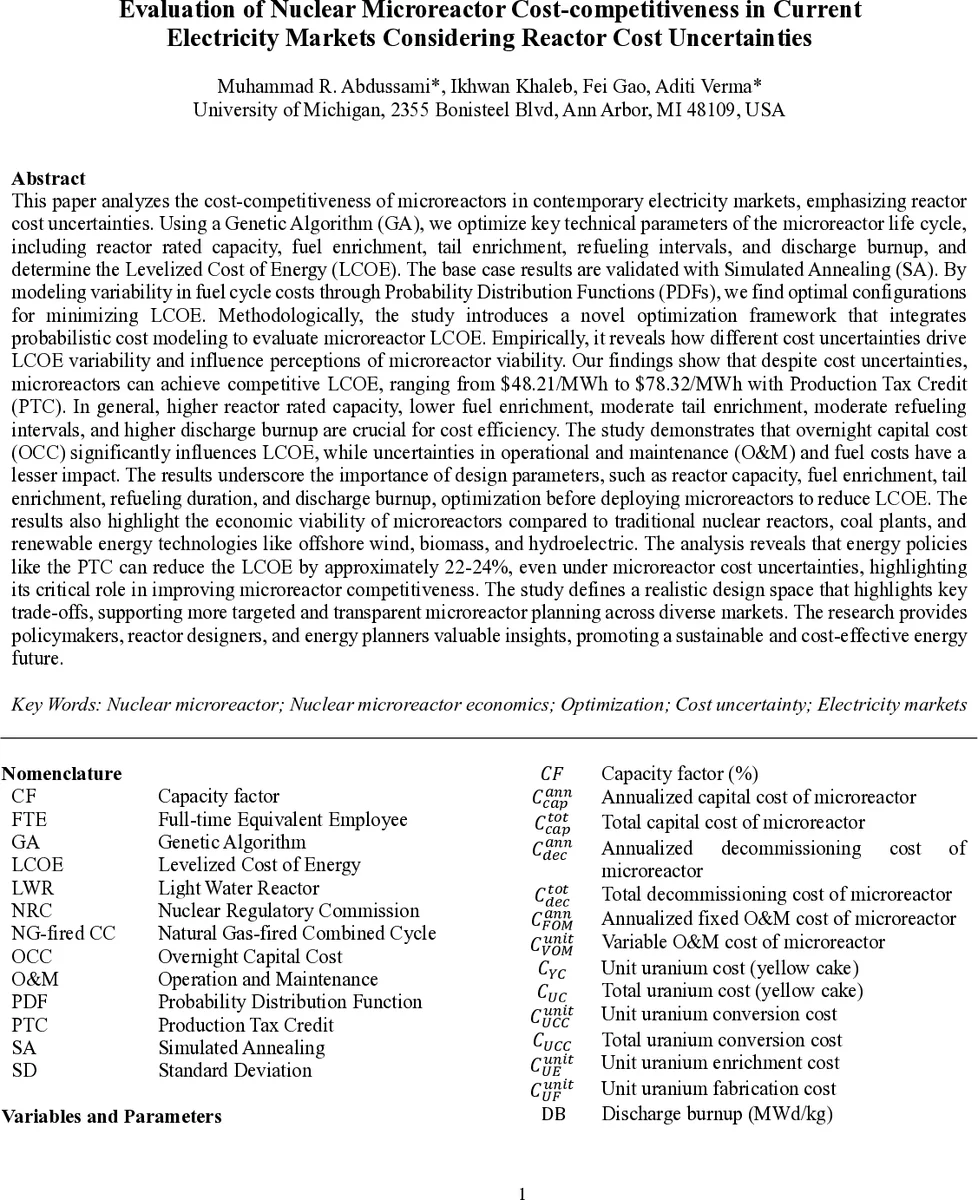
This paper evaluates the cost competitiveness of microreactors in today’s electricity markets, with a focus on uncertainties in reactor costs. A Genetic Algorithm (GA) is used to optimize key technical parameters, such as reactor capacity, fuel enrichment, tail enrichment, refueling interval, and discharge burnup, to minimize the Levelized Cost of Energy (LCOE). Base case results are validated using Simulated Annealing (SA). By incorporating Probability Distribution Functions (PDFs) for fuel cycle costs, the study identifies optimal configurations under uncertainty. Methodologically, it introduces a novel framework combining probabilistic cost modeling with evolutionary optimization. Results show that microreactors can remain cost-competitive, with LCOEs ranging from $48.21/MWh to $78.32/MWh when supported by the Production Tax Credit (PTC). High reactor capacity, low fuel enrichment, moderate tail enrichment and refueling intervals, and high discharge burnup enhance cost efficiency. Among all factors, overnight capital cost (OCC) has the most significant impact on LCOE, while O&M and fuel cost uncertainties have lesser effects. The analysis highlights how energy policies like the PTC can reduce LCOE by 22-24%, improving viability despite cost variability. Compared to conventional nuclear, coal, and renewable sources like offshore wind, hydro, and biomass, optimized microreactors show strong economic potential. This research defines a realistic design space and key trade-offs, offering actionable insights for policymakers, reactor designers, and energy planners aiming to accelerate the deployment of affordable, sustainable microreactors.
💡 Research Summary
This paper investigates whether nuclear microreactors can be cost‑competitive in today’s electricity markets when the inherent uncertainties of reactor costs are explicitly taken into account. The authors develop a probabilistic life‑cycle cost model that captures capital, fixed and variable O&M, fuel‑cycle (yellow‑cake, conversion, enrichment, fabrication, waste disposal), decommissioning, and policy incentives. For each cost component a probability distribution function (PDF) is assigned—normal distributions for well‑studied items such as uranium price and enrichment cost, and uniform distributions for less‑documented parameters—allowing Monte‑Carlo‑style sampling of the cost space.
The technical design variables subject to optimization are reactor electric rating (10–50 MWₑ), fuel enrichment (5–20 % U‑235), tail enrichment (≤ 0.3 % U‑235), refueling interval (1–5 years), and discharge burnup (30–80 MWd/kg). The objective is to minimize the expected Levelized Cost of Energy (LCOE) while respecting engineering bounds and policy constraints (e.g., Production Tax Credit (PTC) rate and duration). The optimization problem is solved with a Genetic Algorithm (GA) implemented in MATLAB, employing roulette‑wheel selection, two‑point crossover, and a 5 % mutation rate over 200 generations. To verify that the GA does not settle in a local minimum, the authors independently solve the same problem with Simulated Annealing (SA); both methods converge to virtually identical LCOE values, confirming robustness.
Results indicate that the cost‑optimal configuration features a relatively large reactor (≈ 45 MWₑ), low fuel enrichment (~6 % U‑235), moderate tail enrichment (~0.2 % U‑235), a refueling interval of about 2.5 years, and a high discharge burnup (~75 MWd/kg). Under these settings the expected LCOE ranges from $78.32 /MWh without any policy support to $48.21 /MWh when the Production Tax Credit (PTC) is applied. The PTC reduces LCOE by roughly 22–24 %, demonstrating the substantial role of fiscal incentives in improving microreactor economics.
A sensitivity analysis reveals that the overnight capital cost (OCC) dominates LCOE variability, accounting for roughly 55–60 % of the total variance. Uncertainties in O&M and fuel costs each contribute less than 15 % of the variance, confirming that microreactor economics are primarily capital‑driven. The authors also compare the optimized microreactor LCOE against conventional baseload (large nuclear, coal, natural‑gas combined cycle) and renewable technologies (offshore wind, hydro, biomass). While the microreactor is not universally cheaper than all alternatives, it becomes competitive in high‑price or remote markets—such as island grids or off‑grid microgrids—where diesel or gas generation is expensive and where the reliability of nuclear power is valued.
The paper discusses several practical implications. First, designers should prioritize reducing OCC through modular manufacturing, supply‑chain optimization, and economies of series production, as this yields the greatest LCOE improvement. Second, policy makers can leverage the PTC or similar mechanisms to bridge the remaining cost gap, especially during the early deployment phase. Third, the probabilistic framework highlights that cost‑competitiveness claims based on single deterministic cost estimates can be misleading; a full uncertainty analysis is essential for realistic investment decisions.
Limitations are acknowledged. The cost model is based on a generic uranium‑TRISO microreactor and does not capture design‑specific nuances (e.g., gas‑cooled vs. molten‑salt concepts, mobile vs. stationary deployments). Environmental, safety, licensing, and social acceptance costs are omitted, which could materially affect real‑world feasibility. Moreover, the study assumes static market conditions; dynamic electricity price trajectories, carbon pricing, and fuel market volatility are not modeled.
Future work is suggested in three directions: (1) integration of detailed, design‑specific cost data as microreactor prototypes mature; (2) extension of the optimization to a multi‑objective framework that simultaneously minimizes LCOE, carbon emissions, and risk metrics; and (3) coupling the probabilistic cost model with power system dispatch simulations to assess system‑level impacts of large‑scale microreactor adoption.
In summary, the authors present a novel, uncertainty‑aware optimization methodology that demonstrates microreactors can achieve LCOE levels comparable to other generation options when capital costs are managed and supportive policies like the Production Tax Credit are applied. The work provides actionable insights for reactor designers, investors, and policy makers aiming to accelerate the deployment of affordable, low‑carbon microreactor technology.
Comments & Academic Discussion
Loading comments...
Leave a Comment