PEAR: Equal Area Weather Forecasting on the Sphere
Artificial intelligence is rapidly reshaping the natural sciences, with weather forecasting emerging as a flagship AI4Science application where machine learning models can now rival and even surpass traditional numerical simulations. Following the success of the landmark models Pangu Weather and Graphcast, outperforming traditional numerical methods for global medium-range forecasting, many novel data-driven methods have emerged. A common limitation shared by many of these models is their reliance on an equiangular discretization of the sphere which suffers from a much finer grid at the poles than around the equator. In contrast, in the Hierarchical Equal Area iso-Latitude Pixelization (HEALPix) of the sphere, each pixel covers the same surface area, removing unphysical biases. Motivated by a growing support for this grid in meteorology and climate sciences, we propose to perform weather forecasting with deep learning models which natively operate on the HEALPix grid. To this end, we introduce Pangu Equal ARea (PEAR), a transformer-based weather forecasting model which operates directly on HEALPix-features and outperforms the corresponding model on an equiangular grid without any computational overhead.
💡 Research Summary
The paper introduces PEAR (Pangu Equal Area), a transformer‑based neural weather forecasting model that operates directly on the Hierarchical Equal Area iso‑Latitude Pixelization (HEALPix) grid rather than the conventional latitude‑longitude or Gaussian grids. Traditional AI‑driven weather models such as Pangu‑Weather and GraphCast inherit the non‑uniform resolution of equiangular grids, which leads to an over‑dense sampling near the poles, artificial biases, and the need for area‑weighted loss functions. HEALPix, originally developed for astrophysical applications, partitions the sphere into equal‑area quadrilateral pixels with a hierarchical “nside” parameter, providing uniform spatial resolution and a natural multiscale structure.
The authors resample the ERA5‑lite dataset (2007‑2017, 24‑hour intervals) onto a HEALPix grid with nside = 64, yielding 49,152 pixels covering the globe. Surface variables (temperature, wind speed, pressure, humidity) and upper‑level variables (wind, temperature, specific humidity, geopotential) are arranged into 4‑channel and 5‑channel tensors, respectively, across 13 vertical levels. Input tensors are first embedded using a 1‑D convolution for surface fields and a 2‑D convolution for upper‑level fields, producing 48‑dimensional patch embeddings.
PEAR’s core architecture adapts the Swin‑V2 volumetric transformer to the 1‑D indexed HEALPix layout. Using the nested indexing scheme, the model partitions the token sequence into contiguous windows of size (W_hp, W_d) and performs multi‑head self‑attention within each window. Because all HEALPix cells have identical area, a single relative positional embedding can be shared across windows, dramatically reducing the number of parameters compared with the original Pangu‑Weather. To enable cross‑window communication, the grid is cyclically shifted by roughly half a window size after each attention block; a mask prevents attention between spatially disjoint voxels that arise from the shift, especially near the poles and at the top/bottom of the vertical stack.
Downsampling and upsampling exploit HEALPix’s hierarchical nature: four neighboring pixels are concatenated and linearly projected to a coarser representation, while upsampling reverses this operation by expanding the embedding dimension and reshaping back into four finer pixels. This approach yields an efficient bottleneck without any additional interpolation steps.
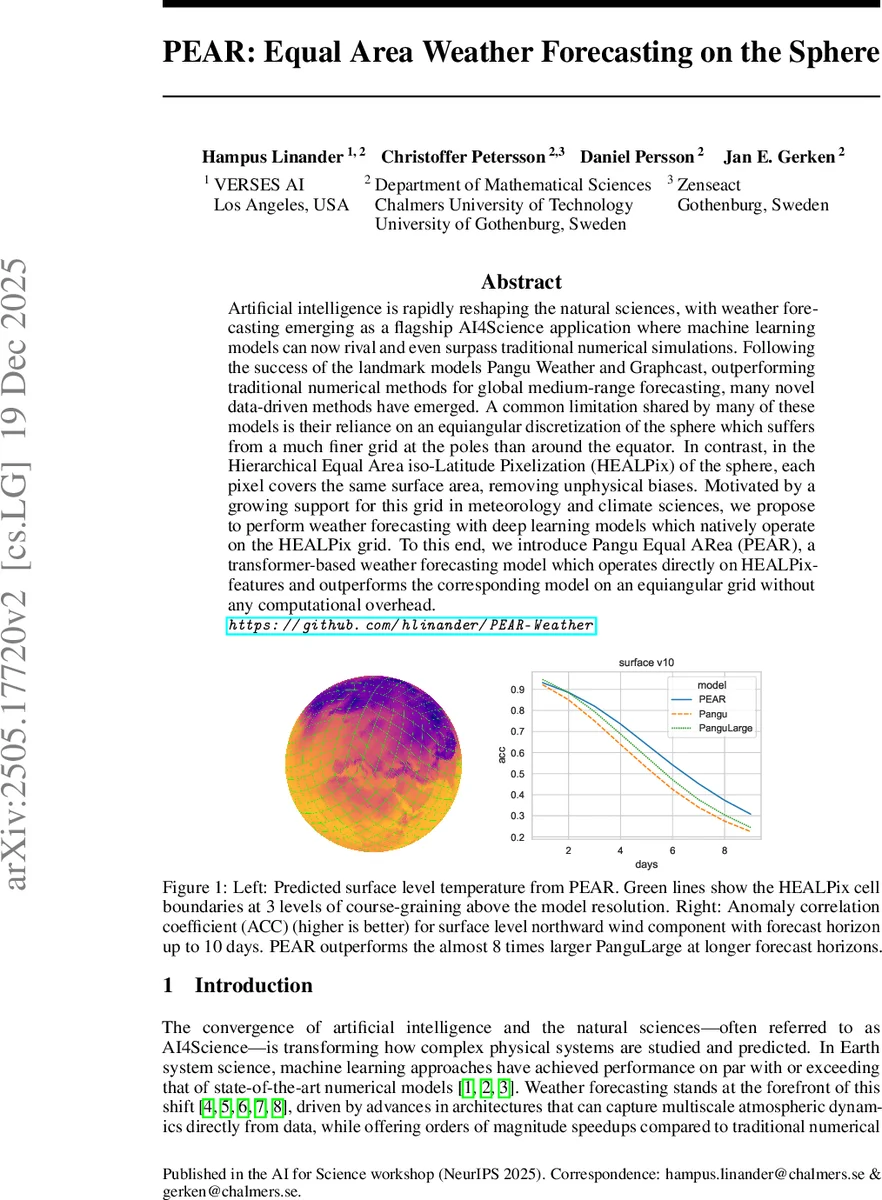
The model is trained to predict the global atmospheric state 24 hours ahead, and forecasts are rolled out up to ten days. Evaluation uses anomaly correlation coefficient (ACC) and mean squared error on key variables such as surface temperature and northward wind. Compared with an identical architecture run on an equiangular grid, PEAR consistently achieves higher ACC (2–5 % improvement) across all lead times, with the gap widening beyond five days. Remarkably, despite having roughly 30 % fewer parameters than the equiangular baseline, PEAR outperforms the much larger Pangu‑Large model (≈ 8× parameters) at the five‑day horizon, demonstrating that uniform area sampling can compensate for model size.
A further advantage highlighted by the authors is the elimination of area‑weighting in loss functions and evaluation metrics; the uniform HEALPix cells make raw errors directly comparable across the globe. This simplification streamlines training pipelines and facilitates the integration of additional physical constraints or multi‑task objectives.
In summary, the contributions of the paper are threefold: (1) advocating the HEALPix grid as the native representation for data‑driven weather prediction, thereby removing spatial bias; (2) designing a volumetric transformer that leverages HEALPix’s hierarchical indexing for efficient windowed attention with shared positional embeddings; and (3) demonstrating that a model built on this foundation can surpass both a parameter‑matched equiangular baseline and a substantially larger state‑of‑the‑art model on medium‑range forecasts. The work underscores the importance of choosing physically appropriate discretizations in AI‑for‑Science and opens avenues for applying equal‑area spherical representations to other domains such as climate modeling, astrophysics, and geophysical fluid dynamics.
Comments & Academic Discussion
Loading comments...
Leave a Comment